 Analysis
Read Next
Human Interest
Baby girl born at 27 weeks is home with her parents and big sister
Right to Life UK
·

CDC nominee Dr. Erica Schwartz: Abortion data collection is 'critical'
UPDATE, 8/7/26: Dr. Erica Schwartz was confirmed by a Senate vote on August 5. NBC News reports:
The 51-44 vote was largely split along party lines, with Republicans in favor and Democrats against, though Sen. Tim Kaine, D-Va., voted with Republicans. Kaine said last month that he regretted voting against the previous CDC director, Susan Monarez, and had apologized to her.
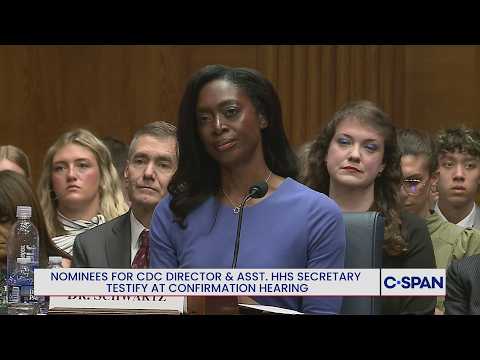
7/23/26: During a Senate Health, Education, Labor and Pensions committee hearing on her nomination this week, Dr. Erica Schwartz, President Trump's latest nominee to head the Centers for Disease Control and Prevention (CDC), called abortion surveillance an "absolutely critical component" of what the CDC does.
Dr. Erica Schwartz, the latest nominee to lead the CDC, stated in a hearing this week that "abortion surveillance is an absolutely critical component of what the CDC is currently doing" and noted the need for "clear case definitions regarding abortions, so the data is actually accurate."
The CDC and the Guttmacher Institute (with the latter being more comprehensive in its information) have historically tracked abortion data. Since the overturning of Roe v. Wade, the Society of Family Planning's #WeCount also began to release estimated data.
Not all states report abortion statistics to CDC, and since the Dobbs decision in 2022, additional states are considering either halting their reporting altogether or scaling back what data they publish.
According to Guttmacher, by July 2026, just "44 states plus DC have some form of mandated abortion reporting." Excluded are California, Maryland, Michigan, New Jersey, New Mexico, and New York; many of these states have historically reflected high abortion numbers.
Schwartz began:
"If confirmed, my first priority will be restoring trust in public health institutions through radical transparency and unwavering scientific integrity. As CDC director, my sacred responsibility is to provide the American people with public health guidance that is clear, honest, and evidence based. I will never betray the science."

Schwartz has been endorsed by the American Public Health Association (APHA), which wrote:
As a well-trained and credentialed physician and former Deputy Surgeon General, Erica Schwartz possesses the medical background and public health knowledge to understand that the Centers for Disease Control and Prevention must be guided by evidence-based science.
With her previous service at HHS during the first Trump administration and as Chief Medical Officer with the U.S. Coast Guard, she has demonstrated strong leadership skills.
During the nomination hearing, Missouri Senator Josh Hawley asked Schwartz about abortion data collection:
“The CDC collects data on abortions that are committed in the United States of America through a system called the Abortion Reporting System.
This system is voluntary, and so a number of states, not coincidentally large blue states, do not turn over any data, so that it's difficult to get a picture of just how many abortions and under what circumstances are committed in this country.”
Hawley, who accurately suggested that not all abortions are reported, then pointed out the increases in abortion after the Dobbs Supreme Court decision overturning Roe v. Wade:
"We do know the numbers are going up — way up. Since the Dobbs decision just a few years ago, the numbers of abortions committed in the United States have gone way up. Well over a million abortions last year. I'm sure the number, based on what we know so far, will be higher this year. And all of that is just based on what we can cobble together without full reporting."

As Live Action News previously documented, Big Abortion admits that a contributor to the increase is the intentional erosion of abortion pill safety regulations by Biden's Food and Drug Administration (FDA) in 2023, from in-person dispensing to mail-order and pharmacy dispensing. This has enabled abortion drugs to permeate pro-life states despite laws protecting preborn children, and in the face of the Federal Comstock Act, which prohibits mailing abortion-inducing drugs.
In June of 2026, the Guttmacher Institute (Planned Parenthood's former research arm and "special affiliate") updated abortion data for 2025, revealing that nearly 66 million abortions have been committed since 1973 when the Roe v. Wade Supreme Court ruling forced legalized abortion upon every state in the nation. Over 4.6 million of those abortions were committed since the year the Dobbs decision was decided (2022).
Sen. Hawley continued his question to Ms. Schwartz:
"My question to you is — and I realize that the abortion reporting system, there's been some talk of moving it to a different component in HHS other than CDC — but, historically, its been located in what would be your agency.
So, if that continues to be the case, would you commit to trying to get as much information — again, to collect the data on the number and circumstances of abortions — as is provided for in this system?
To collect that data from these states and to work with those states that are currently holding out and not giving it?
To actually give the data so that we can know, we can get a picture of what really is going on here?
Will you do that?"
In response to Sen. Hawley's concerns, Schwartz stated:
"Senator, you have my commitment.
Abortion surveillance is an absolutely critical component of what the CDC is currently doing.
To your point, it may be moved to another agency in HHS."
She then reiterated, "I agree, yes, I will look into that," before adding:
“But I also want to also make sure that certain states are not conflating emergency services and hiding abortions in that 'emergency services' case definition.
We need to make sure we're pulling out true abortions and making sure that we're really having clear case definitions regarding abortions, so the data is actually accurate.”
"Tremendous, fantastic, thank you for that," Sen. Hawley replied.
Traditionally, abortion data has been compiled by the Guttmacher Institute (a former Planned Parenthood research arm and “special affiliate") and the Centers for Disease Control and Prevention (CDC).
Guttmacher did not begin publishing abortion data until 1973. The organization previously utilized responses to abortion provider surveys for its abortion reports. Then, in late 2023, after nearly 50 years of using the same methodology, and after the Dobbs decision, Guttmacher changed this methodology and began publishing monthly abortion estimates.
Guttmacher did this despite describing this new methodology as less reliable than what had been previously used.
Since Dobbs, the pro-abortion Society of Family Planning (SFP)'s #WeCount has also been publishing estimated abortion data nationally.
Both are based on surveys or reports submitted by abortion providers.
The CDC relies solely on data voluntarily reported from the states, which individually set the standards for abortion reporting, and is not as comprehensive.
Currently, not all states report abortion statistics to CDC, and since the Dobbs decision in 2022, additional states are considering either halting their reporting altogether or scaling back what data they publish. According to Guttmacher, by July 2026, just "44 states plus DC have some form of mandated abortion reporting."
Excluded are California, Maryland, Michigan, New Jersey, New Mexico, and New York; many of these states have historically reflected high abortion numbers. New Mexico reportedly had the highest abortion rate among all U.S. states in 2025.
The CDC began publishing abortion data before Roe in 1969.
According to Perspectives in Reproductive Health, published by the Guttmacher Institute, “[T]he Population Council, The Alan Guttmacher Institute and the Centers for Disease Control and Prevention (CDC)—collaborated to gather data by conducting what became known as abortion surveillance…”
As Live Action News previously documented, in 1969, the CDC began its abortion surveillance branch to document the number and characteristics of women obtaining legal abortions. By this time, 10 states had decriminalized abortion and the CDC had estimated that there were 22,670 abortions. As more states began to decriminalize it, the numbers climbed dramatically, before declining some years after Roe.
In that report the CDC acknowledged, “The need for abortion surveillance is based on a lack of accurate incidence, morbidity and mortality data.” It goes on to state, “The incidence and prevalence of induced abortion are unknown… Abortion-related morbidity is also unknown….”
Yet post-Dobbs, abortion proponents want all abortion data collecting to be halted.
For quite some time, there had been speculation that the CDC might halt or delay abortion reports, partly because more states have removed requirements to report any abortion data at all, and partly because of cuts within the Division of Reproductive Health of the CDC.
The latest report published by the CDC was for 2022 data, when Dobbs was released midway through that year in June. The CDC later paused its annual abortion surveillance report for the first time since it began publishing the reports in 1969, and to date has yet to release data for 2023.
In 2025, the agency clarified to Live Action News that the CDC was working to release an abortion surveillance report in the spring of 2026. That time has now passed, with no updates on when the data will be released.
While Guttmacher's overall abortion numbers tend to be higher than CDC, the government agency gave analysts additional data based on:
Race
Previous live births
Gestational age of the baby, including later abortions at or after 21 weeks gestation
Infants born alive
Other characteristics
Guttmacher reported:
For decades, the federal Centers for Disease Control and Prevention (CDC) has partnered with states to collect aggregate statistics on abortions in the United States. The CDC does not require states to submit abortion data, but most do so through state laws requiring abortion providers, hospitals and other medical facilities to submit regular reports. Certain localities also require abortion reporting.
The information collected in these reports varies by state but typically includes the names of the medical facility and the clinician providing abortion care, the patient’s demographic characteristics (e.g., age, race, ethnicity, marital status and number of previous live births), the patient’s residence details (e.g., state or locality), the gestational duration of the pregnancy and the type of abortion provided.
Both Guttmacher and the CDC have attempted to document who obtains abortions, as Live Action News previously noted.
In June of 2026, Guttmacher updated abortion data, now estimating that 1,129,900 abortions were committed in 2025 alone.
The number tragically reflects 3,096 abortions per day, 21,729 per week, and 94,158 per month.
We now estimate that from 1973 to June of 2026, nearly 66 million preborn children have lost their lives to abortion, based on Guttmacher's current reports.
Live Action News is pro-life news and commentary from a pro-life perspective.
Our work is possible because of our donors. Please consider giving to further our work of changing hearts and minds on issues of life and human dignity.
Contact editor@liveaction.org for questions, corrections, or if you are seeking permission to reprint any Live Action News content.
Guest Articles: To submit a guest article to Live Action News, email editor@liveaction.org with an attached Word document of 800-1000 words. Please also attach any photos relevant to your submission if applicable. If your submission is accepted for publication, you will be notified within three weeks. Guest articles are not compensated (see our Open License Agreement). Thank you for your interest in Live Action News!
Right to Life UK
·
Analysis
Newsroom
·
Analysis
Cassy Cooke
·
Analysis
Bridget Sielicki
·
Analysis
Cassy Cooke
·
Fact Checks
Nancy Flanders
·
Abortion Pill
Carole Novielli
·
Abortion Pill
Carole Novielli
·
Abortion Pill
Carole Novielli
·
Abortion Pill
Carole Novielli
·
Abortion Pill
Carole Novielli
·CDC nominee Dr. Erica Schwartz: Abortion data collection is 'critical'
UPDATE, 8/7/26: Dr. Erica Schwartz was confirmed by a Senate vote on August 5. NBC News reports:
The 51-44 vote was largely split along party lines, with Republicans in favor and Democrats against, though Sen. Tim Kaine, D-Va., voted with Republicans. Kaine said last month that he regretted voting against the previous CDC director, Susan Monarez, and had apologized to her.
7/23/26: During a Senate Health, Education, Labor and Pensions committee hearing on her nomination this week, Dr. Erica Schwartz, President Trump's latest nominee to head the Centers for Disease Control and Prevention (CDC), called abortion surveillance an "absolutely critical component" of what the CDC does.
Dr. Erica Schwartz, the latest nominee to lead the CDC, stated in a hearing this week that "abortion surveillance is an absolutely critical component of what the CDC is currently doing" and noted the need for "clear case definitions regarding abortions, so the data is actually accurate."
The CDC and the Guttmacher Institute (with the latter being more comprehensive in its information) have historically tracked abortion data. Since the overturning of Roe v. Wade, the Society of Family Planning's #WeCount also began to release estimated data.
Not all states report abortion statistics to CDC, and since the Dobbs decision in 2022, additional states are considering either halting their reporting altogether or scaling back what data they publish.
According to Guttmacher, by July 2026, just "44 states plus DC have some form of mandated abortion reporting." Excluded are California, Maryland, Michigan, New Jersey, New Mexico, and New York; many of these states have historically reflected high abortion numbers.
Schwartz began:
"If confirmed, my first priority will be restoring trust in public health institutions through radical transparency and unwavering scientific integrity. As CDC director, my sacred responsibility is to provide the American people with public health guidance that is clear, honest, and evidence based. I will never betray the science."
Schwartz has been endorsed by the American Public Health Association (APHA), which wrote:
As a well-trained and credentialed physician and former Deputy Surgeon General, Erica Schwartz possesses the medical background and public health knowledge to understand that the Centers for Disease Control and Prevention must be guided by evidence-based science.
With her previous service at HHS during the first Trump administration and as Chief Medical Officer with the U.S. Coast Guard, she has demonstrated strong leadership skills.
During the nomination hearing, Missouri Senator Josh Hawley asked Schwartz about abortion data collection:
“The CDC collects data on abortions that are committed in the United States of America through a system called the Abortion Reporting System.
This system is voluntary, and so a number of states, not coincidentally large blue states, do not turn over any data, so that it's difficult to get a picture of just how many abortions and under what circumstances are committed in this country.”
Hawley, who accurately suggested that not all abortions are reported, then pointed out the increases in abortion after the Dobbs Supreme Court decision overturning Roe v. Wade:
"We do know the numbers are going up — way up. Since the Dobbs decision just a few years ago, the numbers of abortions committed in the United States have gone way up. Well over a million abortions last year. I'm sure the number, based on what we know so far, will be higher this year. And all of that is just based on what we can cobble together without full reporting."
As Live Action News previously documented, Big Abortion admits that a contributor to the increase is the intentional erosion of abortion pill safety regulations by Biden's Food and Drug Administration (FDA) in 2023, from in-person dispensing to mail-order and pharmacy dispensing. This has enabled abortion drugs to permeate pro-life states despite laws protecting preborn children, and in the face of the Federal Comstock Act, which prohibits mailing abortion-inducing drugs.
In June of 2026, the Guttmacher Institute (Planned Parenthood's former research arm and "special affiliate") updated abortion data for 2025, revealing that nearly 66 million abortions have been committed since 1973 when the Roe v. Wade Supreme Court ruling forced legalized abortion upon every state in the nation. Over 4.6 million of those abortions were committed since the year the Dobbs decision was decided (2022).
Sen. Hawley continued his question to Ms. Schwartz:
"My question to you is — and I realize that the abortion reporting system, there's been some talk of moving it to a different component in HHS other than CDC — but, historically, its been located in what would be your agency.
So, if that continues to be the case, would you commit to trying to get as much information — again, to collect the data on the number and circumstances of abortions — as is provided for in this system?
To collect that data from these states and to work with those states that are currently holding out and not giving it?
To actually give the data so that we can know, we can get a picture of what really is going on here?
Will you do that?"
In response to Sen. Hawley's concerns, Schwartz stated:
"Senator, you have my commitment.
Abortion surveillance is an absolutely critical component of what the CDC is currently doing.
To your point, it may be moved to another agency in HHS."
She then reiterated, "I agree, yes, I will look into that," before adding:
“But I also want to also make sure that certain states are not conflating emergency services and hiding abortions in that 'emergency services' case definition.
We need to make sure we're pulling out true abortions and making sure that we're really having clear case definitions regarding abortions, so the data is actually accurate.”
"Tremendous, fantastic, thank you for that," Sen. Hawley replied.
Traditionally, abortion data has been compiled by the Guttmacher Institute (a former Planned Parenthood research arm and “special affiliate") and the Centers for Disease Control and Prevention (CDC).
Guttmacher did not begin publishing abortion data until 1973. The organization previously utilized responses to abortion provider surveys for its abortion reports. Then, in late 2023, after nearly 50 years of using the same methodology, and after the Dobbs decision, Guttmacher changed this methodology and began publishing monthly abortion estimates.
Guttmacher did this despite describing this new methodology as less reliable than what had been previously used.
Since Dobbs, the pro-abortion Society of Family Planning (SFP)'s #WeCount has also been publishing estimated abortion data nationally.
Both are based on surveys or reports submitted by abortion providers.
The CDC relies solely on data voluntarily reported from the states, which individually set the standards for abortion reporting, and is not as comprehensive.
Currently, not all states report abortion statistics to CDC, and since the Dobbs decision in 2022, additional states are considering either halting their reporting altogether or scaling back what data they publish. According to Guttmacher, by July 2026, just "44 states plus DC have some form of mandated abortion reporting."
Excluded are California, Maryland, Michigan, New Jersey, New Mexico, and New York; many of these states have historically reflected high abortion numbers. New Mexico reportedly had the highest abortion rate among all U.S. states in 2025.
The CDC began publishing abortion data before Roe in 1969.
According to Perspectives in Reproductive Health, published by the Guttmacher Institute, “[T]he Population Council, The Alan Guttmacher Institute and the Centers for Disease Control and Prevention (CDC)—collaborated to gather data by conducting what became known as abortion surveillance…”
As Live Action News previously documented, in 1969, the CDC began its abortion surveillance branch to document the number and characteristics of women obtaining legal abortions. By this time, 10 states had decriminalized abortion and the CDC had estimated that there were 22,670 abortions. As more states began to decriminalize it, the numbers climbed dramatically, before declining some years after Roe.
In that report the CDC acknowledged, “The need for abortion surveillance is based on a lack of accurate incidence, morbidity and mortality data.” It goes on to state, “The incidence and prevalence of induced abortion are unknown… Abortion-related morbidity is also unknown….”
Yet post-Dobbs, abortion proponents want all abortion data collecting to be halted.
For quite some time, there had been speculation that the CDC might halt or delay abortion reports, partly because more states have removed requirements to report any abortion data at all, and partly because of cuts within the Division of Reproductive Health of the CDC.
The latest report published by the CDC was for 2022 data, when Dobbs was released midway through that year in June. The CDC later paused its annual abortion surveillance report for the first time since it began publishing the reports in 1969, and to date has yet to release data for 2023.
In 2025, the agency clarified to Live Action News that the CDC was working to release an abortion surveillance report in the spring of 2026. That time has now passed, with no updates on when the data will be released.
While Guttmacher's overall abortion numbers tend to be higher than CDC, the government agency gave analysts additional data based on:
Race
Previous live births
Gestational age of the baby, including later abortions at or after 21 weeks gestation
Infants born alive
Other characteristics
Guttmacher reported:
For decades, the federal Centers for Disease Control and Prevention (CDC) has partnered with states to collect aggregate statistics on abortions in the United States. The CDC does not require states to submit abortion data, but most do so through state laws requiring abortion providers, hospitals and other medical facilities to submit regular reports. Certain localities also require abortion reporting.
The information collected in these reports varies by state but typically includes the names of the medical facility and the clinician providing abortion care, the patient’s demographic characteristics (e.g., age, race, ethnicity, marital status and number of previous live births), the patient’s residence details (e.g., state or locality), the gestational duration of the pregnancy and the type of abortion provided.
Both Guttmacher and the CDC have attempted to document who obtains abortions, as Live Action News previously noted.
In June of 2026, Guttmacher updated abortion data, now estimating that 1,129,900 abortions were committed in 2025 alone.
The number tragically reflects 3,096 abortions per day, 21,729 per week, and 94,158 per month.
We now estimate that from 1973 to June of 2026, nearly 66 million preborn children have lost their lives to abortion, based on Guttmacher's current reports.
Live Action News is pro-life news and commentary from a pro-life perspective.
Our work is possible because of our donors. Please consider giving to further our work of changing hearts and minds on issues of life and human dignity.
Contact editor@liveaction.org for questions, corrections, or if you are seeking permission to reprint any Live Action News content.
Guest Articles: To submit a guest article to Live Action News, email editor@liveaction.org with an attached Word document of 800-1000 words. Please also attach any photos relevant to your submission if applicable. If your submission is accepted for publication, you will be notified within three weeks. Guest articles are not compensated (see our Open License Agreement). Thank you for your interest in Live Action News!
Right to Life UK
·Analysis
Newsroom
·Analysis
Cassy Cooke
·Analysis
Bridget Sielicki
·Analysis
Cassy Cooke
·Fact Checks
Nancy Flanders
·Abortion Pill
Carole Novielli
·Abortion Pill
Carole Novielli
·Abortion Pill
Carole Novielli
·Abortion Pill
Carole Novielli
·Abortion Pill
Carole Novielli
·