 Politics
Read Next
Guest Column
Residents of Seminole in Texas head to polls to consider ‘Sanctuary for the Unborn’ Ordinance
Mark Lee Dickson
·

US bishops urge Congress to reject IVF insurance mandate
The US Conference of Catholic Bishops (USCCB) is calling on Congress to steer away from a federal IVF bill, cautioning that the initiative would increase the loss of human beings in their earliest developmental stages, while also pressuring employers and religious institutions to violate conscience rights.
H.R. 8119 would require insurers to include coverage for IVF, with civil fines of $100 daily if they do not comply.
The USCCB has called on Congress to oppose the bill, noting conscience objections and the loss of unborn human beings.
While the USCCB expressed sympathy for those experiencing infertility, the group pointed to restorative reproductive medicine as an option, rather than promoting IVF.
In a recent missive released April 29, the bishops declared that lawmakers should not encourage or facilitate in vitro fertilization (IVF) through insurance coverage mandates, pointing to the Helping to Optimize Patients’ Experience (HOPE) with Fertility Services Act.
According to the bill, insurers could face civil fines of $100 daily if they sell plans that do not include IVF coverage. The language does not seem to take into account the conscience objections of religious employers, even though the USCCB and the Southern Baptist Convention both reject IVF.
The bill was introduced by Rep. Zachary Nunn (R-Iowa), and is co-sponsored by 18 members of Congress, including nine Democrats, eight Republicans, and one Independent. So far, the bill has been introduced and referred to the House Committee on Education and Workforce, with no other action taken.
“Infertility impacts millions of families and it doesn’t discriminate. It can affect anyone who wants to start or grow a family,” bill cosponsor Rep. Debbie Wasserman Schultz (D-Fla.), said in a statement. “I know firsthand. Thanks to IVF, my husband and I conceived our twins, now both healthy young adults. But after enduring that struggle, I’ve fought to expand insurance coverage for the prohibitively costly fertility treatments that can make this only accessible to the very few who can afford it.”
In response to the bill, the USCCB reinforced its “grief for the growing number of families suffering infertility” and “corresponding support for life-affirming, but often overlooked, restorative reproductive medicine,” but denounced H.R. 8119, pointing out the differences between restorative reproductive medicine and IVF:
Restorative reproductive medicine involves deeper and more comprehensive diagnostic studies, and more detailed cycle monitoring than a typical workup, to inform surgical, hormonal, and/or even lifestyle treatments that frequently work to truly heal patients.
These practices, and additional research to strengthen them, warrant support and awareness. Patients and hopeful parents deserve no less.
IVF in contrast, especially as practiced in the United States, represents a relatively unregulated industry that creates hundreds of thousands or even millions of preborn children who will be interminably frozen, expended in attempts to place them within a mother, or discarded and killed (often in a selective, eugenic manner).
Furthermore, alluding to how H.R. 8119 poses threats to religious freedom, the bishops continued:
Many religious employers that are otherwise exempt from ERISA, however, choose to provide their employees’ health insurance under ERISA anyway precisely because ERISA’s preemption of state law allows them to avoid having their consciences violated by state-level insurance requirements (including for IVF).
A mandate within ERISA would therefore place these employers in a new bind between its requirements and those of problematic state laws. At the same time, certain other religious employers’ plans, such as those of independent religious schools, may not qualify as “church plans” exempt from ERISA in the first place.
As pastors, we see the suffering that infertility can cause and the deep desire of couples to grow their family. We strongly encourage licit means of easing this suffering, both medically and emotionally. For all of the above reasons, we implore you to consider that life-ending assisted reproductive technologies (ART) cannot be the solution.
The April 29 letter was signed by Archbishop Alexander K. Sample, who chairs the USCCB's Committee on Religious Liberty; Bishop Daniel E. Thomas, head of the Committee on Pro-Life Activities; and Bishop Edward J. Burns, leader of the Committee on Laity, Marriage, Family Life, and Youth.
In 2025, the bishops emphasized that IVF infringes on the dignity of children by manufacturing children in a laboratory environment.
“Every human life, born and preborn, is sacred and loved by God. Without diminishing the dignity of people born through IVF, we must recognize that children have a right to be born of a natural and exclusive act of married love, rather than a business’s technological intervention. And harmful government action to expand access to IVF must not also push people of faith to be complicit in its evils,” the bishops said.
As Live Action News has previously reported, IVF can never truly be pro-life:
[T]he majority of human embryos created through IVF do not survive to birth. It is now known that more human beings die annually during the IVF process in the U.S. than from abortion. It is unknown exactly how many are destroyed for failing to meet the standards set by fertility doctors, but estimates paint a grim picture.
In 2023, there were 432,641 IVF cycles at 371 reporting clinics in the U.S., but only 95,860 babies were born. Based on a conservative average of nine embryos created per cycle (a study found nine to be the number needed to optimize live birth rates), an estimated 3,893,769 embryos were created in 2023 alone. About half of those are estimated to have not survived beyond the next two stages: the blastocyst stage and the genetic testing stage.
Of the remaining estimate of 1,946,884 embryos, 91,360 were automatically "banked" for "future use." Of the remainder, only 95,860 survived to birth after being graded, labeled, selected, and transferred. This leaves 1,759,664 human embryos unaccounted for, who were either frozen, miscarried, donated to research, or released for embryo adoption (with the adoption rate at just 1-6%). In comparison, there were an estimated 1,037,880 abortions in 2024 in the U.S. (and 1,053,430 abortions in 2024).
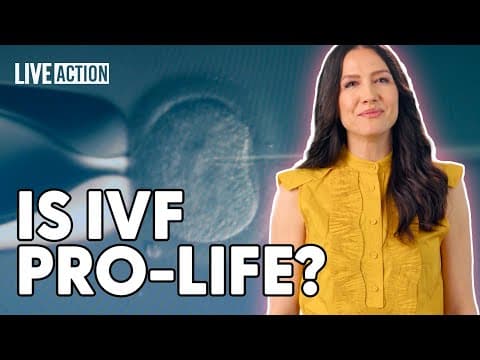
The bishops’ statement underscores the friction that has become more acute in recent years: between “family-building” government measures and the destruction of embryonic human lives through IVF. Traditional Catholic teaching states that addressing infertility should not imply endorsing treatments that hinge on choosing, storing, and discarding children at the earliest stage of life.
As IVF becomes more prominent politically, pro-lifers have to clearly maintain their stance that compassion for infertile couples and the protection of embryonic life are not mutually exclusive values in face of life-affirming alternatives such as ethical fertility research, restorative approaches, and adoption.
Live Action News is pro-life news and commentary from a pro-life perspective.
Our work is possible because of our donors. Please consider giving to further our work of changing hearts and minds on issues of life and human dignity.
Contact editor@liveaction.org for questions, corrections, or if you are seeking permission to reprint any Live Action News content.
Guest Articles: To submit a guest article to Live Action News, email editor@liveaction.org with an attached Word document of 800-1000 words. Please also attach any photos relevant to your submission if applicable. If your submission is accepted for publication, you will be notified within three weeks. Guest articles are not compensated (see our Open License Agreement). Thank you for your interest in Live Action News!
Mark Lee Dickson
·
Politics
Nancy Flanders
·
International
Bridget Sielicki
·
International
Bridget Sielicki
·
Guest Column
Liberty Counsel
·
Politics
Bridget Sielicki
·
Human Interest
Angeline Tan
·
Human Interest
Angeline Tan
·
International
Angeline Tan
·
Analysis
Angeline Tan
·
Human Interest
Angeline Tan
·US bishops urge Congress to reject IVF insurance mandate
The US Conference of Catholic Bishops (USCCB) is calling on Congress to steer away from a federal IVF bill, cautioning that the initiative would increase the loss of human beings in their earliest developmental stages, while also pressuring employers and religious institutions to violate conscience rights.
H.R. 8119 would require insurers to include coverage for IVF, with civil fines of $100 daily if they do not comply.
The USCCB has called on Congress to oppose the bill, noting conscience objections and the loss of unborn human beings.
While the USCCB expressed sympathy for those experiencing infertility, the group pointed to restorative reproductive medicine as an option, rather than promoting IVF.
In a recent missive released April 29, the bishops declared that lawmakers should not encourage or facilitate in vitro fertilization (IVF) through insurance coverage mandates, pointing to the Helping to Optimize Patients’ Experience (HOPE) with Fertility Services Act.
According to the bill, insurers could face civil fines of $100 daily if they sell plans that do not include IVF coverage. The language does not seem to take into account the conscience objections of religious employers, even though the USCCB and the Southern Baptist Convention both reject IVF.
The bill was introduced by Rep. Zachary Nunn (R-Iowa), and is co-sponsored by 18 members of Congress, including nine Democrats, eight Republicans, and one Independent. So far, the bill has been introduced and referred to the House Committee on Education and Workforce, with no other action taken.
“Infertility impacts millions of families and it doesn’t discriminate. It can affect anyone who wants to start or grow a family,” bill cosponsor Rep. Debbie Wasserman Schultz (D-Fla.), said in a statement. “I know firsthand. Thanks to IVF, my husband and I conceived our twins, now both healthy young adults. But after enduring that struggle, I’ve fought to expand insurance coverage for the prohibitively costly fertility treatments that can make this only accessible to the very few who can afford it.”
In response to the bill, the USCCB reinforced its “grief for the growing number of families suffering infertility” and “corresponding support for life-affirming, but often overlooked, restorative reproductive medicine,” but denounced H.R. 8119, pointing out the differences between restorative reproductive medicine and IVF:
Restorative reproductive medicine involves deeper and more comprehensive diagnostic studies, and more detailed cycle monitoring than a typical workup, to inform surgical, hormonal, and/or even lifestyle treatments that frequently work to truly heal patients.
These practices, and additional research to strengthen them, warrant support and awareness. Patients and hopeful parents deserve no less.
IVF in contrast, especially as practiced in the United States, represents a relatively unregulated industry that creates hundreds of thousands or even millions of preborn children who will be interminably frozen, expended in attempts to place them within a mother, or discarded and killed (often in a selective, eugenic manner).
Furthermore, alluding to how H.R. 8119 poses threats to religious freedom, the bishops continued:
Many religious employers that are otherwise exempt from ERISA, however, choose to provide their employees’ health insurance under ERISA anyway precisely because ERISA’s preemption of state law allows them to avoid having their consciences violated by state-level insurance requirements (including for IVF).
A mandate within ERISA would therefore place these employers in a new bind between its requirements and those of problematic state laws. At the same time, certain other religious employers’ plans, such as those of independent religious schools, may not qualify as “church plans” exempt from ERISA in the first place.
As pastors, we see the suffering that infertility can cause and the deep desire of couples to grow their family. We strongly encourage licit means of easing this suffering, both medically and emotionally. For all of the above reasons, we implore you to consider that life-ending assisted reproductive technologies (ART) cannot be the solution.
The April 29 letter was signed by Archbishop Alexander K. Sample, who chairs the USCCB's Committee on Religious Liberty; Bishop Daniel E. Thomas, head of the Committee on Pro-Life Activities; and Bishop Edward J. Burns, leader of the Committee on Laity, Marriage, Family Life, and Youth.
In 2025, the bishops emphasized that IVF infringes on the dignity of children by manufacturing children in a laboratory environment.
“Every human life, born and preborn, is sacred and loved by God. Without diminishing the dignity of people born through IVF, we must recognize that children have a right to be born of a natural and exclusive act of married love, rather than a business’s technological intervention. And harmful government action to expand access to IVF must not also push people of faith to be complicit in its evils,” the bishops said.
As Live Action News has previously reported, IVF can never truly be pro-life:
[T]he majority of human embryos created through IVF do not survive to birth. It is now known that more human beings die annually during the IVF process in the U.S. than from abortion. It is unknown exactly how many are destroyed for failing to meet the standards set by fertility doctors, but estimates paint a grim picture.
In 2023, there were 432,641 IVF cycles at 371 reporting clinics in the U.S., but only 95,860 babies were born. Based on a conservative average of nine embryos created per cycle (a study found nine to be the number needed to optimize live birth rates), an estimated 3,893,769 embryos were created in 2023 alone. About half of those are estimated to have not survived beyond the next two stages: the blastocyst stage and the genetic testing stage.
Of the remaining estimate of 1,946,884 embryos, 91,360 were automatically "banked" for "future use." Of the remainder, only 95,860 survived to birth after being graded, labeled, selected, and transferred. This leaves 1,759,664 human embryos unaccounted for, who were either frozen, miscarried, donated to research, or released for embryo adoption (with the adoption rate at just 1-6%). In comparison, there were an estimated 1,037,880 abortions in 2024 in the U.S. (and 1,053,430 abortions in 2024).
The bishops’ statement underscores the friction that has become more acute in recent years: between “family-building” government measures and the destruction of embryonic human lives through IVF. Traditional Catholic teaching states that addressing infertility should not imply endorsing treatments that hinge on choosing, storing, and discarding children at the earliest stage of life.
As IVF becomes more prominent politically, pro-lifers have to clearly maintain their stance that compassion for infertile couples and the protection of embryonic life are not mutually exclusive values in face of life-affirming alternatives such as ethical fertility research, restorative approaches, and adoption.
Live Action News is pro-life news and commentary from a pro-life perspective.
Our work is possible because of our donors. Please consider giving to further our work of changing hearts and minds on issues of life and human dignity.
Contact editor@liveaction.org for questions, corrections, or if you are seeking permission to reprint any Live Action News content.
Guest Articles: To submit a guest article to Live Action News, email editor@liveaction.org with an attached Word document of 800-1000 words. Please also attach any photos relevant to your submission if applicable. If your submission is accepted for publication, you will be notified within three weeks. Guest articles are not compensated (see our Open License Agreement). Thank you for your interest in Live Action News!
Mark Lee Dickson
·Politics
Nancy Flanders
·International
Bridget Sielicki
·International
Bridget Sielicki
·Guest Column
Liberty Counsel
·Politics
Bridget Sielicki
·Human Interest
Angeline Tan
·Human Interest
Angeline Tan
·International
Angeline Tan
·Analysis
Angeline Tan
·Human Interest
Angeline Tan
·