Read Next
International
Report: 25% of Belgian euthanasia patients in 2025 were not terminally ill
Cassy Cooke
·

 Abortion Pill·By Nancy Flanders
This Isn't Healthcare: How the abortion pill kills and injures
Heavily marketed as 'safe and effective,' the abortion pill has rapidly grown in popularity among women seeking abortions. It now accounts for about 65% of all abortions. Pro-abortion groups portray the abortion pill as just another 'treatment,' even using the moniker "medication abortion." But medication is meant to heal, not intentionally harm. The abortion pill is not healthcare.
The abortion pill is deceptively marketed as safe and effective healthcare.
The intent of healthcare is to heal and improve a person's life. The intent of the abortion pill is to end a human life.
The abortion pill kills innocent human beings in the womb and also frequently causes physical and emotional harm to the women who take it.
The FDA allegedly approved the abortion pill based on the false idea that pregnancy is an illness.
First and foremost, the abortion pill has one purpose: to kill a living preborn child.
Based on that alone, it cannot be healthcare because healthcare is meant to care for a human being's health — not to kill. There's a reason why the abortion industry has in recent years begun to label abortion as abortion "care" — it is a deliberate effort to ignore the life that is being aborted, pretending as if intentionally killing a woman's child is caring for her.
Beyond the obvious atrocity of abortion itself, the abortion pill frequently has devastating effects on women — both physically and mentally.
The abortion pill is a drug regimen that includes mifepristone and misoprostol. The two drugs work together to kill and expel the growing human child in the earliest days of her life. The abortion pill is "effective" only when the child is expelled and dead.
According to the pro-abortion Guttmacher Institute, abortion pill "failure" includes an incomplete abortion and the survival of the child.
In 2025, an analysis by the Ethics & Public Policy Center (EPPC) found that the failure rate of mifepristone, the first drug of the abortion pill regimen, is nearly double the failure rate currently listed on the FDA-approved drug label.
The abortion pill "works" when mifepristone deprives the baby of nutrients and oxygen and when misoprostol causes the uterus to contract to expel the baby's body. This video explains the process:
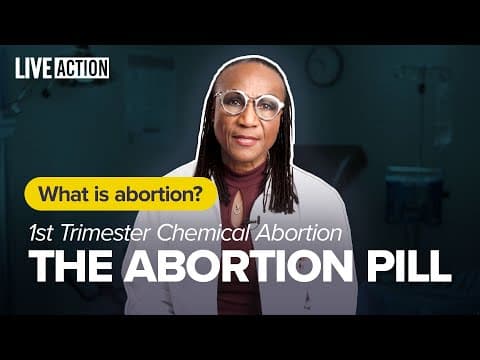
A 'successful' result is a dead human being. That's not healthcare. That's intent to kill.
The child is dead, and the mother who took the abortion pill may be physically suffering. The abortion industry often claims that taking the abortion pill is like having a heavy period and is safer than Tylenol; research and personal testimony have shown otherwise.
Dr. Christine Francis, CEO of the American Association of Pro-Life Obstetricians and Gynecologists (AAPLOG), told Newsmax that she has personally witnessed the harm the abortion pill is doing to women and girls:
“Women and girls are being endangered and injured every day in our country through these dangerous chemical abortion drugs.
I am a board-certified OB/GYN and I practice in an in-patient setting and I, personally, along with many of my colleagues, have seen women and girls come in through our emergency rooms with severe complications from these drugs. Complications that should be being addressed by the FDA.
Complications like heavy bleeding and hemorrhage and the need for emergency surgery, the need for admission to the hospital for blood transfusions and infections, and even one of our members took care of a woman who likely will not be able to have children in the future because of major complications that required two major surgeries to correct these complications due to these chemical abortion drugs.”
The FDA does not require that complications of the abortion pill be reported. However...
A pro-abortion Gynuity-sponsored study published in 2021 in the journal Contraception revealed that six percent (6%) of 1,157 women who took the abortion pill visited the emergency room or an urgent care center for abortion pill-related complications. Ten of those were serious, and five of the women needed a blood transfusion.
This data mirrors abortion complication data in the United Kingdom, where it was found that nearly six percent (6%) of women who took the abortion pill in the UK between June 1, 2019, and May 31, 2021, were treated for complications.
A 2020 report from the abortion group Marie Stopes Australia also revealed an overall complication rate of 6.37% for women who took the abortion pill that year.
However, abortion pill prescribers often instruct women to lie to ER doctors about taking the abortion pill and tell the doctors that they are miscarrying, skewing the data on abortion pill complications.
The EPPC analysis found a nearly 11% rate of serious adverse events, including sepsis, infection, and hemorrhage. This rate is 22 times higher than the FDA's rate listed on the mifepristone label.
Women have come forward to share their personal stories, but pro-abortion media outlets have ignored them.
Leslie called her experience with the abortion pill “incredibly terrifying, isolating, and painful.” She said, “It should not be downplayed as similar to a heavy period or an early miscarriage. I’ve had both. The chemical abortion was a violent, unnatural pain.”
Another woman said on the website AbortionChangesYou.com that after taking the abortion pill, she bled heavily for eight weeks, was rushed to the hospital for an emergency D&C, and still had problems with complications a year later. The abortion facility told her she could bleed for up to six weeks, but she found herself bleeding longer:
"One day at work, I started hemorrhaging.… This was probably 8 weeks [after taking the abortion pill]. I had been notifying the clinic I felt I was bleeding too long and too heavy. They always brushed me off saying yes you can bleed longer.
Well, this day I couldn’t ignore it. I was changing tampons and pads that overflowed every 20 minutes. To finish my shift, I stuffed paper towels in. Nothing would hold it until I bled down my pants in front of a patient. I made it home covered up with a jacket.
I was feeling like passing out and asked my brother to take me to the hospital. I had to admit to him what was going on."
A year later, she was still suffering from the physical trauma the abortion pill caused her body. She was “still severely anemic and having to get IV iron treatment which takes 4 hrs. I may have to do every six months the hematologist says. Have to see gyno to reduce my heavy periods.”
She, like many women, also suffered mental health effects from taking the abortion pill. She even felt she deserved the physical complications she suffered:
All this shame and illness and I knew I deserved it, I deserved to die for the baby I killed. The horror of nights not sleeping thinking of the baby. Looking at my kids thinking of another beautiful child. Couldn’t live with myself. Wishing God would take my life. But every day putting on a smile around people to mask it all. Inside I felt a disgust towards myself, towards the lie and hypocrisy.
She's not alone.
In 2019, Life Issues Institute released a documentary on the abortion pill, which included an interview with Tammi Morris. She explained:
"It wasn’t very long until after I took that pill that I began to experience labor. And it didn’t take long at all for those labor pains to intensify. Because I had already given birth to a child, my daughter, I knew what labor felt like, and I was shocked.
I thought that I would cramp, like I had with my surgical abortion, but it would be over relatively quickly. This was not that. This was horrific! This was me, alone, afraid, and feeling like I’m going to give birth to death. They didn’t prepare me for this. They told me that some tissue would be expelled from me, much like clots."
She continued:
And I was on the toilet, and I wasn’t there very long, and the urge to push was there. And I felt a mass, and then I heard a sound. Horrified, I looked down, and there was my baby. In a toilet… [I felt] devastated. This wasn’t uterine tissue. This was a formed, recognizable, undeniable baby. My baby. My fiancé’s baby.
She had to seek medical attention for serious bleeding, but what was worse was knowing she killed her baby:
I was angry, I was ashamed, I was very hard to be around, because I had this secret. I had this traumatic experience that I couldn’t share with anybody. And after all, how does the mother who killed her own child in the womb, intentionally, how does she grieve outwardly?
Also in the documentary, Elizabeth Gillett shared that after she took the abortion pill...
"I miscarried my entire child whole. It was the size of a tennis ball, probably, round, just a perfect little sack. And inside was this tiny little gummy bear. And I held him… The doctor had promised me that I would feel relieved. I didn’t feel any relief. Overwhelming guilt. Just a sickness inside that I couldn’t, couldn’t put away.
Nightmares started shortly after. I stopped eating. I became anorexic. I was later diagnosed with acute posttraumatic stress disorder."
Live Action’s webpage, “I Saw My Baby,” brings awareness to stories like these.

Salome shared, “After taking the abortion pill, I felt like my inside was being torn and sliced to pieces. I had blood all over my legs and went into the tub to wash them,” she explained. “Right before the fetus came out I started vomiting everything that I had in my system that morning. And then I bled more and I hurt more. And I started praying curled up in the blood in the tub, for the first time in years. I don’t even remember the last time I prayed before this happened.”
She added:
"After hours of hurting, I finally felt a huge physical relief and the pain was immediately gone. I managed to get up, and when I turned around, I saw the most heartbreaking thing that I’ve seen in my entire life — I saw my child.
It was at that moment that it sunk in properly that I really had been pregnant. I had been carrying the life that I created inside of me until that very moment.... I felt like part of me died. I felt angry, I felt guilty. I felt like my world was coming to an end and that I was the most terrible person on this earth."
She added, “I couldn’t believe what I was looking at. It was the most beautiful thing that I’d ever created and I destroyed it.”
The lawsuit behind the Alliance for Hippocratic Medicine (AHM) v. Food and Drug Administration (FDA) case challenged the legitimacy of the abortion pill's approval in 2000. During that case, there was discussion over whether pregnancy is an “illness” — a classification that was allegedly used to “fast-track approval authority” of the drug — according to the plaintiffs.
“The only way the FDA could have approved chemical abortion drugs was to use its accelerated drug approval authority, necessitating the FDA to call pregnancy an ‘illness’ and argue that these dangerous drugs provide a ‘meaningful therapeutic benefit’ over existing treatments,” the pro-life plaintiffs wrote. “But pregnancy is not an illness."
Circuit Court Judge James Ho agreed, telling abortion pill manufacturer Danco's attorney, “Pregnancy is not a serious illness.” He added, “When we celebrate Mother’s Day – are we celebrating illness?”
The abortion pill does not treat any health condition. Healthcare is meant to heal and to improve a person's life. The abortion pill kills babies while physically and emotionally destroying their mothers.
Live Action News is pro-life news and commentary from a pro-life perspective.
Our work is possible because of our donors. Please consider giving to further our work of changing hearts and minds on issues of life and human dignity.
Contact editor@liveaction.org for questions, corrections, or if you are seeking permission to reprint any Live Action News content.
Guest Articles: To submit a guest article to Live Action News, email editor@liveaction.org with an attached Word document of 800-1000 words. Please also attach any photos relevant to your submission if applicable. If your submission is accepted for publication, you will be notified within three weeks. Guest articles are not compensated (see our Open License Agreement). Thank you for your interest in Live Action News!
Cassy Cooke
·
Abortion Pill
Cassy Cooke
·
Abortion Pill
Carole Novielli
·
Abortion Pill
Carole Novielli
·
Abortion Pill
Carole Novielli
·
Abortion Pill
Bridget Sielicki
·
Politics
Nancy Flanders
·
International
Nancy Flanders
·
Activism
Nancy Flanders
·
International
Nancy Flanders
·
Issues
Nancy Flanders
·Abortion Pill·By Nancy Flanders
This Isn't Healthcare: How the abortion pill kills and injures
Heavily marketed as 'safe and effective,' the abortion pill has rapidly grown in popularity among women seeking abortions. It now accounts for about 65% of all abortions. Pro-abortion groups portray the abortion pill as just another 'treatment,' even using the moniker "medication abortion." But medication is meant to heal, not intentionally harm. The abortion pill is not healthcare.
The abortion pill is deceptively marketed as safe and effective healthcare.
The intent of healthcare is to heal and improve a person's life. The intent of the abortion pill is to end a human life.
The abortion pill kills innocent human beings in the womb and also frequently causes physical and emotional harm to the women who take it.
The FDA allegedly approved the abortion pill based on the false idea that pregnancy is an illness.
First and foremost, the abortion pill has one purpose: to kill a living preborn child.
Based on that alone, it cannot be healthcare because healthcare is meant to care for a human being's health — not to kill. There's a reason why the abortion industry has in recent years begun to label abortion as abortion "care" — it is a deliberate effort to ignore the life that is being aborted, pretending as if intentionally killing a woman's child is caring for her.
Beyond the obvious atrocity of abortion itself, the abortion pill frequently has devastating effects on women — both physically and mentally.
The abortion pill is a drug regimen that includes mifepristone and misoprostol. The two drugs work together to kill and expel the growing human child in the earliest days of her life. The abortion pill is "effective" only when the child is expelled and dead.
According to the pro-abortion Guttmacher Institute, abortion pill "failure" includes an incomplete abortion and the survival of the child.
In 2025, an analysis by the Ethics & Public Policy Center (EPPC) found that the failure rate of mifepristone, the first drug of the abortion pill regimen, is nearly double the failure rate currently listed on the FDA-approved drug label.
The abortion pill "works" when mifepristone deprives the baby of nutrients and oxygen and when misoprostol causes the uterus to contract to expel the baby's body. This video explains the process:
A 'successful' result is a dead human being. That's not healthcare. That's intent to kill.
The child is dead, and the mother who took the abortion pill may be physically suffering. The abortion industry often claims that taking the abortion pill is like having a heavy period and is safer than Tylenol; research and personal testimony have shown otherwise.
Dr. Christine Francis, CEO of the American Association of Pro-Life Obstetricians and Gynecologists (AAPLOG), told Newsmax that she has personally witnessed the harm the abortion pill is doing to women and girls:
“Women and girls are being endangered and injured every day in our country through these dangerous chemical abortion drugs.
I am a board-certified OB/GYN and I practice in an in-patient setting and I, personally, along with many of my colleagues, have seen women and girls come in through our emergency rooms with severe complications from these drugs. Complications that should be being addressed by the FDA.
Complications like heavy bleeding and hemorrhage and the need for emergency surgery, the need for admission to the hospital for blood transfusions and infections, and even one of our members took care of a woman who likely will not be able to have children in the future because of major complications that required two major surgeries to correct these complications due to these chemical abortion drugs.”
The FDA does not require that complications of the abortion pill be reported. However...
A pro-abortion Gynuity-sponsored study published in 2021 in the journal Contraception revealed that six percent (6%) of 1,157 women who took the abortion pill visited the emergency room or an urgent care center for abortion pill-related complications. Ten of those were serious, and five of the women needed a blood transfusion.
This data mirrors abortion complication data in the United Kingdom, where it was found that nearly six percent (6%) of women who took the abortion pill in the UK between June 1, 2019, and May 31, 2021, were treated for complications.
A 2020 report from the abortion group Marie Stopes Australia also revealed an overall complication rate of 6.37% for women who took the abortion pill that year.
However, abortion pill prescribers often instruct women to lie to ER doctors about taking the abortion pill and tell the doctors that they are miscarrying, skewing the data on abortion pill complications.
The EPPC analysis found a nearly 11% rate of serious adverse events, including sepsis, infection, and hemorrhage. This rate is 22 times higher than the FDA's rate listed on the mifepristone label.
Women have come forward to share their personal stories, but pro-abortion media outlets have ignored them.
Leslie called her experience with the abortion pill “incredibly terrifying, isolating, and painful.” She said, “It should not be downplayed as similar to a heavy period or an early miscarriage. I’ve had both. The chemical abortion was a violent, unnatural pain.”
Another woman said on the website AbortionChangesYou.com that after taking the abortion pill, she bled heavily for eight weeks, was rushed to the hospital for an emergency D&C, and still had problems with complications a year later. The abortion facility told her she could bleed for up to six weeks, but she found herself bleeding longer:
"One day at work, I started hemorrhaging.… This was probably 8 weeks [after taking the abortion pill]. I had been notifying the clinic I felt I was bleeding too long and too heavy. They always brushed me off saying yes you can bleed longer.
Well, this day I couldn’t ignore it. I was changing tampons and pads that overflowed every 20 minutes. To finish my shift, I stuffed paper towels in. Nothing would hold it until I bled down my pants in front of a patient. I made it home covered up with a jacket.
I was feeling like passing out and asked my brother to take me to the hospital. I had to admit to him what was going on."
A year later, she was still suffering from the physical trauma the abortion pill caused her body. She was “still severely anemic and having to get IV iron treatment which takes 4 hrs. I may have to do every six months the hematologist says. Have to see gyno to reduce my heavy periods.”
She, like many women, also suffered mental health effects from taking the abortion pill. She even felt she deserved the physical complications she suffered:
All this shame and illness and I knew I deserved it, I deserved to die for the baby I killed. The horror of nights not sleeping thinking of the baby. Looking at my kids thinking of another beautiful child. Couldn’t live with myself. Wishing God would take my life. But every day putting on a smile around people to mask it all. Inside I felt a disgust towards myself, towards the lie and hypocrisy.
She's not alone.
In 2019, Life Issues Institute released a documentary on the abortion pill, which included an interview with Tammi Morris. She explained:
"It wasn’t very long until after I took that pill that I began to experience labor. And it didn’t take long at all for those labor pains to intensify. Because I had already given birth to a child, my daughter, I knew what labor felt like, and I was shocked.
I thought that I would cramp, like I had with my surgical abortion, but it would be over relatively quickly. This was not that. This was horrific! This was me, alone, afraid, and feeling like I’m going to give birth to death. They didn’t prepare me for this. They told me that some tissue would be expelled from me, much like clots."
She continued:
And I was on the toilet, and I wasn’t there very long, and the urge to push was there. And I felt a mass, and then I heard a sound. Horrified, I looked down, and there was my baby. In a toilet… [I felt] devastated. This wasn’t uterine tissue. This was a formed, recognizable, undeniable baby. My baby. My fiancé’s baby.
She had to seek medical attention for serious bleeding, but what was worse was knowing she killed her baby:
I was angry, I was ashamed, I was very hard to be around, because I had this secret. I had this traumatic experience that I couldn’t share with anybody. And after all, how does the mother who killed her own child in the womb, intentionally, how does she grieve outwardly?
Also in the documentary, Elizabeth Gillett shared that after she took the abortion pill...
"I miscarried my entire child whole. It was the size of a tennis ball, probably, round, just a perfect little sack. And inside was this tiny little gummy bear. And I held him… The doctor had promised me that I would feel relieved. I didn’t feel any relief. Overwhelming guilt. Just a sickness inside that I couldn’t, couldn’t put away.
Nightmares started shortly after. I stopped eating. I became anorexic. I was later diagnosed with acute posttraumatic stress disorder."
Live Action’s webpage, “I Saw My Baby,” brings awareness to stories like these.
Salome shared, “After taking the abortion pill, I felt like my inside was being torn and sliced to pieces. I had blood all over my legs and went into the tub to wash them,” she explained. “Right before the fetus came out I started vomiting everything that I had in my system that morning. And then I bled more and I hurt more. And I started praying curled up in the blood in the tub, for the first time in years. I don’t even remember the last time I prayed before this happened.”
She added:
"After hours of hurting, I finally felt a huge physical relief and the pain was immediately gone. I managed to get up, and when I turned around, I saw the most heartbreaking thing that I’ve seen in my entire life — I saw my child.
It was at that moment that it sunk in properly that I really had been pregnant. I had been carrying the life that I created inside of me until that very moment.... I felt like part of me died. I felt angry, I felt guilty. I felt like my world was coming to an end and that I was the most terrible person on this earth."
She added, “I couldn’t believe what I was looking at. It was the most beautiful thing that I’d ever created and I destroyed it.”
The lawsuit behind the Alliance for Hippocratic Medicine (AHM) v. Food and Drug Administration (FDA) case challenged the legitimacy of the abortion pill's approval in 2000. During that case, there was discussion over whether pregnancy is an “illness” — a classification that was allegedly used to “fast-track approval authority” of the drug — according to the plaintiffs.
“The only way the FDA could have approved chemical abortion drugs was to use its accelerated drug approval authority, necessitating the FDA to call pregnancy an ‘illness’ and argue that these dangerous drugs provide a ‘meaningful therapeutic benefit’ over existing treatments,” the pro-life plaintiffs wrote. “But pregnancy is not an illness."
Circuit Court Judge James Ho agreed, telling abortion pill manufacturer Danco's attorney, “Pregnancy is not a serious illness.” He added, “When we celebrate Mother’s Day – are we celebrating illness?”
The abortion pill does not treat any health condition. Healthcare is meant to heal and to improve a person's life. The abortion pill kills babies while physically and emotionally destroying their mothers.
Live Action News is pro-life news and commentary from a pro-life perspective.
Our work is possible because of our donors. Please consider giving to further our work of changing hearts and minds on issues of life and human dignity.
Contact editor@liveaction.org for questions, corrections, or if you are seeking permission to reprint any Live Action News content.
Guest Articles: To submit a guest article to Live Action News, email editor@liveaction.org with an attached Word document of 800-1000 words. Please also attach any photos relevant to your submission if applicable. If your submission is accepted for publication, you will be notified within three weeks. Guest articles are not compensated (see our Open License Agreement). Thank you for your interest in Live Action News!
Cassy Cooke
·Abortion Pill
Cassy Cooke
·Abortion Pill
Carole Novielli
·Abortion Pill
Carole Novielli
·Abortion Pill
Carole Novielli
·Abortion Pill
Bridget Sielicki
·Politics
Nancy Flanders
·International
Nancy Flanders
·Activism
Nancy Flanders
·International
Nancy Flanders
·Issues
Nancy Flanders
·