 Analysis
Read Next
International
Poland's president expected to veto lawmakers' efforts to expand abortion
Bridget Sielicki
·

This Isn't Healthcare: Induction abortion vs. inducing labor and delivery
This is part two of a series. Read part one and part three here.
Stories about abortions late in pregnancy have been blurring the line between induction abortion and inducing labor to deliver a child — and the confusion only seems to be growing. The difference is in the core intent of the procedures; the processes, despite their similarities, have one major difference.
Induction abortion, like all forms of induced abortion, carries the intent to kill.
That isn't health care.
Induction abortion carries the intent to produce a dead baby.
Inducing labor is carried out to deliver a child and provide medical care to both mother and baby.
Though similar, the key difference between induction abortion and inducing labor is that, in an induction abortion, the intent is to cause or hasten the baby's death. The baby may be put into cardiac arrest before delivery, or be delivered early with the goal of hastening her death at birth.
Doctors from the American Association of Pro-Life Obstetricians and Gynecologists (AAPLOG) confirm that intentionally killing a child or hastening a child's death is not necessary to save the mother's life.
Since the fall of Roe v. Wade in 2022, the media has been overflowing with stories of women who claim they had to have an abortion for medical reasons because their own health or lives were in danger.
But what these stories often do is conflate induced abortion with inducing labor (and delivery), claiming that inducing labor to save the mother's life is an abortion; it's not.
Killing a child for any reason is not health care, and it doesn't need to be done to save the mother.
⭐️An induced labor and delivery are carried out to save the mother's life or to save the baby's life; the doctor induces labor, and the baby is born. This is considered health care because the purpose is to heal and protect life.
Depending on the child's age, neonatologists will provide necessary care to that child. Babies born as young as 21 weeks have survived when given proper care.
Babies younger than 21 weeks may be unable to survive, and may instead be provided with comfort care, depending on the level of NICU available at the hospital where they were born.
If the baby dies as a result of extreme prematurity despite efforts to save her, it does not make the emergency delivery an induced abortion.
Sometimes it is better for the baby to be born prematurely than to stay in the womb. This could be due to a growth restriction issue, low amniotic fluid, and other conditions, but the decision of if and when to induce labor is made in the best interest of the child.
➡ Induced labor/delivery is also the standard of care for medical conditions related to the pregnancy, such premature preterm rupture of membranes (PPROM), when doctors are unable to prevent labor or the baby is protruding from the uterus due to an incompetent cervix. It is also often used when the mother develops pre-eclampsia or gestational diabetes that can not be controlled.
There are a host of other reasons that it may be necessary to induce labor, such as physical trauma suffered by the mother, like a car accident. But it is never the intent to cause harm to the child.
In emergencies that require immediate delivery, an emergency c-section can be performed to remove the baby from the womb in minutes. Again, depending on the child's age, she would receive immediate, appropriate medical care. This is also not an induced abortion.
Dr. Donna Harrison, executive director of The American Association of Pro-Life Obstetricians and Gynecologists (AAPLOG) explained:
In these situations where a mother and her fetus must be separated in order to save the life of the mother we would try to optimize the conditions of the separation so that the fetus has the best possibility to live. But there are cases when the baby will not survive the separation due to gestational age.
We call these previable separations. These separations are done with the intent to save both if possible, but at least to save the life of one.
AAPLOG further noted:
There is a night and day difference between induced abortion and separating a mother and her unborn child for the purposes of saving a mother’s life (preterm parturition).
There are times when separating the mother and her unborn child is necessary to save the life of the mother, even if the unborn child is too premature to live. In those tragic cases, if possible the life of the baby will be attempted to be preserved, and if not possible, the body of the unborn child is treated with respect, recognizing the humanity of the life which is lost in the separation.
In contrast, the purpose of an induced abortion is to produce a dead baby.
⭐️ Induction abortion is a process carried out in the third trimester of pregnancy with the intent of ending the baby's life. Intent to kill is not health care.
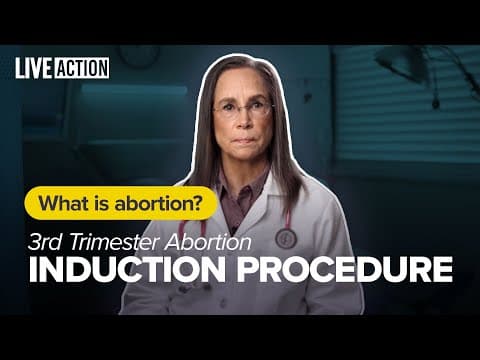
In several recent viral stories, induction abortion has been used to end the life of a baby under the guise of protecting the mother's health — or out of a distorted belief that killing is compassionate for the baby.
Many of the mothers in these cases were not experiencing emergencies, but had an increased risk of complications that could potentially become emergencies later. The intent in these cases was often to hasten the child's expected death to avoid those potential complications, or to "mercy kill" the baby because of a diagnosis.
➡ Though an induction abortion involves inducing labor in the mother, it typically involves the additional step of injecting a feticide to cause cardiac arrest in the child prior to the induction of labor to delivery a stillborn baby. Inducing such a delivery without a medical emergency and with the goal being that the baby dies, is considered an abortion.
According to the Centers for Disease Control and Prevention, a legal induced abortion is an “intervention performed by a licensed clinician (e.g., a physician, nurse-midwife, nurse practitioner, or physician assistant) that is intended to terminate a suspected or known ongoing intrauterine pregnancy and produce a non-viable fetus at any gestational age.”
AAPLOG explained:
That is what an abortionist is paid to do: to kill the unborn child before delivering it, or to kill the child during the delivery process, as is done with partial-birth abortion. So the focus of the abortion procedure is on killing the unborn child, and the purpose of the abortion is to produce a dead baby.
Induced abortion, that is the deliberate killing of an unborn child prior to separating that child from the mother, is never necessary to save the life or preserve the health of any woman.
WARNING: GRAPHIC IMAGES OF ABORTION VICTIMS BELOW.
The photos below show babies known as Christopher X and Phoenix, whose bodies were discovered in a medical waste box from a late-term abortion facility in Washington, D.C. in 2022. These children were likely victims of induction abortion, a procedure carried out to ensure their deaths.


Intentionally killing a preborn baby by inducing cardiac arrest or intentionally hastening the death of a baby by carrying out a premature birth with the purpose of causing the baby's death are forms of abortion because the purpose is the death of the baby.
Whether the baby was initially "wanted" or "planned" by the parents is of no consequence. The decision was made to either kill the baby in the womb or hasten the baby's death — and these are abortions.
Delivering the baby to separate mother and child during an emergency and then attempting to save both lives is not an abortion, even if the baby doesn't survive.
Dr. Harrison explained:
Previable separations are not the same as elective abortions. The intent of an abortion was made very clear at the Supreme Court hearings over the Partial Birth Abortion Ban.
The abortionists argued that the product the abortionist is paid to produce is a dead baby, and that is what distinguishes a delivery from an abortion.
The intent of a delivery is to produce, if possible, both a live baby and live mom. The intent of an abortion is to produce a dead baby.
On its website, (AAPLOG) "affirms the Dublin Declaration," which more than 1,000 doctors have signed. It states that "direct abortion is not medically necessary to save the life of a woman" and that "there is a fundamental difference between abortion and necessary medical treatments that are carried out to save the life of the mother, even if such treatments results in the loss of life of her unborn child."
Pro-life laws do not, in any way, restrict necessary medical care for pregnant women, but the abortion industry intentionally conflates induction abortion with legitimate medical care in order to gain sympathetic votes in favor of unlimited abortion.
Regardless of how the media spins a story, it is never necessary to intentionally hasten a baby's death or intentionally kill a preborn baby.
Live Action News is pro-life news and commentary from a pro-life perspective.
Our work is possible because of our donors. Please consider giving to further our work of changing hearts and minds on issues of life and human dignity.
Contact editor@liveaction.org for questions, corrections, or if you are seeking permission to reprint any Live Action News content.
Guest Articles: To submit a guest article to Live Action News, email editor@liveaction.org with an attached Word document of 800-1000 words. Please also attach any photos relevant to your submission if applicable. If your submission is accepted for publication, you will be notified within three weeks. Guest articles are not compensated (see our Open License Agreement). Thank you for your interest in Live Action News!
Bridget Sielicki
·
International
Bridget Sielicki
·
Analysis
Nancy Flanders
·
Issues
Nancy Flanders
·
Analysis
Newsroom
·
Analysis
Cassy Cooke
·
Issues
Nancy Flanders
·
Issues
Nancy Flanders
·
Pop Culture
Nancy Flanders
·Analysis
Nancy Flanders
·
Pop Culture
Nancy Flanders
·This Isn't Healthcare: Induction abortion vs. inducing labor and delivery
This is part two of a series. Read part one and part three here.
Stories about abortions late in pregnancy have been blurring the line between induction abortion and inducing labor to deliver a child — and the confusion only seems to be growing. The difference is in the core intent of the procedures; the processes, despite their similarities, have one major difference.
Induction abortion, like all forms of induced abortion, carries the intent to kill.
That isn't health care.
Induction abortion carries the intent to produce a dead baby.
Inducing labor is carried out to deliver a child and provide medical care to both mother and baby.
Though similar, the key difference between induction abortion and inducing labor is that, in an induction abortion, the intent is to cause or hasten the baby's death. The baby may be put into cardiac arrest before delivery, or be delivered early with the goal of hastening her death at birth.
Doctors from the American Association of Pro-Life Obstetricians and Gynecologists (AAPLOG) confirm that intentionally killing a child or hastening a child's death is not necessary to save the mother's life.
Since the fall of Roe v. Wade in 2022, the media has been overflowing with stories of women who claim they had to have an abortion for medical reasons because their own health or lives were in danger.
But what these stories often do is conflate induced abortion with inducing labor (and delivery), claiming that inducing labor to save the mother's life is an abortion; it's not.
Killing a child for any reason is not health care, and it doesn't need to be done to save the mother.
⭐️An induced labor and delivery are carried out to save the mother's life or to save the baby's life; the doctor induces labor, and the baby is born. This is considered health care because the purpose is to heal and protect life.
Depending on the child's age, neonatologists will provide necessary care to that child. Babies born as young as 21 weeks have survived when given proper care.
Babies younger than 21 weeks may be unable to survive, and may instead be provided with comfort care, depending on the level of NICU available at the hospital where they were born.
If the baby dies as a result of extreme prematurity despite efforts to save her, it does not make the emergency delivery an induced abortion.
Sometimes it is better for the baby to be born prematurely than to stay in the womb. This could be due to a growth restriction issue, low amniotic fluid, and other conditions, but the decision of if and when to induce labor is made in the best interest of the child.
➡ Induced labor/delivery is also the standard of care for medical conditions related to the pregnancy, such premature preterm rupture of membranes (PPROM), when doctors are unable to prevent labor or the baby is protruding from the uterus due to an incompetent cervix. It is also often used when the mother develops pre-eclampsia or gestational diabetes that can not be controlled.
There are a host of other reasons that it may be necessary to induce labor, such as physical trauma suffered by the mother, like a car accident. But it is never the intent to cause harm to the child.
In emergencies that require immediate delivery, an emergency c-section can be performed to remove the baby from the womb in minutes. Again, depending on the child's age, she would receive immediate, appropriate medical care. This is also not an induced abortion.
Dr. Donna Harrison, executive director of The American Association of Pro-Life Obstetricians and Gynecologists (AAPLOG) explained:
In these situations where a mother and her fetus must be separated in order to save the life of the mother we would try to optimize the conditions of the separation so that the fetus has the best possibility to live. But there are cases when the baby will not survive the separation due to gestational age.
We call these previable separations. These separations are done with the intent to save both if possible, but at least to save the life of one.
AAPLOG further noted:
There is a night and day difference between induced abortion and separating a mother and her unborn child for the purposes of saving a mother’s life (preterm parturition).
There are times when separating the mother and her unborn child is necessary to save the life of the mother, even if the unborn child is too premature to live. In those tragic cases, if possible the life of the baby will be attempted to be preserved, and if not possible, the body of the unborn child is treated with respect, recognizing the humanity of the life which is lost in the separation.
In contrast, the purpose of an induced abortion is to produce a dead baby.
⭐️ Induction abortion is a process carried out in the third trimester of pregnancy with the intent of ending the baby's life. Intent to kill is not health care.
In several recent viral stories, induction abortion has been used to end the life of a baby under the guise of protecting the mother's health — or out of a distorted belief that killing is compassionate for the baby.
Many of the mothers in these cases were not experiencing emergencies, but had an increased risk of complications that could potentially become emergencies later. The intent in these cases was often to hasten the child's expected death to avoid those potential complications, or to "mercy kill" the baby because of a diagnosis.
➡ Though an induction abortion involves inducing labor in the mother, it typically involves the additional step of injecting a feticide to cause cardiac arrest in the child prior to the induction of labor to delivery a stillborn baby. Inducing such a delivery without a medical emergency and with the goal being that the baby dies, is considered an abortion.
According to the Centers for Disease Control and Prevention, a legal induced abortion is an “intervention performed by a licensed clinician (e.g., a physician, nurse-midwife, nurse practitioner, or physician assistant) that is intended to terminate a suspected or known ongoing intrauterine pregnancy and produce a non-viable fetus at any gestational age.”
AAPLOG explained:
That is what an abortionist is paid to do: to kill the unborn child before delivering it, or to kill the child during the delivery process, as is done with partial-birth abortion. So the focus of the abortion procedure is on killing the unborn child, and the purpose of the abortion is to produce a dead baby.
Induced abortion, that is the deliberate killing of an unborn child prior to separating that child from the mother, is never necessary to save the life or preserve the health of any woman.
WARNING: GRAPHIC IMAGES OF ABORTION VICTIMS BELOW.
The photos below show babies known as Christopher X and Phoenix, whose bodies were discovered in a medical waste box from a late-term abortion facility in Washington, D.C. in 2022. These children were likely victims of induction abortion, a procedure carried out to ensure their deaths.
Intentionally killing a preborn baby by inducing cardiac arrest or intentionally hastening the death of a baby by carrying out a premature birth with the purpose of causing the baby's death are forms of abortion because the purpose is the death of the baby.
Whether the baby was initially "wanted" or "planned" by the parents is of no consequence. The decision was made to either kill the baby in the womb or hasten the baby's death — and these are abortions.
Delivering the baby to separate mother and child during an emergency and then attempting to save both lives is not an abortion, even if the baby doesn't survive.
Dr. Harrison explained:
Previable separations are not the same as elective abortions. The intent of an abortion was made very clear at the Supreme Court hearings over the Partial Birth Abortion Ban.
The abortionists argued that the product the abortionist is paid to produce is a dead baby, and that is what distinguishes a delivery from an abortion.
The intent of a delivery is to produce, if possible, both a live baby and live mom. The intent of an abortion is to produce a dead baby.
On its website, (AAPLOG) "affirms the Dublin Declaration," which more than 1,000 doctors have signed. It states that "direct abortion is not medically necessary to save the life of a woman" and that "there is a fundamental difference between abortion and necessary medical treatments that are carried out to save the life of the mother, even if such treatments results in the loss of life of her unborn child."
Pro-life laws do not, in any way, restrict necessary medical care for pregnant women, but the abortion industry intentionally conflates induction abortion with legitimate medical care in order to gain sympathetic votes in favor of unlimited abortion.
Regardless of how the media spins a story, it is never necessary to intentionally hasten a baby's death or intentionally kill a preborn baby.
Live Action News is pro-life news and commentary from a pro-life perspective.
Our work is possible because of our donors. Please consider giving to further our work of changing hearts and minds on issues of life and human dignity.
Contact editor@liveaction.org for questions, corrections, or if you are seeking permission to reprint any Live Action News content.
Guest Articles: To submit a guest article to Live Action News, email editor@liveaction.org with an attached Word document of 800-1000 words. Please also attach any photos relevant to your submission if applicable. If your submission is accepted for publication, you will be notified within three weeks. Guest articles are not compensated (see our Open License Agreement). Thank you for your interest in Live Action News!
Bridget Sielicki
·International
Bridget Sielicki
·Analysis
Nancy Flanders
·Issues
Nancy Flanders
·Analysis
Newsroom
·Analysis
Cassy Cooke
·Issues
Nancy Flanders
·Issues
Nancy Flanders
·Pop Culture
Nancy Flanders
·Analysis
Nancy Flanders
·Pop Culture
Nancy Flanders
·