 International
Read Next
Investigative
Nevada woman sentenced for attempted murder of newborn left in trash
Nancy Flanders
·

The new eugenics: When human life becomes a data profile
New reproductive technology is again highlighting the eugenics-based mindset prevalent within the fertility industry.
In 1978, the first baby conceived through in vitro fertilization (IVF) was born.
Millions more have been born since then, though countless millions more have been created and then destroyed.
IVF often leads to the commodification of children, with would-be parents choosing embryos based on various characteristics and traits.
New technology goes even further, letting people choose an embryo that is expected to have more desired characteristics such as a higher IQ, greater physical height, and have other supposedly-desirable characteristics.
A breakthrough in reproductive technology has emerged — and with it, perhaps, a new moral problem.
In the United Kingdom (UK), some IVF clinics are purportedly permitting couples to tap on advanced genetic ranking systems to choose embryos not only according to health conditions but also based on expected IQ, height, and other characteristics previously deemed beyond human control.
Where advocates of such technologies claim such options give couples “choice,” critics fear an ominous reversion to eugenics — whereby human lives are judged, measured, and disposed of if they do not meet expectations.
At the crux of this phenomenon is a private genetics company called Herasight, which alleges it can offer an “average gain of six IQ points” for couples who fertilize several embryos, providing sex prediction, expected height, and risk evaluations for conditions like Alzheimer’s, heart disease, and schizophrenia. To obtain that “gain,” parents must pay $50,000 (£37,000) to the firm and produce multiple embryos, each to be studied and ranked before only a chosen few are implanted.
In one instance, a 29-year-old woman who planned to use Herasight’s services explained her decision:
"People are willing to spend loads of money and heartache to give their kids slightly better lives after they’re born. This seems the best bang for your buck; it’s less per year than private school."
The same woman added: “I’m hoping to have six where I’m like: ‘Wow, that’s an excellent profile.’”
Peter Thompson, the chief executive of the HFEA, stated that polygenic testing is illegal in the UK. “Licensed clinics in the UK are responsible for selecting embryos based on what is permitted in the HFE Act and therefore should not offer such testing and subsequent treatment,” he asserted.
“However, there is nothing to stop a UK-based couple seeking such testing, and indeed treatment, overseas, but a UK licensed clinic should not then make decisions on what embryo to put back using that information,” Thompson said.
Dr. Cristina Hickman, a senior embryologist and founder of Avenues fertility clinic in London, conceded that her clinic would typically not dismiss a couple’s request that a specific embryo be transferred, as long as medical safety conditions were not breached:
"If a patient wants to have embryo number one transferred and the clinic says no, we want embryo number three, I cannot think that, if this were to go to a judge, they would say no, you have to transfer embryo number three. I would rather have [polygenic testing] allowed here and have the HFEA control how to do it ethically."
The medical community has lambasted such embryo evaluation services as “scientifically unverified and unethical." The European Society of Human Genetics stated that “using polygenic testing for embryo selection is highly problematic and has significant illegal elements.”
Angus Clarke, an eminent geneticist at Cardiff University, added, “Companies providing genetic analysis services are exploiting parents’ anxieties. Their services lack scientific grounding.”
For pro-life advocates, the phrase itself — “excellent profile” — unravels how the desire to have babies with desirable traits has overwhelmed and superseded moral considerations. These embryos are not “potential” people; they already are human beings in their earliest stage of existence, each possessing the same intrinsic dignity.
Yet, owing to the increasing prevalence of fertility treatments and technologies such as polygenic screening, these embryos are now regarded like samples in a database, classified and ranked according to categories.
Although IVF has long been objectionable within pro-life circles because it separates conception from the natural marital act, often giving rise to the creation and destruction of surplus embryos, polygenic screening (embryo ranking as per predicted intelligence or attractiveness) takes that moral breach to a whole new questionable level.
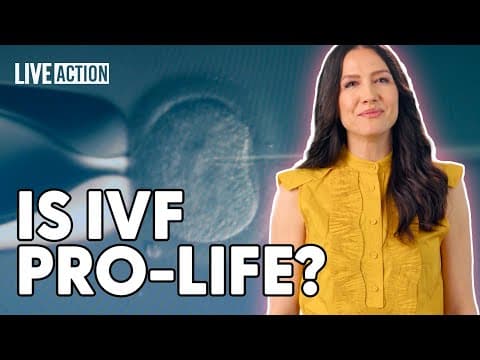
When embryos’ right to live hinges on numerical ratings and algorithms — “IQ plus six,” “height minus two,” or “low cancer risk” — statistical desirability becomes a crass substitution for human dignity. What was once deemed unthinkable — choosing embryos for cosmetic or intellectual advantage — is presently depicted as only a step towards “personalized reproduction.” In this vein, an embryo is no longer a child to be welcomed, but a product to be optimized.
Live Action News is pro-life news and commentary from a pro-life perspective.
Our work is possible because of our donors. Please consider giving to further our work of changing hearts and minds on issues of life and human dignity.
Contact editor@liveaction.org for questions, corrections, or if you are seeking permission to reprint any Live Action News content.
Guest Articles: To submit a guest article to Live Action News, email editor@liveaction.org with an attached Word document of 800-1000 words. Please also attach any photos relevant to your submission if applicable. If your submission is accepted for publication, you will be notified within three weeks. Guest articles are not compensated (see our Open License Agreement). Thank you for your interest in Live Action News!
Nancy Flanders
·
International
Bridget Sielicki
·
International
Bridget Sielicki
·
Human Interest
Angeline Tan
·
International
Bridget Sielicki
·
International
Bridget Sielicki
·Human Interest
Angeline Tan
·
Human Interest
Angeline Tan
·
International
Angeline Tan
·
Analysis
Angeline Tan
·
Human Interest
Angeline Tan
·The new eugenics: When human life becomes a data profile
New reproductive technology is again highlighting the eugenics-based mindset prevalent within the fertility industry.
In 1978, the first baby conceived through in vitro fertilization (IVF) was born.
Millions more have been born since then, though countless millions more have been created and then destroyed.
IVF often leads to the commodification of children, with would-be parents choosing embryos based on various characteristics and traits.
New technology goes even further, letting people choose an embryo that is expected to have more desired characteristics such as a higher IQ, greater physical height, and have other supposedly-desirable characteristics.
A breakthrough in reproductive technology has emerged — and with it, perhaps, a new moral problem.
In the United Kingdom (UK), some IVF clinics are purportedly permitting couples to tap on advanced genetic ranking systems to choose embryos not only according to health conditions but also based on expected IQ, height, and other characteristics previously deemed beyond human control.
Where advocates of such technologies claim such options give couples “choice,” critics fear an ominous reversion to eugenics — whereby human lives are judged, measured, and disposed of if they do not meet expectations.
At the crux of this phenomenon is a private genetics company called Herasight, which alleges it can offer an “average gain of six IQ points” for couples who fertilize several embryos, providing sex prediction, expected height, and risk evaluations for conditions like Alzheimer’s, heart disease, and schizophrenia. To obtain that “gain,” parents must pay $50,000 (£37,000) to the firm and produce multiple embryos, each to be studied and ranked before only a chosen few are implanted.
In one instance, a 29-year-old woman who planned to use Herasight’s services explained her decision:
"People are willing to spend loads of money and heartache to give their kids slightly better lives after they’re born. This seems the best bang for your buck; it’s less per year than private school."
The same woman added: “I’m hoping to have six where I’m like: ‘Wow, that’s an excellent profile.’”
Peter Thompson, the chief executive of the HFEA, stated that polygenic testing is illegal in the UK. “Licensed clinics in the UK are responsible for selecting embryos based on what is permitted in the HFE Act and therefore should not offer such testing and subsequent treatment,” he asserted.
“However, there is nothing to stop a UK-based couple seeking such testing, and indeed treatment, overseas, but a UK licensed clinic should not then make decisions on what embryo to put back using that information,” Thompson said.
Dr. Cristina Hickman, a senior embryologist and founder of Avenues fertility clinic in London, conceded that her clinic would typically not dismiss a couple’s request that a specific embryo be transferred, as long as medical safety conditions were not breached:
"If a patient wants to have embryo number one transferred and the clinic says no, we want embryo number three, I cannot think that, if this were to go to a judge, they would say no, you have to transfer embryo number three. I would rather have [polygenic testing] allowed here and have the HFEA control how to do it ethically."
The medical community has lambasted such embryo evaluation services as “scientifically unverified and unethical." The European Society of Human Genetics stated that “using polygenic testing for embryo selection is highly problematic and has significant illegal elements.”
Angus Clarke, an eminent geneticist at Cardiff University, added, “Companies providing genetic analysis services are exploiting parents’ anxieties. Their services lack scientific grounding.”
For pro-life advocates, the phrase itself — “excellent profile” — unravels how the desire to have babies with desirable traits has overwhelmed and superseded moral considerations. These embryos are not “potential” people; they already are human beings in their earliest stage of existence, each possessing the same intrinsic dignity.
Yet, owing to the increasing prevalence of fertility treatments and technologies such as polygenic screening, these embryos are now regarded like samples in a database, classified and ranked according to categories.
Although IVF has long been objectionable within pro-life circles because it separates conception from the natural marital act, often giving rise to the creation and destruction of surplus embryos, polygenic screening (embryo ranking as per predicted intelligence or attractiveness) takes that moral breach to a whole new questionable level.
When embryos’ right to live hinges on numerical ratings and algorithms — “IQ plus six,” “height minus two,” or “low cancer risk” — statistical desirability becomes a crass substitution for human dignity. What was once deemed unthinkable — choosing embryos for cosmetic or intellectual advantage — is presently depicted as only a step towards “personalized reproduction.” In this vein, an embryo is no longer a child to be welcomed, but a product to be optimized.
Live Action News is pro-life news and commentary from a pro-life perspective.
Our work is possible because of our donors. Please consider giving to further our work of changing hearts and minds on issues of life and human dignity.
Contact editor@liveaction.org for questions, corrections, or if you are seeking permission to reprint any Live Action News content.
Guest Articles: To submit a guest article to Live Action News, email editor@liveaction.org with an attached Word document of 800-1000 words. Please also attach any photos relevant to your submission if applicable. If your submission is accepted for publication, you will be notified within three weeks. Guest articles are not compensated (see our Open License Agreement). Thank you for your interest in Live Action News!
Nancy Flanders
·International
Bridget Sielicki
·International
Bridget Sielicki
·Human Interest
Angeline Tan
·International
Bridget Sielicki
·International
Bridget Sielicki
·Human Interest
Angeline Tan
·Human Interest
Angeline Tan
·International
Angeline Tan
·Analysis
Angeline Tan
·Human Interest
Angeline Tan
·