 Fact Checks
Read Next
International
Quebec premier who helped legalize euthanasia now has doubts
Cassy Cooke
·

FACT CHECK: Abortion is the deliberate killing of a human, not just 'ending a pregnancy'
Those who want abortion on demand have in recent years begun claiming that any procedure that ends a pregnancy is an abortion — including c-sections, induction of labor, and even natural labor in which a child is delivered alive.
But laws regulating abortion do not define it this way, and stating otherwise causes mass confusion — not just among medical professionals, but among parents who have suffered losses during pregnancy and been led to believe they had abortions when they did not.
The definition of abortion is being conflated with other things, as women claim that any procedure that "ends a pregnancy" is an abortion (which sometimes even includes birth).
Under this false definition of abortion, women are claiming that c-sections and induced delivery are abortions because they can end pregnancies.
The intent of an induced abortion, however, is to ensure the baby's death. If the intent of the procedure is to ensure a dead baby, then it is an abortion.
C-sections and induced delivery for emergency medical conditions are not performed with the intent of killing the baby, and are therefore not abortions. Doctors in these situations are attempting to save both mother and child. But if the child is unable to be saved, that does not make her death an abortion.
Induced abortion carries one goal: to produce a dead baby.
Any other procedure that would "end the pregnancy" — miscarriage treatment, induced delivery due to a medical emergency involving the safety of the baby or the mother, c-section for medical reasons related to protecting the mother or baby, ectopic pregnancy treatment to protect the mother's life — serves a purpose of caring for and protecting the mother, the baby, or both.
Regardless of whether the baby ultimately survives, the goal of these procedures is not to ensure that the baby dies.
But abortion advocates intentionally conflate all of these procedures, which is convincing women who haven't had abortions that they have. This also tricks young men and women into believing the lie that intentionally killing a preborn child is medically necessary, and that a pregnant woman could need to have her baby intentionally killed at any moment.
In a debate on Surrounded, Ben Shapiro was confronted with the false idea that c-sections or any kind of delivery outside of a "natural" one are abortions. The pro-abortion debater, who supports abortion through all nine months of pregnancy, claimed that every hospital, including the Mayo Clinic, defines abortion as the ending of a pregnancy.
Shapiro was quick to tell her that the moral issue at the center of the abortion debate is the intent to cause the child's death.
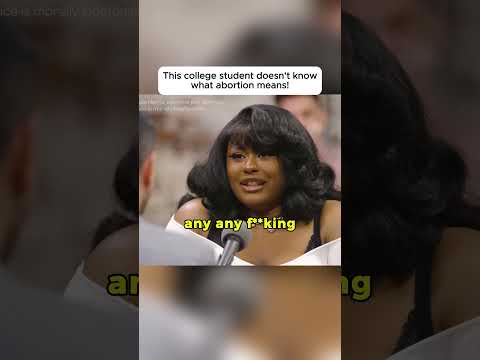
The debater asked:
"Why would you not assume that something like a c-section is an abortion? Why does the definition have to include the death of the fetus? You can say simply abortion is the ending of the pregnancy. Why would it have to end with the death of the fetus?"
Shapiro replied that if abortion didn't intend the death of a preborn child, there would be no moral issue (emphasis added):
"I just don't understand how you're removing the death of the fetus from the equation about abortion. That's literally the entire moral issue. You and I would not even be arguing if we were talking about c-sections or about natural birth."
While the Mayo Clinic does not appear to offer a definition of abortion, it discuss induced labor, saying, "The main reason to induce labor is concern for the health of the baby or the health of the pregnant person."
Clearly, the intent is not to end the baby's life.
About c-sections, it says:
Cesarean birth is the delivery of a baby through surgical incisions made in the belly and uterus.... A C-section may be planned if there are pregnancy complications. And people who have had a C-section before are more likely to need another one. But the decision for a first-time C-section typically isn't made until after labor starts.
Again, the intent is not to cause the baby's death.
The American College of Obstetricians and Gynecologists (ACOG) defines induced abortion as a procedure that "ends a pregnancy with medication or a medical procedure." But if you hover the cursor over "induced abortion," there's a little pop-up that states:
An intervention to end a pregnancy so that it does not result in a live birth.
As for what pro-life laws say, they all consider abortion a procedure in which there is an intent to not have a live birth.
Texas defines abortion as (emphasis added):
The act of using or prescribing an instrument, a drug, a medicine, or any other substance, device, or means with the intent to cause the death of an unborn child of a woman known to be pregnant. The term does not include birth control devices or oral contraceptives. An act is not an abortion if the act is done with the intent to save the life or preserve the health of an unborn child; remove a dead, unborn child whose death was caused by spontaneous abortion; or remove an ectopic pregnancy.
Mississippi defines abortion as (emphasis added):
the use or prescription of any instrument, medicine, drug or any other substance or device to terminate the pregnancy of a woman known to be pregnant with an intention other than to increase the probability of a live birth, to preserve the life or health of the child after live birth or to remove a dead fetus.
Alabama defines abortion as (emphasis added):
the use or prescription of any instrument, medicine, drug, or any other substance or device with the intent to terminate the pregnancy of a woman known to be pregnant with knowledge that the termination by those means will with reasonable likelihood cause the death of the unborn child. Such use or prescription is not an abortion if done with the intent to save the life or preserve the health of an unborn child, remove a dead unborn child, or to deliver the unborn child prematurely in order to preserve the health of both the mother (pregnant woman) and her unborn child.
Those are just a few. Pro-life laws are clear that the difference is the intention.
Such confusion is leading to false conclusions and headlines stating women "need" abortions.
Perhaps the headlines that could cause the most damage are the ones like the BBC's article, "Chrissy Teigen says she has come to realize she had an abortion, not a miscarriage."
It's completely untrue, and has the potential to cause massive emotional, mental, and political chaos among women who have suffered from a similar type of child loss. And the BBC wasn't the only media outlet to run such a headline. People, The Hollywood Reporter, US Weekly, and the Los Angeles Times all ran headlines claiming that Teigen's pregnancy loss was an abortion.
In 2020, Teigen, who is married to musician John Legend, was pregnant with their third child, Jack, when she suffered a partial placental abruption. She was put on bedrest as doctors tried to get her to 28 weeks, but it got to the point that they could not stop the bleeding, and she was given multiple blood transfusions. Jack had to be delivered at just 20 weeks.
The youngest premature baby to ever survive was born at 21 weeks. Jack, tragically, did not survive. But his death was not intentional. The purpose of his delivery was not to end his life, but to stop what had become a dangerous situation for both mother and baby.
The doctors had fought for both Teigen's and her son's lives, but, unfortunately, Jack's could not be saved.
At the time, Teigen referred to this as a miscarriage, and while it was more likely an emergency induced delivery, it was not an abortion.
Two years later, after Dobbs v. Jackson Women's Health Organization overturned Roe v. Wade, Teigen changed her story and began claiming her son's emergency delivery was an abortion.
"I told the world we had a miscarriage, the world agreed we had a miscarriage, all the headlines said it was a miscarriage," she said. "And I became really frustrated that I didn't, in the first place, say what it was, and I felt silly that it had taken me over a year to actually understand that we had had an abortion."
But Teigen's early delivery was not an attempt to end Jack's life. She wanted him to survive. She fought for his survival. His death was an unintended effect, not the goal.
As a celebrity, her words carry weight in this world. Her decision to use her words to normalize the intentional killing of preborn children as healthcare — misrepresenting what happened to her and her son — has far-reaching consequences.
The more intentional killing by induced abortion is falsely normalized as if it's "healthcare," the more likely people are to vote to support abortion through all nine months of pregnancy.
According to a study published on Guttmacher’s website, the reasons women gave for having abortions late in pregnancy are the same reasons they have them early in pregnancy, including “raising children alone, were depressed or using illicit substances, were in conflict with a male partner or experiencing domestic violence, had trouble deciding and then had access problems, or were young and nulliparous.” Yet, there's a false belief that late abortions only happen for tragic reasons.
In 2023, a disturbing TikTok trend of pregnant women posting videos telling their doctors to save them instead of their babies led two doctors to speak out and let everyone know that these situations really don't exist.
"We do everything in our efforts to save both (mother and baby)," said Dr. Franziska Haydanek, an OB-GYN in Rochester, New York. "I can't think of a time where the medical team has had to make a decision about who to save in a viable laboring patient. It's just not a real scenario in modern medicine — just one we are seeing played out on TV."
Dr. Elizabeth Langen, a maternal-fetal medicine physician at the University of Michigan Von Voigtlander Women's Hospital, explained, "If mom's health is deteriorating, ultimately, she's not going to be able to support baby's well-being. And so generally, what we encourage folks to do is really support mom's health, because that's in the best interest of both mother and baby."
Haydanek went so far as to make her own video responding to the TikTok trend. She said that many women are worried about telling their husbands or partners who to choose in an emergency: the baby or her.
"Please don't feel like you have to make this choice," Haydanek said in the video. "I know firsthand how much anxiety there can be in pregnancy ... but it's just not a situation that you're gonna find yourself in."
Live Action News is pro-life news and commentary from a pro-life perspective.
Our work is possible because of our donors. Please consider giving to further our work of changing hearts and minds on issues of life and human dignity.
Contact editor@liveaction.org for questions, corrections, or if you are seeking permission to reprint any Live Action News content.
Guest Articles: To submit a guest article to Live Action News, email editor@liveaction.org with an attached Word document of 800-1000 words. Please also attach any photos relevant to your submission if applicable. If your submission is accepted for publication, you will be notified within three weeks. Guest articles are not compensated (see our Open License Agreement). Thank you for your interest in Live Action News!
Cassy Cooke
·
Fact Checks
Cassy Cooke
·
Fact Checks
Nancy Flanders
·
Pop Culture
Nancy Flanders
·
Fact Checks
Carole Novielli
·
Fact Checks
Kelli Keane
·
Politics
Nancy Flanders
·
Politics
Nancy Flanders
·
Issues
Nancy Flanders
·
Politics
Nancy Flanders
·
International
Nancy Flanders
·FACT CHECK: Abortion is the deliberate killing of a human, not just 'ending a pregnancy'
Those who want abortion on demand have in recent years begun claiming that any procedure that ends a pregnancy is an abortion — including c-sections, induction of labor, and even natural labor in which a child is delivered alive.
But laws regulating abortion do not define it this way, and stating otherwise causes mass confusion — not just among medical professionals, but among parents who have suffered losses during pregnancy and been led to believe they had abortions when they did not.
The definition of abortion is being conflated with other things, as women claim that any procedure that "ends a pregnancy" is an abortion (which sometimes even includes birth).
Under this false definition of abortion, women are claiming that c-sections and induced delivery are abortions because they can end pregnancies.
The intent of an induced abortion, however, is to ensure the baby's death. If the intent of the procedure is to ensure a dead baby, then it is an abortion.
C-sections and induced delivery for emergency medical conditions are not performed with the intent of killing the baby, and are therefore not abortions. Doctors in these situations are attempting to save both mother and child. But if the child is unable to be saved, that does not make her death an abortion.
Induced abortion carries one goal: to produce a dead baby.
Any other procedure that would "end the pregnancy" — miscarriage treatment, induced delivery due to a medical emergency involving the safety of the baby or the mother, c-section for medical reasons related to protecting the mother or baby, ectopic pregnancy treatment to protect the mother's life — serves a purpose of caring for and protecting the mother, the baby, or both.
Regardless of whether the baby ultimately survives, the goal of these procedures is not to ensure that the baby dies.
But abortion advocates intentionally conflate all of these procedures, which is convincing women who haven't had abortions that they have. This also tricks young men and women into believing the lie that intentionally killing a preborn child is medically necessary, and that a pregnant woman could need to have her baby intentionally killed at any moment.
In a debate on Surrounded, Ben Shapiro was confronted with the false idea that c-sections or any kind of delivery outside of a "natural" one are abortions. The pro-abortion debater, who supports abortion through all nine months of pregnancy, claimed that every hospital, including the Mayo Clinic, defines abortion as the ending of a pregnancy.
Shapiro was quick to tell her that the moral issue at the center of the abortion debate is the intent to cause the child's death.
The debater asked:
"Why would you not assume that something like a c-section is an abortion? Why does the definition have to include the death of the fetus? You can say simply abortion is the ending of the pregnancy. Why would it have to end with the death of the fetus?"
Shapiro replied that if abortion didn't intend the death of a preborn child, there would be no moral issue (emphasis added):
"I just don't understand how you're removing the death of the fetus from the equation about abortion. That's literally the entire moral issue. You and I would not even be arguing if we were talking about c-sections or about natural birth."
While the Mayo Clinic does not appear to offer a definition of abortion, it discuss induced labor, saying, "The main reason to induce labor is concern for the health of the baby or the health of the pregnant person."
Clearly, the intent is not to end the baby's life.
About c-sections, it says:
Cesarean birth is the delivery of a baby through surgical incisions made in the belly and uterus.... A C-section may be planned if there are pregnancy complications. And people who have had a C-section before are more likely to need another one. But the decision for a first-time C-section typically isn't made until after labor starts.
Again, the intent is not to cause the baby's death.
The American College of Obstetricians and Gynecologists (ACOG) defines induced abortion as a procedure that "ends a pregnancy with medication or a medical procedure." But if you hover the cursor over "induced abortion," there's a little pop-up that states:
An intervention to end a pregnancy so that it does not result in a live birth.
As for what pro-life laws say, they all consider abortion a procedure in which there is an intent to not have a live birth.
Texas defines abortion as (emphasis added):
The act of using or prescribing an instrument, a drug, a medicine, or any other substance, device, or means with the intent to cause the death of an unborn child of a woman known to be pregnant. The term does not include birth control devices or oral contraceptives. An act is not an abortion if the act is done with the intent to save the life or preserve the health of an unborn child; remove a dead, unborn child whose death was caused by spontaneous abortion; or remove an ectopic pregnancy.
Mississippi defines abortion as (emphasis added):
the use or prescription of any instrument, medicine, drug or any other substance or device to terminate the pregnancy of a woman known to be pregnant with an intention other than to increase the probability of a live birth, to preserve the life or health of the child after live birth or to remove a dead fetus.
Alabama defines abortion as (emphasis added):
the use or prescription of any instrument, medicine, drug, or any other substance or device with the intent to terminate the pregnancy of a woman known to be pregnant with knowledge that the termination by those means will with reasonable likelihood cause the death of the unborn child. Such use or prescription is not an abortion if done with the intent to save the life or preserve the health of an unborn child, remove a dead unborn child, or to deliver the unborn child prematurely in order to preserve the health of both the mother (pregnant woman) and her unborn child.
Those are just a few. Pro-life laws are clear that the difference is the intention.
Such confusion is leading to false conclusions and headlines stating women "need" abortions.
Perhaps the headlines that could cause the most damage are the ones like the BBC's article, "Chrissy Teigen says she has come to realize she had an abortion, not a miscarriage."
It's completely untrue, and has the potential to cause massive emotional, mental, and political chaos among women who have suffered from a similar type of child loss. And the BBC wasn't the only media outlet to run such a headline. People, The Hollywood Reporter, US Weekly, and the Los Angeles Times all ran headlines claiming that Teigen's pregnancy loss was an abortion.
In 2020, Teigen, who is married to musician John Legend, was pregnant with their third child, Jack, when she suffered a partial placental abruption. She was put on bedrest as doctors tried to get her to 28 weeks, but it got to the point that they could not stop the bleeding, and she was given multiple blood transfusions. Jack had to be delivered at just 20 weeks.
The youngest premature baby to ever survive was born at 21 weeks. Jack, tragically, did not survive. But his death was not intentional. The purpose of his delivery was not to end his life, but to stop what had become a dangerous situation for both mother and baby.
The doctors had fought for both Teigen's and her son's lives, but, unfortunately, Jack's could not be saved.
At the time, Teigen referred to this as a miscarriage, and while it was more likely an emergency induced delivery, it was not an abortion.
Two years later, after Dobbs v. Jackson Women's Health Organization overturned Roe v. Wade, Teigen changed her story and began claiming her son's emergency delivery was an abortion.
"I told the world we had a miscarriage, the world agreed we had a miscarriage, all the headlines said it was a miscarriage," she said. "And I became really frustrated that I didn't, in the first place, say what it was, and I felt silly that it had taken me over a year to actually understand that we had had an abortion."
But Teigen's early delivery was not an attempt to end Jack's life. She wanted him to survive. She fought for his survival. His death was an unintended effect, not the goal.
As a celebrity, her words carry weight in this world. Her decision to use her words to normalize the intentional killing of preborn children as healthcare — misrepresenting what happened to her and her son — has far-reaching consequences.
The more intentional killing by induced abortion is falsely normalized as if it's "healthcare," the more likely people are to vote to support abortion through all nine months of pregnancy.
According to a study published on Guttmacher’s website, the reasons women gave for having abortions late in pregnancy are the same reasons they have them early in pregnancy, including “raising children alone, were depressed or using illicit substances, were in conflict with a male partner or experiencing domestic violence, had trouble deciding and then had access problems, or were young and nulliparous.” Yet, there's a false belief that late abortions only happen for tragic reasons.
In 2023, a disturbing TikTok trend of pregnant women posting videos telling their doctors to save them instead of their babies led two doctors to speak out and let everyone know that these situations really don't exist.
"We do everything in our efforts to save both (mother and baby)," said Dr. Franziska Haydanek, an OB-GYN in Rochester, New York. "I can't think of a time where the medical team has had to make a decision about who to save in a viable laboring patient. It's just not a real scenario in modern medicine — just one we are seeing played out on TV."
Dr. Elizabeth Langen, a maternal-fetal medicine physician at the University of Michigan Von Voigtlander Women's Hospital, explained, "If mom's health is deteriorating, ultimately, she's not going to be able to support baby's well-being. And so generally, what we encourage folks to do is really support mom's health, because that's in the best interest of both mother and baby."
Haydanek went so far as to make her own video responding to the TikTok trend. She said that many women are worried about telling their husbands or partners who to choose in an emergency: the baby or her.
"Please don't feel like you have to make this choice," Haydanek said in the video. "I know firsthand how much anxiety there can be in pregnancy ... but it's just not a situation that you're gonna find yourself in."
Live Action News is pro-life news and commentary from a pro-life perspective.
Our work is possible because of our donors. Please consider giving to further our work of changing hearts and minds on issues of life and human dignity.
Contact editor@liveaction.org for questions, corrections, or if you are seeking permission to reprint any Live Action News content.
Guest Articles: To submit a guest article to Live Action News, email editor@liveaction.org with an attached Word document of 800-1000 words. Please also attach any photos relevant to your submission if applicable. If your submission is accepted for publication, you will be notified within three weeks. Guest articles are not compensated (see our Open License Agreement). Thank you for your interest in Live Action News!
Cassy Cooke
·Fact Checks
Cassy Cooke
·Fact Checks
Nancy Flanders
·Pop Culture
Nancy Flanders
·Fact Checks
Carole Novielli
·Fact Checks
Kelli Keane
·Politics
Nancy Flanders
·Politics
Nancy Flanders
·Issues
Nancy Flanders
·Politics
Nancy Flanders
·International
Nancy Flanders
·