 Fact Checks
Read Next
Issues
Las Vegas archbishop urges faithful to vote 'no' on abortion ballot measure
Bridget Sielicki
·

Woman shares story of live birth and negligent care to promote abortion
In an effort to advocate for legalized induced abortion, a mother named Kaitlyn Kash went before Congress to share her horrific and traumatic birth story. And that's what her story was — a birth story, not an abortion story. But it appears that the pro-abortion goal of telling these heartbreaking and frightening stories is to exploit negligent medical care and traumatic circumstances to push for laws that allow preborn human beings to be actively and intentionally killed.
Is the abortion advocates' fight truly about saving women, or about broadly legalizing the intentional killing of preborn babies, in any and all circumstances?
Kaitlyn Kash shared testimony with Congress claiming that because of pro-life laws, she had difficulty getting a D&C immediately after the birth of her daughter.
However, the Center for Reproductive Rights stated that "the hospital had difficulty locating the equipment and staff for the procedure." It hasn't been specified as to why this was the case.
A hospital social worker reportedly told Kash the hospital "[doesn't] do those procedures anymore."
Based on Texas law, there's no reason why any hospital shouldn't or couldn't carry out D&C procedures that do not intentionally kill preborn children.
Laws to protect preborn children from being intentionally killed would not interfere with prenatal and postnatal care if mass confusion weren't being spread through pro-abortion groups and media.
Kaitlyn Kash has faced immensely difficult experiences that can change women forever, including a miscarriage, an abortion, and a prenatal diagnosis.
But during the Senate Spotlight Forum, she chose to share a traumatic and frightening experience immediately following her daughter's live birth in 2023, which had nothing to do with abortion or Texas's pro-life law, helping to conflate abortion and actual health care.
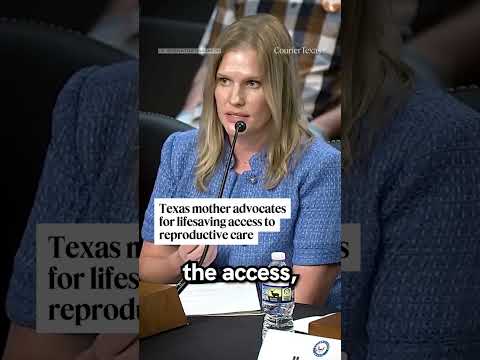
It was shortly after giving birth to her daughter that Kash's doctor told her that they were struggling to remove the remaining placental tissue.
According to the Center for Reproductive Rights:
[Kash] needed a dilation and curettage (D&C) procedure to remove remaining placental tissue, but the hospital had difficulty locating the equipment and staff for the procedure.
While waiting, Kaitlyn’s condition deteriorated, and after vomiting, losing blood, and losing consciousness, she was transferred to the ICU, where she was later told she was lucky she hadn’t lost her uterus.
Kaitlyn still struggles to understand why the hospital had so much trouble providing her with routine postpartum care.
That is indeed the question.
Was it because of the pro-life law or because the hospital was not prepared? A hospital social worker reportedly told Kash before she was discharged that the hospital didn't do D&Cs anymore.
If this off-handed remark from a social worker is true, it was a huge red flag that this hospital, Ascension Seton Medical Center, or at least its administration, did not understand that Texas does not prohibit D&C procedures. In fact, no state law does.
Texas law prohibits using a D&C only if used to intentionally kill a preborn child. Using a D&C to intentionally kill equals abortion. Using a D&C to remove retained placental tissue does not equal an abortion.
Yet, Kash told Congress:
"When politicians get to decide what healthcare is moral and immoral, every woman you have ever loved is put at risk."
Intentional killing cannot reasonably be considered "health care," but it can be reasonably considered "immoral" to commit such an act. A D&C is not 'an abortion'; it's a procedure used to clear the uterus. The procedure itself is neither moral nor immoral.
But it is possible for a D&C to be used immorally to intentionally kill preborn human beings.
That is what pro-life politicians in Texas have determined to be immoral — the killing innocent human beings in the womb. D&C procedures may be used for diagnosis and treatments that do not involve intentional killing, such as treatment for miscarriage and uterine polyps.
Kash continued:
As I lay there holding my baby on my chest, my doctor informed me that my placenta was not delivering. I needed a D&C, a procedure used to clear tissue from the uterus.
And yes, it is also used in abortions, and I needed it quickly.
Fifty minutes after my daughter's birth, I started violently throwing up and shaking, still in the delivery room, waiting to go to the OR. When they finally took me back, I remember [hearing] rushing and shouting. I lost consciousness as I went into hemorrhagic shock.
My records indicate that we were finally able to start my procedure one hour and 59 minutes after my daughter's birth. When I woke up, I had lost half of my blood and I was told that I'm lucky I still had my uterus.
Instead of spending my daughter's first night in the world with her, I was in an ICU bed while a nurse cared for my baby three floors away.
This is inarguably a horrible experience.
Retained placental tissue must be removed quickly, according to research. One study found that "[u]ntreated, retained placenta is considered the second leading cause of postpartum hemorrhage (PPH)." It also found (emphasis added), "Although retained placenta is an obstetrical complication encountered relatively infrequently on the labor and delivery floor, recognizing patient risk factors and understanding management are important steps in mitigating this morbidity."
So was Kash's care delayed due to the law, due to a medical team's lack of preparedness, due to a media blitz spreading confusion about the law, or even due to advertising carried out by pro-abortion groups? Accounts like this are told by women across the country, even in pro-abortion states, because it isn't due to pro-life laws; it's often due to negligence. Again, a D&C is not in and of itself an abortion, and Texas does not prohibit D&Cs. Texas prohibits induced abortions.
Kash went on to say:
"After attempting to get answers on what had gone wrong, a hospital social worker listened to my account. When I got to the part about the D&C, she interrupted and plainly stated, 'Well, we don't do those procedures anymore.' That one sentence said everything. This delay wasn't chaos; it was policy.
You do not know the healthcare you need until you need it. You can be against abortion for yourself. You can never choose it, but you cannot restrict access to a category of medical care without consequences that reach every pregnant person in this country...
These states' bans are forcing unimaginable pain and pushing hundreds of thousands of women into impossible situations they never saw coming. Trust me, I never saw it either."
There's no reason that Ascension Seton shouldn't or couldn't carry out D&C procedures that do not intentionally kill preborn children.
In 2024, the hospital released a statement written by the Catholic Health Association of the United States (CHA), saying:
... Catholic health care providers do not perform elective abortions and remain committed to protecting and upholding the dignity of every human life..." It added, "... Catholic hospitals in the United States are held to the exact same clinical standards of care and adhere to the same policies as every other hospital in the country."
... Catholic medical providers ... care for pregnant women follow guidelines set forth by the American College of Obstetricians and Gynecologists (ACOG). ... [T]here is nothing in the ERDs [ethical and religious directives] that prohibits a Catholic health care provider from providing medically indicated care to a woman who is suffering from serious or life-threatening conditions during pregnancy.
Kash claims the delay in her care was due to "policy." But the Center for Reproductive Rights didn't say this when it shared Kash's story.
It said that the hospital had difficulty finding the staff and the equipment to carry out the D&C.
Even if the hospital thought it couldn't legally carry out a D&C, why would it fail to prepare for the inevitable serious emergency?
The story Kash told Congress had nothing to do with abortion, but there's a reason that either she or the Center for Reproductive Rights chose it as the story to share.
It's the one most likely to convince well-intended people that abortion must remain legal because this type of emergency could happen to any woman.
It is something that is out of their hands — not like choosing abortion for a fetal diagnosis, which is a decision Kash also made.
According to the Center for Reproductive Rights, when Kash was pregnant with her second child, she learned at 13 weeks that her baby had severe skeletal dysplasia and was "unlikely to survive until birth or would suffocate soon after being born," likely because it can cause issues with lung development. There are 450 genetic conditions that are classified as skeletal dysplasia, ranging from mild to severe.
Kash wanted to know her options, and she was told to seek a second opinion "outside Texas." She traveled to Kansas to have an abortion. It's unclear why she didn't share this story with Congress, other than that it may have happened before Roe was overturned.
It's important to note that one of the 'established risk factors' for retained placental tissue is a previous abortion.
Kash became pregnant again, but miscarried at seven weeks and was prescribed "a medication to help her pass" the baby, but because the drug is also used for chemical abortion, she said she "struggled to find a pharmacy to fill the prescription."
It is unclear which drug is being referenced here. But if this is referring to mifepristone, then difficulty in finding a pharmacy to fill would be is unsurprising because a pharmacy has to be specifically certified to carry it. According to the FDA, "Mifepristone may only be dispensed by or under the supervision of a certified prescriber, or by a certified pharmacy on a prescription issued by a certified prescriber. To become certified to dispense mifepristone, pharmacies must complete a Pharmacy Agreement Form."
If they are talking about misoprostol, it is unclear why it would have been difficult to get the medication.
After another miscarriage, Kash became pregnant with her daughter.
In a Facebook post, the Center for Reproductive Rights claimed,:
"Kaitlyn Kash's experience illustrates how abortion bans can affect far more than abortion care itself. When she needed a routine D&C procedure to remove retained placental tissue, delays in accessing care landed her in the ICU.
These are the consequences medical experts have warned about for years. Pregnancy, miscarriage, and postpartum recovery can all require urgent medical intervention, and patients depend on providers being able to act quickly when complications arise.
But when abortion bans create confusion, fear, and legal risk around standard medical procedures, patients can face dangerous delays in care."
Laws to protect preborn children from being intentionally killed would not interfere with prenatal and postnatal care if mass confusion weren't being spread through pro-abortion groups and media.
It is actually quite simple: If an act is being carried out to kill a preborn child or ensure a baby is not born alive, it is an induced abortion and is prohibited by pro-life laws.
If the intent is not to kill the baby, it is not an abortion.
Live Action News is pro-life news and commentary from a pro-life perspective.
Our work is possible because of our donors. Please consider giving to further our work of changing hearts and minds on issues of life and human dignity.
Contact editor@liveaction.org for questions, corrections, or if you are seeking permission to reprint any Live Action News content.
Guest Articles: To submit a guest article to Live Action News, email editor@liveaction.org with an attached Word document of 800-1000 words. Please also attach any photos relevant to your submission if applicable. If your submission is accepted for publication, you will be notified within three weeks. Guest articles are not compensated (see our Open License Agreement). Thank you for your interest in Live Action News!
Bridget Sielicki
·
Fact Checks
Cassy Cooke
·
Fact Checks
Nancy Flanders
·
Pop Culture
Nancy Flanders
·
Fact Checks
Carole Novielli
·
Fact Checks
Kelli Keane
·
Politics
Nancy Flanders
·
International
Nancy Flanders
·
Issues
Nancy Flanders
·
Politics
Nancy Flanders
·
International
Nancy Flanders
·Woman shares story of live birth and negligent care to promote abortion
In an effort to advocate for legalized induced abortion, a mother named Kaitlyn Kash went before Congress to share her horrific and traumatic birth story. And that's what her story was — a birth story, not an abortion story. But it appears that the pro-abortion goal of telling these heartbreaking and frightening stories is to exploit negligent medical care and traumatic circumstances to push for laws that allow preborn human beings to be actively and intentionally killed.
Is the abortion advocates' fight truly about saving women, or about broadly legalizing the intentional killing of preborn babies, in any and all circumstances?
Kaitlyn Kash shared testimony with Congress claiming that because of pro-life laws, she had difficulty getting a D&C immediately after the birth of her daughter.
However, the Center for Reproductive Rights stated that "the hospital had difficulty locating the equipment and staff for the procedure." It hasn't been specified as to why this was the case.
A hospital social worker reportedly told Kash the hospital "[doesn't] do those procedures anymore."
Based on Texas law, there's no reason why any hospital shouldn't or couldn't carry out D&C procedures that do not intentionally kill preborn children.
Laws to protect preborn children from being intentionally killed would not interfere with prenatal and postnatal care if mass confusion weren't being spread through pro-abortion groups and media.
Kaitlyn Kash has faced immensely difficult experiences that can change women forever, including a miscarriage, an abortion, and a prenatal diagnosis.
But during the Senate Spotlight Forum, she chose to share a traumatic and frightening experience immediately following her daughter's live birth in 2023, which had nothing to do with abortion or Texas's pro-life law, helping to conflate abortion and actual health care.
It was shortly after giving birth to her daughter that Kash's doctor told her that they were struggling to remove the remaining placental tissue.
According to the Center for Reproductive Rights:
[Kash] needed a dilation and curettage (D&C) procedure to remove remaining placental tissue, but the hospital had difficulty locating the equipment and staff for the procedure.
While waiting, Kaitlyn’s condition deteriorated, and after vomiting, losing blood, and losing consciousness, she was transferred to the ICU, where she was later told she was lucky she hadn’t lost her uterus.
Kaitlyn still struggles to understand why the hospital had so much trouble providing her with routine postpartum care.
That is indeed the question.
Was it because of the pro-life law or because the hospital was not prepared? A hospital social worker reportedly told Kash before she was discharged that the hospital didn't do D&Cs anymore.
If this off-handed remark from a social worker is true, it was a huge red flag that this hospital, Ascension Seton Medical Center, or at least its administration, did not understand that Texas does not prohibit D&C procedures. In fact, no state law does.
Texas law prohibits using a D&C only if used to intentionally kill a preborn child. Using a D&C to intentionally kill equals abortion. Using a D&C to remove retained placental tissue does not equal an abortion.
Yet, Kash told Congress:
"When politicians get to decide what healthcare is moral and immoral, every woman you have ever loved is put at risk."
Intentional killing cannot reasonably be considered "health care," but it can be reasonably considered "immoral" to commit such an act. A D&C is not 'an abortion'; it's a procedure used to clear the uterus. The procedure itself is neither moral nor immoral.
But it is possible for a D&C to be used immorally to intentionally kill preborn human beings.
That is what pro-life politicians in Texas have determined to be immoral — the killing innocent human beings in the womb. D&C procedures may be used for diagnosis and treatments that do not involve intentional killing, such as treatment for miscarriage and uterine polyps.
Kash continued:
As I lay there holding my baby on my chest, my doctor informed me that my placenta was not delivering. I needed a D&C, a procedure used to clear tissue from the uterus.
And yes, it is also used in abortions, and I needed it quickly.
Fifty minutes after my daughter's birth, I started violently throwing up and shaking, still in the delivery room, waiting to go to the OR. When they finally took me back, I remember [hearing] rushing and shouting. I lost consciousness as I went into hemorrhagic shock.
My records indicate that we were finally able to start my procedure one hour and 59 minutes after my daughter's birth. When I woke up, I had lost half of my blood and I was told that I'm lucky I still had my uterus.
Instead of spending my daughter's first night in the world with her, I was in an ICU bed while a nurse cared for my baby three floors away.
This is inarguably a horrible experience.
Retained placental tissue must be removed quickly, according to research. One study found that "[u]ntreated, retained placenta is considered the second leading cause of postpartum hemorrhage (PPH)." It also found (emphasis added), "Although retained placenta is an obstetrical complication encountered relatively infrequently on the labor and delivery floor, recognizing patient risk factors and understanding management are important steps in mitigating this morbidity."
So was Kash's care delayed due to the law, due to a medical team's lack of preparedness, due to a media blitz spreading confusion about the law, or even due to advertising carried out by pro-abortion groups? Accounts like this are told by women across the country, even in pro-abortion states, because it isn't due to pro-life laws; it's often due to negligence. Again, a D&C is not in and of itself an abortion, and Texas does not prohibit D&Cs. Texas prohibits induced abortions.
Kash went on to say:
"After attempting to get answers on what had gone wrong, a hospital social worker listened to my account. When I got to the part about the D&C, she interrupted and plainly stated, 'Well, we don't do those procedures anymore.' That one sentence said everything. This delay wasn't chaos; it was policy.
You do not know the healthcare you need until you need it. You can be against abortion for yourself. You can never choose it, but you cannot restrict access to a category of medical care without consequences that reach every pregnant person in this country...
These states' bans are forcing unimaginable pain and pushing hundreds of thousands of women into impossible situations they never saw coming. Trust me, I never saw it either."
There's no reason that Ascension Seton shouldn't or couldn't carry out D&C procedures that do not intentionally kill preborn children.
In 2024, the hospital released a statement written by the Catholic Health Association of the United States (CHA), saying:
... Catholic health care providers do not perform elective abortions and remain committed to protecting and upholding the dignity of every human life..." It added, "... Catholic hospitals in the United States are held to the exact same clinical standards of care and adhere to the same policies as every other hospital in the country."
... Catholic medical providers ... care for pregnant women follow guidelines set forth by the American College of Obstetricians and Gynecologists (ACOG). ... [T]here is nothing in the ERDs [ethical and religious directives] that prohibits a Catholic health care provider from providing medically indicated care to a woman who is suffering from serious or life-threatening conditions during pregnancy.
Kash claims the delay in her care was due to "policy." But the Center for Reproductive Rights didn't say this when it shared Kash's story.
It said that the hospital had difficulty finding the staff and the equipment to carry out the D&C.
Even if the hospital thought it couldn't legally carry out a D&C, why would it fail to prepare for the inevitable serious emergency?
The story Kash told Congress had nothing to do with abortion, but there's a reason that either she or the Center for Reproductive Rights chose it as the story to share.
It's the one most likely to convince well-intended people that abortion must remain legal because this type of emergency could happen to any woman.
It is something that is out of their hands — not like choosing abortion for a fetal diagnosis, which is a decision Kash also made.
According to the Center for Reproductive Rights, when Kash was pregnant with her second child, she learned at 13 weeks that her baby had severe skeletal dysplasia and was "unlikely to survive until birth or would suffocate soon after being born," likely because it can cause issues with lung development. There are 450 genetic conditions that are classified as skeletal dysplasia, ranging from mild to severe.
Kash wanted to know her options, and she was told to seek a second opinion "outside Texas." She traveled to Kansas to have an abortion. It's unclear why she didn't share this story with Congress, other than that it may have happened before Roe was overturned.
It's important to note that one of the 'established risk factors' for retained placental tissue is a previous abortion.
Kash became pregnant again, but miscarried at seven weeks and was prescribed "a medication to help her pass" the baby, but because the drug is also used for chemical abortion, she said she "struggled to find a pharmacy to fill the prescription."
It is unclear which drug is being referenced here. But if this is referring to mifepristone, then difficulty in finding a pharmacy to fill would be is unsurprising because a pharmacy has to be specifically certified to carry it. According to the FDA, "Mifepristone may only be dispensed by or under the supervision of a certified prescriber, or by a certified pharmacy on a prescription issued by a certified prescriber. To become certified to dispense mifepristone, pharmacies must complete a Pharmacy Agreement Form."
If they are talking about misoprostol, it is unclear why it would have been difficult to get the medication.
After another miscarriage, Kash became pregnant with her daughter.
In a Facebook post, the Center for Reproductive Rights claimed,:
"Kaitlyn Kash's experience illustrates how abortion bans can affect far more than abortion care itself. When she needed a routine D&C procedure to remove retained placental tissue, delays in accessing care landed her in the ICU.
These are the consequences medical experts have warned about for years. Pregnancy, miscarriage, and postpartum recovery can all require urgent medical intervention, and patients depend on providers being able to act quickly when complications arise.
But when abortion bans create confusion, fear, and legal risk around standard medical procedures, patients can face dangerous delays in care."
Laws to protect preborn children from being intentionally killed would not interfere with prenatal and postnatal care if mass confusion weren't being spread through pro-abortion groups and media.
It is actually quite simple: If an act is being carried out to kill a preborn child or ensure a baby is not born alive, it is an induced abortion and is prohibited by pro-life laws.
If the intent is not to kill the baby, it is not an abortion.
Live Action News is pro-life news and commentary from a pro-life perspective.
Our work is possible because of our donors. Please consider giving to further our work of changing hearts and minds on issues of life and human dignity.
Contact editor@liveaction.org for questions, corrections, or if you are seeking permission to reprint any Live Action News content.
Guest Articles: To submit a guest article to Live Action News, email editor@liveaction.org with an attached Word document of 800-1000 words. Please also attach any photos relevant to your submission if applicable. If your submission is accepted for publication, you will be notified within three weeks. Guest articles are not compensated (see our Open License Agreement). Thank you for your interest in Live Action News!
Bridget Sielicki
·Fact Checks
Cassy Cooke
·Fact Checks
Nancy Flanders
·Pop Culture
Nancy Flanders
·Fact Checks
Carole Novielli
·Fact Checks
Kelli Keane
·Politics
Nancy Flanders
·International
Nancy Flanders
·Issues
Nancy Flanders
·Politics
Nancy Flanders
·International
Nancy Flanders
·This is the dumbest sh** ever!! Her healthy baby was already born, so she didn’t need or get an abortion. All this blame on pro-life laws just because of ONE hearsay remark of a social worker supposedly saying “we don’t do this anymore?” So where’s this social worker?? More Show more
Our client, Kaitlyn Kash, said it best: “When politicians get to decide what healthcare is moral and immoral, every woman you have ever loved is put at risk.” This week she shared her story with Congress to remind them just how devastating anti-abortion laws really are.

