 Analysis
Read Next
International
Queensland euthanasia deaths hit record high as officials push for more
Bridget Sielicki
·

James Talarico spars with Catholic professor, claims Bible is 'silent' on abortion
During a town hall discussion with a Catholic professor, James Talarico claimed the Bible is silent on the issue of abortion, while the professor countered that it is not.
Talarico is running for the United States Senate, representing Texas.
He is a Presbyterian seminarian, and claimed in a recent town hall that the Bible is silent on abortion; therefore, Christians can support its legality.
This same claim was repeated by Talarico earlier this year.
The Bible is not silent on abortion, and Christianity has always been pro-life.
During a televised town hall on October 14, Talarico debated Jodi Hunt — a Catholic and executive director of the Neuhoff Institute for Ministry and Evangelization at the University of Dallas — on the issue of abortion. The conversation started when Hunt (after noting the two had a lot in common) specifically asked Talarico about abortion.
"As you know, Catholics, we tend — and I myself included — to be a one-issue voter," she began. "And abortion is a large part of that, and dignity of the human person and natural law."
Hunt noted that, like Talarico, she's a theologian, but claimed they differ because her faith teaches her to respect life even before birth:
"We believe that, at the moment of conception, there's a human life to protect. And so we struggle with the idea that it's the woman's right to choose, because it takes two people to create that being, and the woman is the bearer of that child into the world.
And through co-creation, that child has been created.
So as people, we are to protect that life at all costs. And so, what makes it difficult for us to vote Democrat is that we have this idea that, if you cannot provide policies or support policies that protect the most innocent among us, who is the unborn child, how can we trust that you're going to provide policies to protect the rest of Texans and to promote dignity and human life in that?
So I challenge you on that. And to provide some feedback on how would you convince me, as a Catholic voter, that I can trust you that you would protect the most innocent among us?"
Talarico thanked her for asking the question, and acknowledged that many voters have similar feelings on the issue.
He then tried to argue that, despite supporting abortion, he is still 'pro-life' because he supports policies addressing things like climate change, poverty, and war. He also repeated the debunked claim that the Bible is silent on abortion, insinuating that Christians can support it.
Ultimately, he claimed that, while he and Hunt may come to different conclusions, they have the same moral goal:
"Some of my spiritual heroes, like Pope Francis and Pope Leo, are pro-life, and they are consistently pro-life. They're not just against abortion, but they are against poverty, against climate change, against war.
So I can respect anyone like you who is consistently pro-life, and I actually think there's common ground we can find here.
We may come to different moral and ethical conclusions when it comes to the question of should abortion be legal or not. It sounds like you and I do come to a different conclusion. That's okay. We're both Christians, and the Bible is silent on the issue of abortion.
It means you and I both have to look at different scriptures to try to come to a conclusion. But what I think we can do is actually come together on reducing the number of unplanned pregnancies and the number of abortions, because if we treat this issue as a public health problem and not a culture war problem, then we can actually make progress together."
Hunt immediately countered the core of Talarico's argument:
"I just want to add that the Bible is not silent on abortion. There is the Ten Commandments, thou shall not kill. And as Catholics, we take great insult, I guess, sometimes when it's spouted that way.
But I also want to add, I know I'm up on time, but contraception and age-appropriate thing also, when it comes to Catholic vote, is a very trying thing for us, because we believe the parents are the primary educator of our children.
And so one of the things that we really struggle with is having any government interference with how we educate our children. So I know we're going to agree to disagree on that, but I do appreciate your comments on tending to the life from the womb to the tomb, and I think that's one common ground we can come to."
In June, Talarico made near-identical statements, claiming the Bible does not condemn abortion. He also claimed that Jesus Himself did not speak against abortion, insinuating that He therefore would have supported its legalization:
"I trust Texas women to make decisions about their own bodies, to shape their own destinies in consultation with their family members, their doctors, their faith leaders. I don't believe that's a place for government. I don't believe it's a place for politicians. I don't believe it's a place for the state. And that's a belief I hold not despite my faith, but because of my faith.
Jesus never talks about abortion. The Bible is silent on abortion. And when that happens with a social issue as important as abortion, we Christians have to take Scripture as a whole. And we've got to try to make some kind of ethical determination."
Pro-life leaders roundly condemned his remarks at the time, with Live Action founder and president Lila Rose tweeting, “'Jesus never talked about infanticide, so it must be ok.' It is sick and shameful to use Jesus Christ as an excuse for politically supporting the killing of unborn children."
The Catholic Church is staunchly pro-life, and always has been. According to the Catechism, "Since the first century the Church has affirmed the moral evil of every procured abortion. This teaching has not changed and remains unchangeable. Direct abortion, that is to say, abortion willed either as an end or a means, is gravely contrary to the moral law."
The Didache, the Teaching Through the Twelve Apostles, is one of the earliest known Christian documents, and also speaks against abortion, saying, "You shall not murder a child by abortion nor kill a child once born.”
But to directly rebut Talarico's point, the Bible itself is also not silent on abortion.
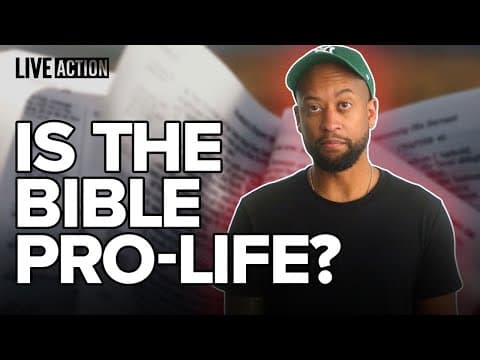
The Bible makes it clear that God became human in the person of Jesus Christ at the moment of conception (fertilization) — not at birth, but at the exact moment when Jesus was conceived by the Holy Spirit inside Mary, His mother.
Luke’s gospel further reiterates this point. During the visitation, when Mary visits her cousin Elizabeth, both women are pregnant. When Elizabeth hears Mary’s greeting, Luke wrote that John the Baptist leaped in [his mother’s] womb, Elizabeth was filled with the Holy Spirit, and addressed the preborn Jesus as "My Lord":
And she cried out with a loud voice and said, ‘Blessed are you among women, and blessed is the fruit of your womb! And how has it happened to me, that the mother of my Lord would come to me? For behold, when the sound of your greeting reached my ears, the baby leaped in my womb for joy.'
In that scripture, the Greek word “brephos” is used for “baby” and “infant," with this term used elsewhere in the Bible to refer to both preborn and born children, insinuating that the two are seen and identified the same way.
The Old Testament also refers to children as being “conceived and born." There are numerous examples, including Eve having conceived and born Cain, and Sarah having conceived and born a son (Isaac) to Abraham.
The Bible continues to acknowledge the humanity of preborn children; one example is Isaac’s children, Jacob and Esau, who are described as struggling together in Rebekah’s womb, with God saying, “[T]wo nations are in your womb.”
In the book of Judges, God instructs a Samson’s mother not to eat certain foods, because Samson was to be “a Nazarite of God from the womb.” Samson had not yet been born, and yet was already living with the dietary restrictions that were part of a Nazarite’s special declaration to God.
Multiple well-known Bible verses further point to the humanity of the preborn:
“Before I formed you in the womb I knew you, and before you were born I consecrated you.” (Jeremiah 1: 5)
"For you created my inmost being; you knit me together in my mother’s womb. I praise you because I am fearfully and wonderfully made; your works are wonderful, I know that full well." (Psalm 139: 13-14)
"Before I was born the Lord called me; from my mother’s womb he has spoken my name. He made my mouth like a sharpened sword, in the shadow of his hand he hid me; he made me into a polished arrow and concealed me in his quiver. He said to me, “You are my servant, Israel, in whom I will display my splendor.” (Isaiah 49: 2-4)
"But when God, who set me apart from my mother’s womb and called me by his grace, was pleased." (Galatians 1: 15)
Through all of this, it is clear that the Bible sees preborn children as living human beings, and therefore, the commandment "You shall not murder" applies to them as well — as Hunt pointed out.
Jesus spoke against murder in Matthew 19:18, and as explained about the word "brephos," the condemnation of murder would apply equally to born and preborn children. In Matthew 15:19 -20, He emphasized that murder is an "evil thought" that will “defile a person.” In Matthew 5:21-22, He also said that murderers “will be liable to judgment.”
Christianity, and by extension, the Bible, is not silent about abortion. It has always been clear that it is never acceptable to take innocent lives, whether born or preborn.
Live Action News is pro-life news and commentary from a pro-life perspective.
Our work is possible because of our donors. Please consider giving to further our work of changing hearts and minds on issues of life and human dignity.
Contact editor@liveaction.org for questions, corrections, or if you are seeking permission to reprint any Live Action News content.
Guest Articles: To submit a guest article to Live Action News, email editor@liveaction.org with an attached Word document of 800-1000 words. Please also attach any photos relevant to your submission if applicable. If your submission is accepted for publication, you will be notified within three weeks. Guest articles are not compensated (see our Open License Agreement). Thank you for your interest in Live Action News!
Bridget Sielicki
·
Analysis
Bridget Sielicki
·
Analysis
Cassy Cooke
·
Fact Checks
Nancy Flanders
·
Analysis
Angeline Tan
·
Analysis
Bridget Sielicki
·
Issues
Cassy Cooke
·
Investigative
Cassy Cooke
·Analysis
Cassy Cooke
·
International
Cassy Cooke
·
Human Interest
Cassy Cooke
·James Talarico spars with Catholic professor, claims Bible is 'silent' on abortion
During a town hall discussion with a Catholic professor, James Talarico claimed the Bible is silent on the issue of abortion, while the professor countered that it is not.
Talarico is running for the United States Senate, representing Texas.
He is a Presbyterian seminarian, and claimed in a recent town hall that the Bible is silent on abortion; therefore, Christians can support its legality.
This same claim was repeated by Talarico earlier this year.
The Bible is not silent on abortion, and Christianity has always been pro-life.
During a televised town hall on October 14, Talarico debated Jodi Hunt — a Catholic and executive director of the Neuhoff Institute for Ministry and Evangelization at the University of Dallas — on the issue of abortion. The conversation started when Hunt (after noting the two had a lot in common) specifically asked Talarico about abortion.
"As you know, Catholics, we tend — and I myself included — to be a one-issue voter," she began. "And abortion is a large part of that, and dignity of the human person and natural law."
Hunt noted that, like Talarico, she's a theologian, but claimed they differ because her faith teaches her to respect life even before birth:
"We believe that, at the moment of conception, there's a human life to protect. And so we struggle with the idea that it's the woman's right to choose, because it takes two people to create that being, and the woman is the bearer of that child into the world.
And through co-creation, that child has been created.
So as people, we are to protect that life at all costs. And so, what makes it difficult for us to vote Democrat is that we have this idea that, if you cannot provide policies or support policies that protect the most innocent among us, who is the unborn child, how can we trust that you're going to provide policies to protect the rest of Texans and to promote dignity and human life in that?
So I challenge you on that. And to provide some feedback on how would you convince me, as a Catholic voter, that I can trust you that you would protect the most innocent among us?"
Talarico thanked her for asking the question, and acknowledged that many voters have similar feelings on the issue.
He then tried to argue that, despite supporting abortion, he is still 'pro-life' because he supports policies addressing things like climate change, poverty, and war. He also repeated the debunked claim that the Bible is silent on abortion, insinuating that Christians can support it.
Ultimately, he claimed that, while he and Hunt may come to different conclusions, they have the same moral goal:
"Some of my spiritual heroes, like Pope Francis and Pope Leo, are pro-life, and they are consistently pro-life. They're not just against abortion, but they are against poverty, against climate change, against war.
So I can respect anyone like you who is consistently pro-life, and I actually think there's common ground we can find here.
We may come to different moral and ethical conclusions when it comes to the question of should abortion be legal or not. It sounds like you and I do come to a different conclusion. That's okay. We're both Christians, and the Bible is silent on the issue of abortion.
It means you and I both have to look at different scriptures to try to come to a conclusion. But what I think we can do is actually come together on reducing the number of unplanned pregnancies and the number of abortions, because if we treat this issue as a public health problem and not a culture war problem, then we can actually make progress together."
Hunt immediately countered the core of Talarico's argument:
"I just want to add that the Bible is not silent on abortion. There is the Ten Commandments, thou shall not kill. And as Catholics, we take great insult, I guess, sometimes when it's spouted that way.
But I also want to add, I know I'm up on time, but contraception and age-appropriate thing also, when it comes to Catholic vote, is a very trying thing for us, because we believe the parents are the primary educator of our children.
And so one of the things that we really struggle with is having any government interference with how we educate our children. So I know we're going to agree to disagree on that, but I do appreciate your comments on tending to the life from the womb to the tomb, and I think that's one common ground we can come to."
In June, Talarico made near-identical statements, claiming the Bible does not condemn abortion. He also claimed that Jesus Himself did not speak against abortion, insinuating that He therefore would have supported its legalization:
"I trust Texas women to make decisions about their own bodies, to shape their own destinies in consultation with their family members, their doctors, their faith leaders. I don't believe that's a place for government. I don't believe it's a place for politicians. I don't believe it's a place for the state. And that's a belief I hold not despite my faith, but because of my faith.
Jesus never talks about abortion. The Bible is silent on abortion. And when that happens with a social issue as important as abortion, we Christians have to take Scripture as a whole. And we've got to try to make some kind of ethical determination."
Pro-life leaders roundly condemned his remarks at the time, with Live Action founder and president Lila Rose tweeting, “'Jesus never talked about infanticide, so it must be ok.' It is sick and shameful to use Jesus Christ as an excuse for politically supporting the killing of unborn children."
The Catholic Church is staunchly pro-life, and always has been. According to the Catechism, "Since the first century the Church has affirmed the moral evil of every procured abortion. This teaching has not changed and remains unchangeable. Direct abortion, that is to say, abortion willed either as an end or a means, is gravely contrary to the moral law."
The Didache, the Teaching Through the Twelve Apostles, is one of the earliest known Christian documents, and also speaks against abortion, saying, "You shall not murder a child by abortion nor kill a child once born.”
But to directly rebut Talarico's point, the Bible itself is also not silent on abortion.
The Bible makes it clear that God became human in the person of Jesus Christ at the moment of conception (fertilization) — not at birth, but at the exact moment when Jesus was conceived by the Holy Spirit inside Mary, His mother.
Luke’s gospel further reiterates this point. During the visitation, when Mary visits her cousin Elizabeth, both women are pregnant. When Elizabeth hears Mary’s greeting, Luke wrote that John the Baptist leaped in [his mother’s] womb, Elizabeth was filled with the Holy Spirit, and addressed the preborn Jesus as "My Lord":
And she cried out with a loud voice and said, ‘Blessed are you among women, and blessed is the fruit of your womb! And how has it happened to me, that the mother of my Lord would come to me? For behold, when the sound of your greeting reached my ears, the baby leaped in my womb for joy.'
In that scripture, the Greek word “brephos” is used for “baby” and “infant," with this term used elsewhere in the Bible to refer to both preborn and born children, insinuating that the two are seen and identified the same way.
The Old Testament also refers to children as being “conceived and born." There are numerous examples, including Eve having conceived and born Cain, and Sarah having conceived and born a son (Isaac) to Abraham.
The Bible continues to acknowledge the humanity of preborn children; one example is Isaac’s children, Jacob and Esau, who are described as struggling together in Rebekah’s womb, with God saying, “[T]wo nations are in your womb.”
In the book of Judges, God instructs a Samson’s mother not to eat certain foods, because Samson was to be “a Nazarite of God from the womb.” Samson had not yet been born, and yet was already living with the dietary restrictions that were part of a Nazarite’s special declaration to God.
Multiple well-known Bible verses further point to the humanity of the preborn:
“Before I formed you in the womb I knew you, and before you were born I consecrated you.” (Jeremiah 1: 5)
"For you created my inmost being; you knit me together in my mother’s womb. I praise you because I am fearfully and wonderfully made; your works are wonderful, I know that full well." (Psalm 139: 13-14)
"Before I was born the Lord called me; from my mother’s womb he has spoken my name. He made my mouth like a sharpened sword, in the shadow of his hand he hid me; he made me into a polished arrow and concealed me in his quiver. He said to me, “You are my servant, Israel, in whom I will display my splendor.” (Isaiah 49: 2-4)
"But when God, who set me apart from my mother’s womb and called me by his grace, was pleased." (Galatians 1: 15)
Through all of this, it is clear that the Bible sees preborn children as living human beings, and therefore, the commandment "You shall not murder" applies to them as well — as Hunt pointed out.
Jesus spoke against murder in Matthew 19:18, and as explained about the word "brephos," the condemnation of murder would apply equally to born and preborn children. In Matthew 15:19 -20, He emphasized that murder is an "evil thought" that will “defile a person.” In Matthew 5:21-22, He also said that murderers “will be liable to judgment.”
Christianity, and by extension, the Bible, is not silent about abortion. It has always been clear that it is never acceptable to take innocent lives, whether born or preborn.
Live Action News is pro-life news and commentary from a pro-life perspective.
Our work is possible because of our donors. Please consider giving to further our work of changing hearts and minds on issues of life and human dignity.
Contact editor@liveaction.org for questions, corrections, or if you are seeking permission to reprint any Live Action News content.
Guest Articles: To submit a guest article to Live Action News, email editor@liveaction.org with an attached Word document of 800-1000 words. Please also attach any photos relevant to your submission if applicable. If your submission is accepted for publication, you will be notified within three weeks. Guest articles are not compensated (see our Open License Agreement). Thank you for your interest in Live Action News!
Bridget Sielicki
·Analysis
Bridget Sielicki
·Analysis
Cassy Cooke
·Fact Checks
Nancy Flanders
·Analysis
Angeline Tan
·Analysis
Bridget Sielicki
·Issues
Cassy Cooke
·Investigative
Cassy Cooke
·Analysis
Cassy Cooke
·International
Cassy Cooke
·Human Interest
Cassy Cooke
·Talarico proved unpersuasive to a Catholic theological professor on abortion.
