 Fact Checks
Read Next
Issues
MAiD practitioner upset that it hasn't been expanded for mental illness
Cassy Cooke
·

She says she's been denied miscarriage care due to state law... but is it true?
A woman in South Carolina claims that doctors are denying her miscarriage care because of the state's law protecting preborn children from abortion, despite the fact that the state's law specifies that treating a miscarriage is not an abortion.
In reality, the reason the woman has not been given a D&C or other treatment is because doctors often wait to carry out such procedures for two distinct reasons — and neither of those reasons has anything to do with the abortion law.
Ashley Brown claims she is experiencing a blighted ovum/anembryonic pregnancy, in which an embryo fails to form in the implanted sac. This is the most common cause of miscarriage in the first trimester.
Brown, however, is blaming South Carolina's pro-life law for the fact that doctors are making her wait to have two follow-up ultrasounds to confirm the diagnosis before they decide on next steps about treating the miscarriage.
This plan is based on the standard of care for this condition, not the state's pro-life law.
South Carolina law does not include miscarriage in its definition of abortion, and therefore, miscarriage care is not restricted in the state; even pro-abortion groups have admitted this.
Ashley Brown's story reached People magazine this week following her June 9th video in which she claims she is being denied miscarriage management amid a 'nonviable pregnancy.' She said her levels of Human chorionic gonadotropin (hCG), which is primarily produced by the placenta during pregnancy, were dropping — a potential sign of miscarriage — and that an ultrasound showed an anembryonic pregnancy (formerly referred to as a blighted ovum). This is described by the Cleveland Clinic as "when a fertilized egg implants into the uterine wall, but the embryo fails to develop."
The gestational sac and the placenta continue to grow, but the embryonic sac is empty. It is the most common cause of first trimester miscarriage.
While some women diagnosed with an anembryonic pregnancy wait for the miscarriage to happen on its own before undergoing treatments, others ask for a D&C procedure or medication to cause the body to complete the miscarriage.
In some cases, however, doctors have found that it was too early in pregnancy to see the embryo on an ultrasound, and then a follow-up ultrasound showed that the baby was alive and growing.
Brown insists that she is indeed experiencing an anembryonic pregnancy based on her dropping hCG levels and the opinion of at least two doctors.
Following a video in which she noted that she has had five previous miscarriages, she discussed her nausea and cravings at six weeks. At that time, Brown said her hCG level was high and that she was having an ultrasound a week later.
A update in the next video on June 6 revealed that her hCG number "did not even double in seven days" despite an early increase. "It does not look like this pregnancy seems to be viable," she said tearfully. "... I don't really have any explanation for it other than a not viable pregnancy." She also said they had learned the gender of the baby the day before.
After experiencing some pain on her right side, she then requested an ultrasound, but the doctor said she thought her hCG numbers were fine and were what they should be for six weeks. But Brown was worried she was having an ectopic pregnancy, so she went to the ER, where she underwent a transvaginal ultrasound and abdominal ultrasound.
She was told her hCG number had dropped, and that she had an empty sac, no yolk sac, and there was no heartbeat — an anembryonic pregnancy — and that her pain was caused by a hemorrhage next to the sac. The dating of the pregnancy showed her to be a week behind where she should be. She then said she was "denied a medical abortion" and was told to have a follow up ultrasound in a week with her OB:
"He goes, 'Yeah it looks like it's not a viable pregnancy. Your HCG is dropping. It's impossible for you to be a week behind and there's an empty sac and at five weeks and four days, if it was a viable pregnancy, we'd at least be seeing like a yolk sac and a fetal pole, so I agree, not viable, right?.' 'So okay great, you agree it's not viable.'
'I don't want to see my empty sac in a week. Can we do a D&C, give me a pill, something to help me pass it? I'm going on vacation next week. I do not want the trauma of having a miscarriage while I'm on vacation with my family.' He didn't even say, 'I'm sorry.' He said, 'No, unfortunately the law says in South Carolina that we have to go by the ultrasound and the ultrasound recommendation is a followup in a week.' I also have to have counseling."
This, however, is not unusual. Emergency rooms do not typically provide miscarriage management. They usually refer women to an OB/GYN, as they did in Brown's case. A single hCG test or ultrasound is often not enough to confirm a miscarriage. The one-week follow-up with her OB would have helped to confirm this.
Brown went for a second opinion, and that OB allegedly said she would need two more weekly scans before she could undergo a D&C.
Then, in a video on June 13, Brown said:
"Come with me to see my dead baby to make sure it's really dead. No, you did not hear me wrong. I really said that because my baby died in me almost two weeks ago but we have to make sure its really dead two more times before they'll help me remove it because my body's not doing that by itself.
If you're thinking, 'Well that sounds wrong,' you would be right. Law says I have to have two more scans before they'll help me remove it."
But South Carolina's abortion law does not say this. The call to have her undergo follow-up ultrasounds is based on pregnancy- and miscarriage-related standards of care.
Ultimately, the first follow-up ultrasound did show a yolk sac, yet her hCG was still dropping. She said she was told that doctors knew the pregnancy was 'not viable' but that she had to wait '11 more days' to have another ultrasound.
In a YouTube video regarding 'blighted ovums,' including what causes them, how they are diagnosed, and how they are treated, Dr. Lora Shahine explained, "We often offer just a follow up ultrasound to sort of say maybe its just a little slow developing, maybe we just give it a little bit more time and we might see a a yolk sac the next time you come in. ... maybe you actually ovulated later than you thought...."
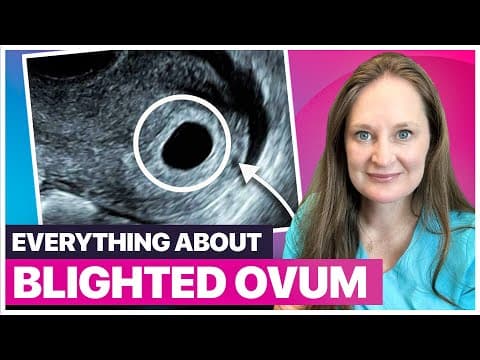
She added:
"So it can be so frustrating to be pregnant, highly desired pregnancy, and you go in to get an ultrasound. You want that reassurance that everything's OK, and be told, 'Gosh we're not sure. we need to follow up with more blood test or another ultrasound to really help you figure out what's going on' and I know that is such a difficult situation to be in but when you are really wanting to build your family and it seems like the right thing to do sometimes just waiting to be 100% sure it is the right thing."
Again, this 'watch and wait' approach is not due to the state's pro-life law. It's standard of care that was in place even when Roe v. Wade was in effect.
No one is denying that miscarriage is traumatic. But South Carolina's Fetal Heartbeat and Protection from Abortion Act does not prevent miscarriage care.
The law defines abortion as (emphasis added):
[T]he act of using or prescribing any instrument, medicine, drug, or any other substance, device, or means with the intent to terminate the clinically diagnosable pregnancy of a woman with knowledge that the termination by those means will, with reasonable likelihood, cause the death of the unborn child. Such use, prescription, or means is not an abortion if done with the intent to save the life or preserve the health of the unborn child, or to remove a dead unborn child.
In other words, the state law makes it clear that abortion does not include any action taken to remove a dead preborn child, whether it be by a D&C or a drug like misoprostol.
In addition to excluding miscarriage treatment from the definition of abortion, the law also states that an abortion can be carried out when necessary "to prevent death or serious risk of a substantial and irreversible physical impairment of a major bodily function, not including psychological or emotional conditions." And it also lists which "medical conditions constitute a risk of death or serious risk of a substantial and irreversible physical impairment..." including "blighted ovum..."
There is clearly nothing in the pro-life law that prevents Brown from getting a D&C or taking a drug to cause the body to complete the miscarriage.
Even pro-abortion groups state this, including the Abortion Defense Network which notes (emphasis added), "Medical care for ectopic or molar pregnancies, medical emergencies, miscarriage, pregnancies where the fetus has a fatal anomaly, and pregnancies with no cardiac activity is legal" and "... treatment for miscarriage where there is no cardiac activity (including medications, D&C, D&E, labor induction) is not an abortion under South Carolina law and thus is not prohibited."
Without seeing Brown's medical records, its impossible to fully know what doctors have told her and whether or not doctors are confused about the law, or Brown is confused about what the doctors are telling her.
Either way, it's clear that the state's abortion law allows Brown to undergo miscarriage care and does not consider that care to be an abortion.
In addition, the standard of care for a suspected anembryonic pregnancy or blighted ovum includes multiple repeat ultrasounds.
One reason is because it can be less risky to let nature take its course rather than put a woman through an invasive procedure. However, another reason to wait is that there have been cases in which the baby was younger than expected and on a second or third ultrasound, a heartbeat was detected and doctors realized the mother was not actually miscarrying.
Even if there is a miscarriage happening, according to Baby Center, some "... women will carry the blighted ovum for several weeks."
Baby Center explained:
Because it can be hard to tell the difference between a very early normal pregnancy and a blighted ovum, strict ultrasound criteria must be met before making the diagnosis. In many cases, a follow up ultrasound two weeks later is necessary to confirm the diagnosis.
That "strict ultrasound criteria" includes:
Mean Sac Diameter (MSD) ≥25 mm with no visible embryo
if the initial scan shows a gestational sac but no yolk sac, a diagnosis is confirmed only when no embryo with a heartbeat is seen ≥ 14 days later
if the initial scan shows a gestational sac with a yolk sac, and there is no embryo with a heartbeat is seen ≥ 11 days later, a blighted ovum can be confirmed
If it is indeed an anembryonic pregnancy (blighted ovum), Baby Center noted:
You're very likely to miscarry – that is, to expel the gestational sac and pregnancy tissue – by the end of your first trimester. The miscarriage process can take weeks, though, and once you find out the diagnosis, you may find it's too emotionally wrenching or physically uncomfortable (if you're cramping a lot) to wait for a spontaneous miscarriage.
It noted that there are three options:
watch and wait for the miscarriage to happen naturally while tracking hCG levels and performing a repeat ultrasound seven to 14 days later to see if a yolk sac or heartbeat appear, along with a final scan to confirm the diagnosis
take misoprostol to cause the uterus to contract and essentially force the body to complete the miscarriage
undergo a D&C procedure to clear out the uterus
And it's important to remember that Brown went to an ER, where miscarriage management is often not an offered service.
The law is not preventing Brown from undergoing a D&C or taking misoprostol; the standard of care is. While she is confident that she is miscarrying, doctors appear to be following protocol. If the diagnosis was confirmed, she would likely be given the choice of how to manage her miscarriage based on what her doctor feels is the safest option.
Brown still has a third and final ultrasound planned at which doctors will make the final diagnosis. Live Action News will update this article when further information is available.
Live Action News is pro-life news and commentary from a pro-life perspective.
Our work is possible because of our donors. Please consider giving to further our work of changing hearts and minds on issues of life and human dignity.
Contact editor@liveaction.org for questions, corrections, or if you are seeking permission to reprint any Live Action News content.
Guest Articles: To submit a guest article to Live Action News, email editor@liveaction.org with an attached Word document of 800-1000 words. Please also attach any photos relevant to your submission if applicable. If your submission is accepted for publication, you will be notified within three weeks. Guest articles are not compensated (see our Open License Agreement). Thank you for your interest in Live Action News!
Cassy Cooke
·
Fact Checks
Nancy Flanders
·
Fact Checks
Cassy Cooke
·
Fact Checks
Nancy Flanders
·
Pop Culture
Nancy Flanders
·
Fact Checks
Carole Novielli
·
Politics
Nancy Flanders
·Fact Checks
Nancy Flanders
·
Politics
Nancy Flanders
·
Politics
Nancy Flanders
·
Issues
Nancy Flanders
·She says she's been denied miscarriage care due to state law... but is it true?
A woman in South Carolina claims that doctors are denying her miscarriage care because of the state's law protecting preborn children from abortion, despite the fact that the state's law specifies that treating a miscarriage is not an abortion.
In reality, the reason the woman has not been given a D&C or other treatment is because doctors often wait to carry out such procedures for two distinct reasons — and neither of those reasons has anything to do with the abortion law.
Ashley Brown claims she is experiencing a blighted ovum/anembryonic pregnancy, in which an embryo fails to form in the implanted sac. This is the most common cause of miscarriage in the first trimester.
Brown, however, is blaming South Carolina's pro-life law for the fact that doctors are making her wait to have two follow-up ultrasounds to confirm the diagnosis before they decide on next steps about treating the miscarriage.
This plan is based on the standard of care for this condition, not the state's pro-life law.
South Carolina law does not include miscarriage in its definition of abortion, and therefore, miscarriage care is not restricted in the state; even pro-abortion groups have admitted this.
Ashley Brown's story reached People magazine this week following her June 9th video in which she claims she is being denied miscarriage management amid a 'nonviable pregnancy.' She said her levels of Human chorionic gonadotropin (hCG), which is primarily produced by the placenta during pregnancy, were dropping — a potential sign of miscarriage — and that an ultrasound showed an anembryonic pregnancy (formerly referred to as a blighted ovum). This is described by the Cleveland Clinic as "when a fertilized egg implants into the uterine wall, but the embryo fails to develop."
The gestational sac and the placenta continue to grow, but the embryonic sac is empty. It is the most common cause of first trimester miscarriage.
While some women diagnosed with an anembryonic pregnancy wait for the miscarriage to happen on its own before undergoing treatments, others ask for a D&C procedure or medication to cause the body to complete the miscarriage.
In some cases, however, doctors have found that it was too early in pregnancy to see the embryo on an ultrasound, and then a follow-up ultrasound showed that the baby was alive and growing.
Brown insists that she is indeed experiencing an anembryonic pregnancy based on her dropping hCG levels and the opinion of at least two doctors.
Following a video in which she noted that she has had five previous miscarriages, she discussed her nausea and cravings at six weeks. At that time, Brown said her hCG level was high and that she was having an ultrasound a week later.
A update in the next video on June 6 revealed that her hCG number "did not even double in seven days" despite an early increase. "It does not look like this pregnancy seems to be viable," she said tearfully. "... I don't really have any explanation for it other than a not viable pregnancy." She also said they had learned the gender of the baby the day before.
After experiencing some pain on her right side, she then requested an ultrasound, but the doctor said she thought her hCG numbers were fine and were what they should be for six weeks. But Brown was worried she was having an ectopic pregnancy, so she went to the ER, where she underwent a transvaginal ultrasound and abdominal ultrasound.
She was told her hCG number had dropped, and that she had an empty sac, no yolk sac, and there was no heartbeat — an anembryonic pregnancy — and that her pain was caused by a hemorrhage next to the sac. The dating of the pregnancy showed her to be a week behind where she should be. She then said she was "denied a medical abortion" and was told to have a follow up ultrasound in a week with her OB:
"He goes, 'Yeah it looks like it's not a viable pregnancy. Your HCG is dropping. It's impossible for you to be a week behind and there's an empty sac and at five weeks and four days, if it was a viable pregnancy, we'd at least be seeing like a yolk sac and a fetal pole, so I agree, not viable, right?.' 'So okay great, you agree it's not viable.'
'I don't want to see my empty sac in a week. Can we do a D&C, give me a pill, something to help me pass it? I'm going on vacation next week. I do not want the trauma of having a miscarriage while I'm on vacation with my family.' He didn't even say, 'I'm sorry.' He said, 'No, unfortunately the law says in South Carolina that we have to go by the ultrasound and the ultrasound recommendation is a followup in a week.' I also have to have counseling."
This, however, is not unusual. Emergency rooms do not typically provide miscarriage management. They usually refer women to an OB/GYN, as they did in Brown's case. A single hCG test or ultrasound is often not enough to confirm a miscarriage. The one-week follow-up with her OB would have helped to confirm this.
Brown went for a second opinion, and that OB allegedly said she would need two more weekly scans before she could undergo a D&C.
Then, in a video on June 13, Brown said:
"Come with me to see my dead baby to make sure it's really dead. No, you did not hear me wrong. I really said that because my baby died in me almost two weeks ago but we have to make sure its really dead two more times before they'll help me remove it because my body's not doing that by itself.
If you're thinking, 'Well that sounds wrong,' you would be right. Law says I have to have two more scans before they'll help me remove it."
But South Carolina's abortion law does not say this. The call to have her undergo follow-up ultrasounds is based on pregnancy- and miscarriage-related standards of care.
Ultimately, the first follow-up ultrasound did show a yolk sac, yet her hCG was still dropping. She said she was told that doctors knew the pregnancy was 'not viable' but that she had to wait '11 more days' to have another ultrasound.
In a YouTube video regarding 'blighted ovums,' including what causes them, how they are diagnosed, and how they are treated, Dr. Lora Shahine explained, "We often offer just a follow up ultrasound to sort of say maybe its just a little slow developing, maybe we just give it a little bit more time and we might see a a yolk sac the next time you come in. ... maybe you actually ovulated later than you thought...."
She added:
"So it can be so frustrating to be pregnant, highly desired pregnancy, and you go in to get an ultrasound. You want that reassurance that everything's OK, and be told, 'Gosh we're not sure. we need to follow up with more blood test or another ultrasound to really help you figure out what's going on' and I know that is such a difficult situation to be in but when you are really wanting to build your family and it seems like the right thing to do sometimes just waiting to be 100% sure it is the right thing."
Again, this 'watch and wait' approach is not due to the state's pro-life law. It's standard of care that was in place even when Roe v. Wade was in effect.
No one is denying that miscarriage is traumatic. But South Carolina's Fetal Heartbeat and Protection from Abortion Act does not prevent miscarriage care.
The law defines abortion as (emphasis added):
[T]he act of using or prescribing any instrument, medicine, drug, or any other substance, device, or means with the intent to terminate the clinically diagnosable pregnancy of a woman with knowledge that the termination by those means will, with reasonable likelihood, cause the death of the unborn child. Such use, prescription, or means is not an abortion if done with the intent to save the life or preserve the health of the unborn child, or to remove a dead unborn child.
In other words, the state law makes it clear that abortion does not include any action taken to remove a dead preborn child, whether it be by a D&C or a drug like misoprostol.
In addition to excluding miscarriage treatment from the definition of abortion, the law also states that an abortion can be carried out when necessary "to prevent death or serious risk of a substantial and irreversible physical impairment of a major bodily function, not including psychological or emotional conditions." And it also lists which "medical conditions constitute a risk of death or serious risk of a substantial and irreversible physical impairment..." including "blighted ovum..."
There is clearly nothing in the pro-life law that prevents Brown from getting a D&C or taking a drug to cause the body to complete the miscarriage.
Even pro-abortion groups state this, including the Abortion Defense Network which notes (emphasis added), "Medical care for ectopic or molar pregnancies, medical emergencies, miscarriage, pregnancies where the fetus has a fatal anomaly, and pregnancies with no cardiac activity is legal" and "... treatment for miscarriage where there is no cardiac activity (including medications, D&C, D&E, labor induction) is not an abortion under South Carolina law and thus is not prohibited."
Without seeing Brown's medical records, its impossible to fully know what doctors have told her and whether or not doctors are confused about the law, or Brown is confused about what the doctors are telling her.
Either way, it's clear that the state's abortion law allows Brown to undergo miscarriage care and does not consider that care to be an abortion.
In addition, the standard of care for a suspected anembryonic pregnancy or blighted ovum includes multiple repeat ultrasounds.
One reason is because it can be less risky to let nature take its course rather than put a woman through an invasive procedure. However, another reason to wait is that there have been cases in which the baby was younger than expected and on a second or third ultrasound, a heartbeat was detected and doctors realized the mother was not actually miscarrying.
Even if there is a miscarriage happening, according to Baby Center, some "... women will carry the blighted ovum for several weeks."
Baby Center explained:
Because it can be hard to tell the difference between a very early normal pregnancy and a blighted ovum, strict ultrasound criteria must be met before making the diagnosis. In many cases, a follow up ultrasound two weeks later is necessary to confirm the diagnosis.
That "strict ultrasound criteria" includes:
Mean Sac Diameter (MSD) ≥25 mm with no visible embryo
if the initial scan shows a gestational sac but no yolk sac, a diagnosis is confirmed only when no embryo with a heartbeat is seen ≥ 14 days later
if the initial scan shows a gestational sac with a yolk sac, and there is no embryo with a heartbeat is seen ≥ 11 days later, a blighted ovum can be confirmed
If it is indeed an anembryonic pregnancy (blighted ovum), Baby Center noted:
You're very likely to miscarry – that is, to expel the gestational sac and pregnancy tissue – by the end of your first trimester. The miscarriage process can take weeks, though, and once you find out the diagnosis, you may find it's too emotionally wrenching or physically uncomfortable (if you're cramping a lot) to wait for a spontaneous miscarriage.
It noted that there are three options:
watch and wait for the miscarriage to happen naturally while tracking hCG levels and performing a repeat ultrasound seven to 14 days later to see if a yolk sac or heartbeat appear, along with a final scan to confirm the diagnosis
take misoprostol to cause the uterus to contract and essentially force the body to complete the miscarriage
undergo a D&C procedure to clear out the uterus
And it's important to remember that Brown went to an ER, where miscarriage management is often not an offered service.
The law is not preventing Brown from undergoing a D&C or taking misoprostol; the standard of care is. While she is confident that she is miscarrying, doctors appear to be following protocol. If the diagnosis was confirmed, she would likely be given the choice of how to manage her miscarriage based on what her doctor feels is the safest option.
Brown still has a third and final ultrasound planned at which doctors will make the final diagnosis. Live Action News will update this article when further information is available.
Live Action News is pro-life news and commentary from a pro-life perspective.
Our work is possible because of our donors. Please consider giving to further our work of changing hearts and minds on issues of life and human dignity.
Contact editor@liveaction.org for questions, corrections, or if you are seeking permission to reprint any Live Action News content.
Guest Articles: To submit a guest article to Live Action News, email editor@liveaction.org with an attached Word document of 800-1000 words. Please also attach any photos relevant to your submission if applicable. If your submission is accepted for publication, you will be notified within three weeks. Guest articles are not compensated (see our Open License Agreement). Thank you for your interest in Live Action News!
Cassy Cooke
·Fact Checks
Nancy Flanders
·Fact Checks
Cassy Cooke
·Fact Checks
Nancy Flanders
·Pop Culture
Nancy Flanders
·Fact Checks
Carole Novielli
·Politics
Nancy Flanders
·Fact Checks
Nancy Flanders
·Politics
Nancy Flanders
·Politics
Nancy Flanders
·Issues
Nancy Flanders
·