 Newsbreak
Read Next
International
Canadian campaign hopes to remove mental illness as criteria for 'assisted dying'
Angeline Tan
·
Federal appeals court rules Kentucky dismemberment abortion ban unconstitutional
A federal appeals court has upheld a district court’s ruling that a Kentucky ban on dismemberment abortion is unconstitutional. The Sixth Circuit’s three-judge panel voted 2-1 refusing to reinstate the law which protects preborn children from the violent abortion procedure.
The bill, HB 454, passed the state’s legislature and was signed into law by then-Governor Matt Bevin in 2018. The legislation outlawed surgical dilation and evacuation (D&E) abortions after 13 weeks. The law was immediately appealed by the ACLU on behalf of EMW Women’s Surgical Center, the state’s sole abortion business. In 2019, U.S. District Judge Joseph McKinley overturned the abortion ban, ruling it unconstitutional because it restricts abortion before the preborn child is considered viable. However, D&E abortions are committed up to 24 weeks gestation, and children born as young as 21 weeks can survive with medical assistance.
In his opinion upholding this ruling this week, U.S. Circuit Judge Eric Clay, an appointee under Bill Clinton, argued against the law because it “imposes substantial burdens on the right to choose.”
READ: When two reporters decided to watch a D&E dismemberment abortion, this is what they saw
U.S. Circuit Judge John Bush, the sole dissenter in the ruling, contended that the case should have been dismissed for lack of standing, noting that “not a single person whose constitutional rights are directly impacted by the law is a party to the case.”
The ACLU lauded the ruling. “Two courts have made it resoundingly clear that D&E abortion care is safe, and Kentuckians have a right to access this care,” wrote the organization’s staff attorney Heather Gatnarek.
Despite Gatnarek’s claim that D&E dismemberment abortion is “safe,” the procedure is anything but. The most common form of surgical abortion in the second trimester, it is a gruesome process that can take two days to complete. To commit the procedure, the abortionist first inserts laminaria into the mother’s cervix. The mother returns to the abortion facility one to two days later so that the abortionist can further dilate her cervix and then insert a clamp to rip the baby apart limb by limb, as explained by former abortionist Dr. Anthony Levatino in the video below. For women, risks include perforated uterus, hemorrhaging, and death.
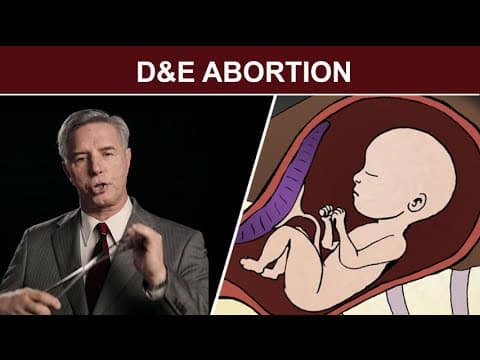
In its argument, the state contended that the intent of the law was to ensure that preborn children did not have to undergo the horrific suffering associated with D&E abortion. With the procedure outlawed, mothers could still choose other methods of abortion. In January, Deputy Solicitor General Matthew Kuhn told the court, “We, Kentucky, can change how abortion procedures are performed to make them more humane,” adding that Ohio has a similar law. “If doctors in Ohio are already doing it, why can’t doctors in Kentucky do it?”
Attorney General Daniel Cameron, who argued the case, expressed his dismay at the ruling. “We’re disappointed with the court’s ruling and will take any steps necessary to continue defending the law, which protects the unborn from a gruesome procedure,” he said.
The state will next weigh its options, which include appealing the ruling with the U.S. Supreme Court or asking for a review among the entire panel of Sixth Circuit judges.
“Like” Live Action News on Facebook for more pro-life news and commentary!
Live Action News is pro-life news and commentary from a pro-life perspective.
Our work is possible because of our donors. Please consider giving to further our work of changing hearts and minds on issues of life and human dignity.
Contact editor@liveaction.org for questions, corrections, or if you are seeking permission to reprint any Live Action News content.
Guest Articles: To submit a guest article to Live Action News, email editor@liveaction.org with an attached Word document of 800-1000 words. Please also attach any photos relevant to your submission if applicable. If your submission is accepted for publication, you will be notified within three weeks. Guest articles are not compensated (see our Open License Agreement). Thank you for your interest in Live Action News!
Angeline Tan
·
Politics
Nancy Flanders
·
International
Angeline Tan
·
Pop Culture
Cassy Cooke
·
International
Angeline Tan
·
Abortion Pill
Cassy Cooke
·
International
Bridget Sielicki
·
Politics
Bridget Sielicki
·
Issues
Bridget Sielicki
·
Human Interest
Bridget Sielicki
·
Media
Bridget Sielicki
·