 Analysis
Read Next
Newsbreak
New report claims cultural shifts prompt decline in US marriage rates
Angeline Tan
·
Fact Check: Woman says she was denied treatment as baby 'poisoned her from inside out'
Self-described "conservative" mom Jess Djukanovic of Iowa recently claimed her life was put at risk because her preborn baby had Trisomy 18 and therefore, her baby was "poisoning [her] from the inside" — a claim not supported by actual, medical fact.
Jess Djukanovic said after her preborn baby was diagnosed with Trisomy 18 at 10 weeks (in the first trimester), her own health began to "rapidly decline." She suffered from chest pain, swelling, fatigue, and kidney issues.
She claimed that despite her symptoms, medical providers refused to treat her.
Djukanovic appeared to blame her child's condition for her own health struggles, which is not supported by any known research, and argued that she should have been able to choose herself over her "dying fetus."
Her husband claimed the "logical step would have been to terminate the pregnancy to save my wife's life."
There is a difference between induced abortion — the direct and intentional killing of the baby — and induced delivery — delivering the baby to save the mother's life, without the direct intent of causing the baby's death.
Though most preborn babies are protected from induced abortion in Iowa, it is legal at any point for the health and life of the mother, and in certain cases of fetal diagnosis.
In a video, Djukanovic said, "[T]he craziest thing has happened to me a few weeks ago and I really feel the need to share it from the perspective of a very pissed off, conservative, Christian woman. I almost died. I almost died because I was denied medical care here in Iowa after being diagnosed with a fatal fetus."
("Fatal fetus" is not a medical term, and could cause confusion; a preborn child may be diagnosed with a "fatal fetal abnormality" or a "life-limiting condition," but 'fatal fetus' could incorrectly be interpreted as if the preborn child was fatal to the mother.)
Djukanovic said there was "no chance" her baby was going to survive and that she sought "multiple opinions."

According to the Iowa Coalition for Reproductive Freedom, Djukanovic's baby was diagnosed at 10 weeks with Trisomy 18, also called Edwards syndrome, a condition it incorrectly describes as "incompatible with life."
The American Academy of Pediatrics no longer classifies Trisomy 13 or Trisomy 18 as "incompatible with life." Unfortunately, many doctors are still using outdated research from data at least 20 years old.
A 2017 study from researchers at Stanford and the University of Arkansas revealed that children with Trisomy 18 are more likely to survive if they undergo pediatric heart surgery. In addition, a 2019 study revealed a 90% discharge rate for children with Trisomy 18 after having their hearts repaired.
Yet, it seems that two-decades-old data is what doctors gave to the Djukanovics, who believed there was "no hope" for their baby.
Iowa law states that abortion is allowed when a preborn baby "has a fetal abnormality that in the physician's reasonable medical judgment is incompatible with life." Though Trisomy 18 is no longer considered "incompatible with life," if Djukanovic's doctor believed it was, an abortion would have been legally allowed.
The law is specific.
Induced delivery involves ending a pregnancy by delivering the baby (regardless of gestational age) when the mother faces a medical emergency. An induced abortion, on the other hand, is done for the purpose of intentionally and directly causing the death of the baby.
Iowa law defines abortion as "the termination of a human pregnancy with the intent other than to produce a live birth or to remove a dead fetus." The law in Iowa protects preborn children from abortion once a heartbeat can be detected, at about six weeks gestation (though the human heart first begins beating and pumping blood around three weeks after fertilization).
But Iowa's law also contains exceptions, including for "medical emergency" or medical necessity (emphases added):
A physician shall not perform an abortion upon a pregnant woman when it has been determined that the unborn child has a detectable fetal heartbeat, unless, in the physician’s reasonable medical judgment, a medical emergency exists, or when the abortion is medically necessary.
How Iowa defines “medical emergency”:
"[A] situation in which an abortion is performed to preserve the life of the pregnant woman whose life is endangered by a physical disorder, physical illness, or physical injury, including a life-endangering physical condition caused by or arising from the pregnancy, or when continuation of the pregnancy will create a serious risk of substantial and irreversible impairment of a major bodily function of the pregnant woman."
How Iowa defines "medically necessary" includes when "the fetus has a fetal abnormality that in the physician's reasonable medical judgment is incompatible with life" (emphases added).
The couple, however, claims to have been "cornered by the government."
In addition to thinking their baby was destined to die, it seems the couple believed that their baby's existence put Djukanovic's life at risk.
She explained in a video, "Shortly after [the diagnosis of Trisomy 18], my health started to rapidly decline and I was not able to seek care in a timely manner or nearly at all." She also said, "... I had a fetus that's poisoning me from the inside out."
It is unclear what Djukanovic means by the vague claim of being "[un]able to seek care in a timely manner or nearly at all," and there is absolutely no medical support for her claim about being "poison[ed]... from the inside out."
There are risks — such as preterm birth and miscarriage — due to Trisomy 18; however, a child's prenatal diagnosis does not necessarily put a woman's life in immediate or imminent danger.
Even if a woman experiences a "missed miscarriage," it is possible that her baby could remain in her body for weeks without causing harm (though she should be monitored for any signs of infection, etc.). In fact, in 'selective reduction' abortions, carried out in a multiples pregnancy, some of the babies are killed via lethal injection and left in the mother's uterus as the other baby or babies continue to develop. Yet abortion advocates frequently claim that even if a baby hasn't died in utero, that baby is a threat to the mother's health if there is a risk that the baby could die in the womb.
“Adverse prenatal diagnoses are not life-threatening for the mother," explained Christina Francis, CEO of the American Association of Pro-Life OBGYNs (AAPLOG), adding:
"Pregnant women and their preborn children deserve care that respects their dignity and protects their health. Healthy mom and healthy baby should be the goal of every medical professional providing them care. Life-affirming physicians have always been able to give life-saving healthcare to both of our patients in every state and we still can, including in states with strong pro-life protections.
The medical community needs to do a better job accompanying and supporting women receiving difficult prenatal diagnoses. It starts with setting aside politics and giving families accurate information that explains the resources available and recognizes the value of both patients’ lives – mother and child."
Djukanovic's husband said she had chest pains when he brought her to the emergency room, as well as trouble walking.
In his own video, Miljan, an immigrant from a "religious, conservative, traditional country," added, "My wife almost died last week. Our baby was dying. There was no hope. The logical step would have been to terminate the pregnancy, save my wife's life."
But he also said (emphasis added), "...If my wife got sepsis and died..." implying that there was the fear of a potentially life-threatening illness, and the situation was not an emergency.
Regardless of her baby's diagnosis, if Djukanovic was experiencing a medical emergency and a physician believed, based on his or her "reasonable medical judgment," that an induced abortion was necessary, it would have been legally allowed (even though it's not necessary to intentionally and directly kill a preborn baby).
Djukanovic should have absolutely received proper medical care, which in an emergency could have meant delivering her very premature baby if necessary to save her life. Even if her baby died secondarily due to prematurity, an induced delivery would not have been considered an abortion because the intent was not to kill the child but to save the mother.
What we do not know is whether doctors believed that Djukanovic was experiencing a medical emergency that necessitated the immediate ending of the pregnancy.
Further in the video, Djukanovic complained about the medical staff, but then said it wasn't their fault:
"I was told to miscarry at home or wait it out or ask Google what to do when I asked where could I go for a resolution to my problem.... Doctors should not be afraid to do their job and that is the case here in Iowa. It's not that they don't want to help us. It's that they are afraid to do their job and save our lives. Politics and religion have no place in health care. They have no place on my body, on my health."
Something doesn't add up here.
If Djukanovic's life was in immediate danger and she was sent home or told to "ask Google," this would surely constitute medical malpractice, no matter what her state of residency or the laws there.
Miljan claimed, "Doctors have a fear of being sued, influenced by the politicians and propaganda. I had to rush her to the hospital in which it took two hours just to see the doctor after she experienced chest pains and could hardly walk." He added, "We had to fight on our own because doctors weren't even allowed to tell us what to do or where to go."
What is being claimed here by Djukanovic and her husband is that doctors are more afraid of being sued for doing an abortion for what they believe is a legitimate medical emergency than they are of being sued for medical negligence that could cause the death of a pregnant patient.
Does this seem likely?
It sounds as if Djukanovic may have been taken to an emergency room, but we are given no information about whether any specialists or OBGYNs were called upon or consulted by ER/hospital staff, and no details about the hospital itself. The claims here seem to be more focused on placing blame upon a state law instead of upon physicians or hospitals, who must function under state laws and medical ethics every single day; it's their job to know all relevant laws and follow them.
Let's be clear:
Any medical practitioner who discharges a critically ill patient with no follow-up, no referrals, and no help beyond telling her to "Google" her symptoms has zero business practicing any kind of medicine. Yet, this is what the Djukanovics claim happened to them.
Iowa's politicians and laws do not prohibit doctors from delivering (or even aborting) a baby if they believe it to be medically necessary based on individual circumstances.
Since Djukanovic said multiple doctors believed her child had a "fetal abnormality that in the physician's reasonable medical judgment [was] incompatible with life" (as stated in Iowa law), she met the requirements for an induced abortion based on her baby's diagnosis alone. A medical emergency regarding her health would have warranted an induced delivery, but would have also allowed an induced abortion.
If Djukanovic truly needed to end her pregnancy and doctors ignored her symptoms, this would be an issue of medical neglect, not an issue of the law.
Hospital attorneys have a responsibility to ensure that doctors understand the law. Assuming the doctors are aware of the difference between induced abortion and induced delivery, as well as state laws surrounding abortion, it shouldn't be ignored that perhaps there is another reason doctors didn't act.
"I have three healthy, lovely children at home, a business to run, a husband, and I'm not allowed to choose me?" Djukanovic said. "Where's the pro-life in that? Pro-life? Like choose me, choose the mother. We're completely forgetting the mother in this situation. At no point should a dying fetus have more precedence in a healthcare system over a healthy mother who's contributing positively [to] society."
Notice how the word "healthy" appears more than once in Djukanovic's remarks — once in reference to her children at home, and once in reference to herself.
Also notice how she juxtaposes "dying fetus" with "a healthy mother who's contributing positively [to] society."
The chosen words are very revealing of an elitist and ableist mindset.
Pro-life laws only ensure that preborn children can't be electively, intentionally killed, not that they can't be delivered prematurely in emergencies. And the law even includes an exception allowing a child to be intentionally killed if a doctor deemed that child to be incompatible with life or deemed the mother to be at risk.
Eventually, Djukanovic went to Broadlawns emergency room, where "staff helped her coordinate with a provider at the University of Iowa... where she was finally treated, over two weeks after learning the fetus was not viable."
"Not viable" is not specified here; this could mean labeled "incompatible with life" or already deceased in the womb.
Interestingly, it seems implied that Djukanovic was referred to a different doctor, who carried out a non-emergency abortion (or a miscarriage treatment, if the baby was already deceased). This also means that Djukanovic's life was not at immediate risk, given the time frame of two weeks; ERs aren't known to "help coordinate" referrals to outside physicians in situations requiring immediate surgery or delivery to save a mother's life.
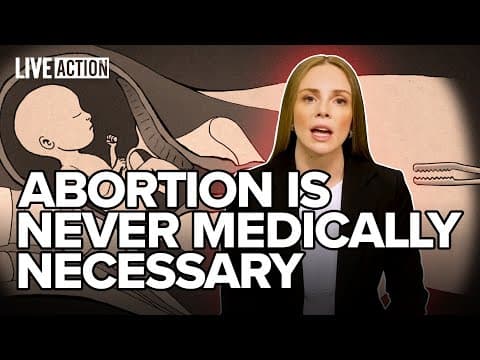
Since Roe v. Wade fell in 2022, there has been no shortage of stories in the media of women claiming they were denied medically necessary abortions. But the truth is, no baby has to be intentionally killed to save her mother's life. And it's a heavy burden to put on a mother's heart to convince her that she has to make that choice.
Live Action News is pro-life news and commentary from a pro-life perspective.
Our work is possible because of our donors. Please consider giving to further our work of changing hearts and minds on issues of life and human dignity.
Contact editor@liveaction.org for questions, corrections, or if you are seeking permission to reprint any Live Action News content.
Guest Articles: To submit a guest article to Live Action News, email editor@liveaction.org with an attached Word document of 800-1000 words. Please also attach any photos relevant to your submission if applicable. If your submission is accepted for publication, you will be notified within three weeks. Guest articles are not compensated (see our Open License Agreement). Thank you for your interest in Live Action News!
Angeline Tan
·
Analysis
Carole Novielli
·
Pop Culture
Cassy Cooke
·
Analysis
Angeline Tan
·
Analysis
Cassy Cooke
·
Analysis
Cassy Cooke
·
Activism
Nancy Flanders
·
Fact Checks
Nancy Flanders
·
Issues
Nancy Flanders
·
Politics
Nancy Flanders
·
International
Nancy Flanders
·
Fact Check: Woman says she was denied treatment as baby 'poisoned her from inside out'
Self-described "conservative" mom Jess Djukanovic of Iowa recently claimed her life was put at risk because her preborn baby had Trisomy 18 and therefore, her baby was "poisoning [her] from the inside" — a claim not supported by actual, medical fact.
Jess Djukanovic said after her preborn baby was diagnosed with Trisomy 18 at 10 weeks (in the first trimester), her own health began to "rapidly decline." She suffered from chest pain, swelling, fatigue, and kidney issues.
She claimed that despite her symptoms, medical providers refused to treat her.
Djukanovic appeared to blame her child's condition for her own health struggles, which is not supported by any known research, and argued that she should have been able to choose herself over her "dying fetus."
Her husband claimed the "logical step would have been to terminate the pregnancy to save my wife's life."
There is a difference between induced abortion — the direct and intentional killing of the baby — and induced delivery — delivering the baby to save the mother's life, without the direct intent of causing the baby's death.
Though most preborn babies are protected from induced abortion in Iowa, it is legal at any point for the health and life of the mother, and in certain cases of fetal diagnosis.
In a video, Djukanovic said, "[T]he craziest thing has happened to me a few weeks ago and I really feel the need to share it from the perspective of a very pissed off, conservative, Christian woman. I almost died. I almost died because I was denied medical care here in Iowa after being diagnosed with a fatal fetus."
("Fatal fetus" is not a medical term, and could cause confusion; a preborn child may be diagnosed with a "fatal fetal abnormality" or a "life-limiting condition," but 'fatal fetus' could incorrectly be interpreted as if the preborn child was fatal to the mother.)
Djukanovic said there was "no chance" her baby was going to survive and that she sought "multiple opinions."
According to the Iowa Coalition for Reproductive Freedom, Djukanovic's baby was diagnosed at 10 weeks with Trisomy 18, also called Edwards syndrome, a condition it incorrectly describes as "incompatible with life."
The American Academy of Pediatrics no longer classifies Trisomy 13 or Trisomy 18 as "incompatible with life." Unfortunately, many doctors are still using outdated research from data at least 20 years old.
A 2017 study from researchers at Stanford and the University of Arkansas revealed that children with Trisomy 18 are more likely to survive if they undergo pediatric heart surgery. In addition, a 2019 study revealed a 90% discharge rate for children with Trisomy 18 after having their hearts repaired.
Yet, it seems that two-decades-old data is what doctors gave to the Djukanovics, who believed there was "no hope" for their baby.
Iowa law states that abortion is allowed when a preborn baby "has a fetal abnormality that in the physician's reasonable medical judgment is incompatible with life." Though Trisomy 18 is no longer considered "incompatible with life," if Djukanovic's doctor believed it was, an abortion would have been legally allowed.
The law is specific.
Induced delivery involves ending a pregnancy by delivering the baby (regardless of gestational age) when the mother faces a medical emergency. An induced abortion, on the other hand, is done for the purpose of intentionally and directly causing the death of the baby.
Iowa law defines abortion as "the termination of a human pregnancy with the intent other than to produce a live birth or to remove a dead fetus." The law in Iowa protects preborn children from abortion once a heartbeat can be detected, at about six weeks gestation (though the human heart first begins beating and pumping blood around three weeks after fertilization).
But Iowa's law also contains exceptions, including for "medical emergency" or medical necessity (emphases added):
A physician shall not perform an abortion upon a pregnant woman when it has been determined that the unborn child has a detectable fetal heartbeat, unless, in the physician’s reasonable medical judgment, a medical emergency exists, or when the abortion is medically necessary.
How Iowa defines “medical emergency”:
"[A] situation in which an abortion is performed to preserve the life of the pregnant woman whose life is endangered by a physical disorder, physical illness, or physical injury, including a life-endangering physical condition caused by or arising from the pregnancy, or when continuation of the pregnancy will create a serious risk of substantial and irreversible impairment of a major bodily function of the pregnant woman."
How Iowa defines "medically necessary" includes when "the fetus has a fetal abnormality that in the physician's reasonable medical judgment is incompatible with life" (emphases added).
The couple, however, claims to have been "cornered by the government."
In addition to thinking their baby was destined to die, it seems the couple believed that their baby's existence put Djukanovic's life at risk.
She explained in a video, "Shortly after [the diagnosis of Trisomy 18], my health started to rapidly decline and I was not able to seek care in a timely manner or nearly at all." She also said, "... I had a fetus that's poisoning me from the inside out."
It is unclear what Djukanovic means by the vague claim of being "[un]able to seek care in a timely manner or nearly at all," and there is absolutely no medical support for her claim about being "poison[ed]... from the inside out."
There are risks — such as preterm birth and miscarriage — due to Trisomy 18; however, a child's prenatal diagnosis does not necessarily put a woman's life in immediate or imminent danger.
Even if a woman experiences a "missed miscarriage," it is possible that her baby could remain in her body for weeks without causing harm (though she should be monitored for any signs of infection, etc.). In fact, in 'selective reduction' abortions, carried out in a multiples pregnancy, some of the babies are killed via lethal injection and left in the mother's uterus as the other baby or babies continue to develop. Yet abortion advocates frequently claim that even if a baby hasn't died in utero, that baby is a threat to the mother's health if there is a risk that the baby could die in the womb.
“Adverse prenatal diagnoses are not life-threatening for the mother," explained Christina Francis, CEO of the American Association of Pro-Life OBGYNs (AAPLOG), adding:
"Pregnant women and their preborn children deserve care that respects their dignity and protects their health. Healthy mom and healthy baby should be the goal of every medical professional providing them care. Life-affirming physicians have always been able to give life-saving healthcare to both of our patients in every state and we still can, including in states with strong pro-life protections.
The medical community needs to do a better job accompanying and supporting women receiving difficult prenatal diagnoses. It starts with setting aside politics and giving families accurate information that explains the resources available and recognizes the value of both patients’ lives – mother and child."
Djukanovic's husband said she had chest pains when he brought her to the emergency room, as well as trouble walking.
In his own video, Miljan, an immigrant from a "religious, conservative, traditional country," added, "My wife almost died last week. Our baby was dying. There was no hope. The logical step would have been to terminate the pregnancy, save my wife's life."
But he also said (emphasis added), "...If my wife got sepsis and died..." implying that there was the fear of a potentially life-threatening illness, and the situation was not an emergency.
Regardless of her baby's diagnosis, if Djukanovic was experiencing a medical emergency and a physician believed, based on his or her "reasonable medical judgment," that an induced abortion was necessary, it would have been legally allowed (even though it's not necessary to intentionally and directly kill a preborn baby).
Djukanovic should have absolutely received proper medical care, which in an emergency could have meant delivering her very premature baby if necessary to save her life. Even if her baby died secondarily due to prematurity, an induced delivery would not have been considered an abortion because the intent was not to kill the child but to save the mother.
What we do not know is whether doctors believed that Djukanovic was experiencing a medical emergency that necessitated the immediate ending of the pregnancy.
Further in the video, Djukanovic complained about the medical staff, but then said it wasn't their fault:
"I was told to miscarry at home or wait it out or ask Google what to do when I asked where could I go for a resolution to my problem.... Doctors should not be afraid to do their job and that is the case here in Iowa. It's not that they don't want to help us. It's that they are afraid to do their job and save our lives. Politics and religion have no place in health care. They have no place on my body, on my health."
Something doesn't add up here.
If Djukanovic's life was in immediate danger and she was sent home or told to "ask Google," this would surely constitute medical malpractice, no matter what her state of residency or the laws there.
Miljan claimed, "Doctors have a fear of being sued, influenced by the politicians and propaganda. I had to rush her to the hospital in which it took two hours just to see the doctor after she experienced chest pains and could hardly walk." He added, "We had to fight on our own because doctors weren't even allowed to tell us what to do or where to go."
What is being claimed here by Djukanovic and her husband is that doctors are more afraid of being sued for doing an abortion for what they believe is a legitimate medical emergency than they are of being sued for medical negligence that could cause the death of a pregnant patient.
Does this seem likely?
It sounds as if Djukanovic may have been taken to an emergency room, but we are given no information about whether any specialists or OBGYNs were called upon or consulted by ER/hospital staff, and no details about the hospital itself. The claims here seem to be more focused on placing blame upon a state law instead of upon physicians or hospitals, who must function under state laws and medical ethics every single day; it's their job to know all relevant laws and follow them.
Let's be clear:
Any medical practitioner who discharges a critically ill patient with no follow-up, no referrals, and no help beyond telling her to "Google" her symptoms has zero business practicing any kind of medicine. Yet, this is what the Djukanovics claim happened to them.
Iowa's politicians and laws do not prohibit doctors from delivering (or even aborting) a baby if they believe it to be medically necessary based on individual circumstances.
Since Djukanovic said multiple doctors believed her child had a "fetal abnormality that in the physician's reasonable medical judgment [was] incompatible with life" (as stated in Iowa law), she met the requirements for an induced abortion based on her baby's diagnosis alone. A medical emergency regarding her health would have warranted an induced delivery, but would have also allowed an induced abortion.
If Djukanovic truly needed to end her pregnancy and doctors ignored her symptoms, this would be an issue of medical neglect, not an issue of the law.
Hospital attorneys have a responsibility to ensure that doctors understand the law. Assuming the doctors are aware of the difference between induced abortion and induced delivery, as well as state laws surrounding abortion, it shouldn't be ignored that perhaps there is another reason doctors didn't act.
"I have three healthy, lovely children at home, a business to run, a husband, and I'm not allowed to choose me?" Djukanovic said. "Where's the pro-life in that? Pro-life? Like choose me, choose the mother. We're completely forgetting the mother in this situation. At no point should a dying fetus have more precedence in a healthcare system over a healthy mother who's contributing positively [to] society."
Notice how the word "healthy" appears more than once in Djukanovic's remarks — once in reference to her children at home, and once in reference to herself.
Also notice how she juxtaposes "dying fetus" with "a healthy mother who's contributing positively [to] society."
The chosen words are very revealing of an elitist and ableist mindset.
Pro-life laws only ensure that preborn children can't be electively, intentionally killed, not that they can't be delivered prematurely in emergencies. And the law even includes an exception allowing a child to be intentionally killed if a doctor deemed that child to be incompatible with life or deemed the mother to be at risk.
Eventually, Djukanovic went to Broadlawns emergency room, where "staff helped her coordinate with a provider at the University of Iowa... where she was finally treated, over two weeks after learning the fetus was not viable."
"Not viable" is not specified here; this could mean labeled "incompatible with life" or already deceased in the womb.
Interestingly, it seems implied that Djukanovic was referred to a different doctor, who carried out a non-emergency abortion (or a miscarriage treatment, if the baby was already deceased). This also means that Djukanovic's life was not at immediate risk, given the time frame of two weeks; ERs aren't known to "help coordinate" referrals to outside physicians in situations requiring immediate surgery or delivery to save a mother's life.
Since Roe v. Wade fell in 2022, there has been no shortage of stories in the media of women claiming they were denied medically necessary abortions. But the truth is, no baby has to be intentionally killed to save her mother's life. And it's a heavy burden to put on a mother's heart to convince her that she has to make that choice.
Live Action News is pro-life news and commentary from a pro-life perspective.
Our work is possible because of our donors. Please consider giving to further our work of changing hearts and minds on issues of life and human dignity.
Contact editor@liveaction.org for questions, corrections, or if you are seeking permission to reprint any Live Action News content.
Guest Articles: To submit a guest article to Live Action News, email editor@liveaction.org with an attached Word document of 800-1000 words. Please also attach any photos relevant to your submission if applicable. If your submission is accepted for publication, you will be notified within three weeks. Guest articles are not compensated (see our Open License Agreement). Thank you for your interest in Live Action News!
Angeline Tan
·Analysis
Carole Novielli
·Pop Culture
Cassy Cooke
·Analysis
Angeline Tan
·Analysis
Cassy Cooke
·Analysis
Cassy Cooke
·Activism
Nancy Flanders
·Fact Checks
Nancy Flanders
·Issues
Nancy Flanders
·Politics
Nancy Flanders
·International
Nancy Flanders
·