 International
Read Next
Human Interest
Infants safely surrendered in Oklahoma and Indiana baby boxes
Bridget Sielicki
·

UK student midwife persecuted for pro-life beliefs has a new mission
Sara Spencer’s brush with her university for expressing her pro-life views could have ended with an investigation file, a suspension, and a quiet retreat from public life.
Instead, the former student midwife has turned one of the most harrowing chapters of her life into a public witness for conscience, the freedom of pro-life expression, and the preborn.
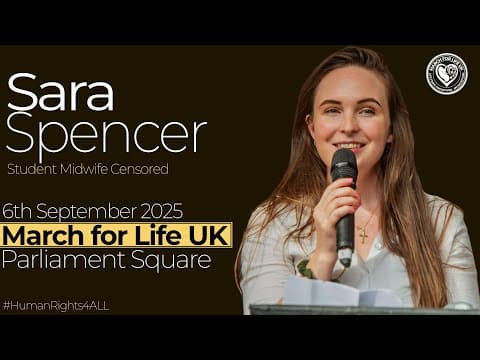
Former UK midwifery student Sara Spencer, an American living in Scotland, disclosed that she was pro-life in a private Facebook conversation which later led to suspension, eventual exoneration, and ongoing discrimination against her.
Spencer encourages individuals in healthcare to speak up and stand up for their pro-life convictions and against the discriminatory idea that those with pro-life beliefs should not enter healthcare professions.
Today, Spencer is raising her family and doing speaking engagements to spur others on to oppose the "dominant culture in Britain, which discriminates against pro-lifers and seeks to silence them."
Spencer, an American-born mother of four now living in Scotland, was suspended from her NHS Fife midwifery placement in 2024 after disclosing in a private Facebook conversation that she was pro-life.
While Edinburgh Napier University subsequently exonerated her through its Fitness to Practice process, the experience did more than disrupt her training—it altered the course of her life.
Today, Spencer speaks openly about cancel culture, freedom of conscience, and the pressures confronting pro-life students across British universities and healthcare institutions. Her message goes beyond her own experience of injustice: silence spreads, but so does courage—and one person willing to speak can prompt others to do the same.
Spencer had never envisioned a career in midwifery. Raised in Southern California until she was 15, she later moved to Idaho, where she became a Christian during high school. She went on to study religion and psychology at Pepperdine University, with no early ambition to work in healthcare.
Everything changed after she relocated to Scotland in 2016 and became a mother. The midwife-led maternity care she received revealed a model of care grounded in confidence in women’s bodies.
Experiencing three births with little or no medical intervention felt empowering to her, and she hoped to help other women encounter that same dignity.
“Midwifery doesn’t regard birth as a medical event or pregnancy as a medical condition, but as natural, normal, healthy events,” Spencer told Live Action News. “I love that about midwifery.”
Later, she enrolled at Edinburgh Napier University and described midwifery as “the dream job I never knew I wanted.”
However, before Spencer could complete her training, her midwife dream clashed with the realities of professional and institutional pressure.
In April 2024, someone posted a question in a private midwifery Facebook group: did midwives provide abortions, and could a midwife refuse to participate on grounds of conscience?

Spencer responded thoughtfully.
She pointed out that while midwives do carry out abortions, the law also defends their statutory right to conscientious objection. Referencing the Nursing and Midwifery Council’s Code, Spencer explained that professionals who object must notify colleagues, managers, and patients and must ensure that a suitably qualified colleague assumes responsibility for the person’s care.
Her reply in full was:
"Yes, midwives do provide abortions. And yes, you have the right to refuse to take part. The law protects your statutory right of conscientious objection. You do not need to provide abortion care if you object to abortion.
‘Paragraph 4.4 of the Code states that nurses, midwives, and nursing associates who have a conscientious objection must tell colleagues, their manager, and the person receiving care that they have a conscientious objection to a particular procedure. They must arrange for a suitably qualified colleague to take over responsibility for that person’s care.’ (NMC)
I am a pro-life midwifery student. Feel free to message me to chat more if you like. ♥️”
Strikingly, Spencer's last sentence changed the direction of her life: “I am a pro-life midwifery student.”
She understood that her remark would not be well-received. Other participants in the discussion had already implied that anyone with reservations about abortion ought to reconsider pursuing midwifery altogether. One participant even lambasted religious belief as “baggage” for the profession.
Spencer felt compelled to react to such responses.
“I felt like the [original poster] was being unfairly pressured to think that her pro-life beliefs made her unfit to train as a midwife,” she admitted. “I didn’t mind that it would inevitably invite a reaction against me — I welcome debate, and I knew I was legally entitled to my views.”
On April 18, 2024, Spencer’s manager at her NHS Fife placement requested to speak with her privately.
Spencer recalled her manager's words: “The conversation I need to have with you right now is not going to be an easy one."
According to Spencer, she was notified that several people had reported her comments, though their identities were never divulged. The issue was then put forth to Edinburgh Napier University.
That same day, a lecturer emailed to claim that Spencer had identified herself as a student midwife during a discussion on termination of pregnancy, sparking concerns about her conduct and professional standards.
The complaint was also passed to the university’s Fitness to Practice office. Spencer stated that the allegations claimed she had articulated her personal beliefs inappropriately, besmirched the university’s reputation, failed to consider how her actions affected others, and used social media irresponsibly.
At first, Spencer was instructed that she could continue clinical placements during the investigation. Within hours, however, she realized that her placement manager did not want her back.
Staff were reportedly “uncomfortable” supporting her learning, and the placement was no longer deemed as a healthy environment for her.
On May 2, a Fitness to Practice officer told her that NHS Fife had formally requested a pause in placements, Spencer recounted. Her later subject access requests, she revealed, uncovered something more severe: NHS Fife had decided to suspend her from placements across the health board.
For Spencer, the ramifications were immediate and personal. She had to forfeit three weeks of clinical placement hours and was notified that attendance was essential unless illness or injury prevented it.
“I was not unwell,” she acknowledged. “I had no broken limbs. I deeply wanted to continue my midwifery training, and yet I was being prevented from doing so for one reason only—I was vocally pro-life.”
The university investigation eventually culminated with a “no case to answer” outcome. Spencer was cleared of all allegations.
“It was so refreshing and encouraging to have finally had my beliefs listened to and received charitably and fairly,” she conceded.
Nevertheless, her vindication felt incomplete.
According to Spencer, NHS Fife initially rejected the outcome of the investigation, demanded an explanation, and said it had been preparing witnesses for a more serious panel stage. Her professors told her that if NHS Fife did not accept the university’s decision, she might need to relocate to another health board to continue training.
When Spencer was eventually allowed back into placements, she returned to an environment where she felt watched and vulnerable, she testified.
Then came what Spencer describes as the most shocking part: months after her exoneration, professors continued to describe her earlier comments as “inappropriate.”
“That sent a message that should disturb all students,” Spencer declared. “You can proceed to do everything right, abide by every rule, cooperate fully with any investigation, be officially absolved of all allegations, and still be considered by your peers, colleagues, supervisors, and professors as guilty.”
At the moment, Spencer is no longer training as a midwife. After successfully completing and passing her first year, she went on maternity leave to give birth to and care for her fourth child.
Her family also relocated further north in Scotland for her husband’s job, making continued study at Edinburgh Napier impractical.
But leaving midwifery did not mean leaving the issue behind.
Her experience made her think more about the issue of the freedom of expression for pro-life students in the United Kingdom.
Spencer points to an alarming trend of universities and student bodies targeting pro-life groups and speakers, citing cases at institutions including Glasgow, Edinburgh, Stirling, Aberdeen, Exeter, Liverpool, Manchester, Oxford, and King’s College London.
Additionally, Spencer referred to the 2020 report Free2Speak, published by SPUC and the Alliance of Pro-Life Students, which recorded discrimination against pro-life groups at several Scottish universities. In one case that Spencer alluded to, Tobias Bailey, president of the Stirling University Catholic Society, faced complaints after posting about a 40 Days for Life vigil.
The student union suspended the Catholic Society; after Bailey contested the decision with support from SPUC, the society was reinstated.
Spencer views her own case as part of that broader cultural pattern.
“The dominant culture in Britain, which discriminates against pro-lifers and seeks to silence them also pervades the NHS and UK educational institutions,” she proclaimed. “The pressure is immense for pro-lifers to either hide their pro-life convictions in professional and educational settings or else to simply not pursue careers in healthcare in the first place.”
Spencer has become a speaker at pro-life events, including the SPUC national conference, where she addressed why young people should resist cancel culture. She is also poised to speak at SPUC’s yearly Youth Conference in England in 2027.
Her central concern is what psychologists and advocates call the 'chilling effect': when people see others punished for expressing a view, they begin to censor themselves before anyone penalizes them.
During her investigation, Spencer testified, a friend in the midwifery program admitted that she shared Spencer’s values but did not have the courage to say so aloud.
“I am very sympathetic to this; truly, I am,” Spencer said. “But the fact that she knew it was best to keep her beliefs to herself lest she be punished for them is exactly the problem.”
Spencer’s message to young people who fear that speaking honestly might cost them friends, marks, placements, or job prospects is blunt: speak the truth regardless.
“Please, when the opportunity presents itself, take the risk,” she exhorted. “Every time we speak up anyway, we embolden others to do the same.”
Her message to young people who believe their voice does not matter is clear.
“In the present time and culture, it matters enormously,” she said. “When a pro-lifer speaks their mind and stands their ground, it sends shockwaves through the people and institutions that oppose us.”
Spencer believes the right to speak one's conscience safeguards pro-life practitioners and upholds the wider principle that no one should be shut out of the caring professions on account of genuine moral or religious convictions.
“To say that people who sincerely hold a certain moral or religious view are not allowed to enter certain careers is patently discriminatory,” she proclaimed, dismissing the notion that pro-life beliefs make someone incapable of compassionate midwifery care:
“To suggest that someone with pro-life beliefs cannot be a good midwife or cannot provide compassionate care to women is a deeply discriminatory comment.
This comment suggests that the vast majority of practicing Christians around the world, as well as many Muslims, many Hindus, and many irreligious people committed to non-violence, are all, by definition, unfit for the work of caring for pregnant, birthing, and postpartum women.”
For Spencer, the preborn child is a real person rather than a theoretical idea. As she sees it, being a midwife means looking after both the mother and her baby.
“We believe that the unborn child is one of the most vulnerable members of the human species,” she told Live Action News, “and we believe we have a moral imperative to stand up for them.”
Spencer urges people on every side of the abortion debate to avoid reducing their opponents to caricatures.
“There are good, rational, and sincere people on the other side of this issue, too,” she said. “We do ourselves no favors by making the same negative assumptions of all pro-choicers that they do of us.”
Spencer’s aim is to prove to young pro-life people that their beliefs are worth speaking up for and that one person’s courage can be contagious.
Live Action News is pro-life news and commentary from a pro-life perspective.
Our work is possible because of our donors. Please consider giving to further our work of changing hearts and minds on issues of life and human dignity.
Contact editor@liveaction.org for questions, corrections, or if you are seeking permission to reprint any Live Action News content.
Guest Articles: To submit a guest article to Live Action News, email editor@liveaction.org with an attached Word document of 800-1000 words. Please also attach any photos relevant to your submission if applicable. If your submission is accepted for publication, you will be notified within three weeks. Guest articles are not compensated (see our Open License Agreement). Thank you for your interest in Live Action News!
Bridget Sielicki
·
Issues
Bridget Sielicki
·
Abortion Pill
Nancy Flanders
·
Activism
Angeline Tan
·
International
Isabella Childs
·
International
Rebecca Oas, Ph.D.
·Activism
Angeline Tan
·
Human Interest
Angeline Tan
·
Human Interest
Angeline Tan
·
International
Angeline Tan
·
Analysis
Angeline Tan
·UK student midwife persecuted for pro-life beliefs has a new mission
Sara Spencer’s brush with her university for expressing her pro-life views could have ended with an investigation file, a suspension, and a quiet retreat from public life.
Instead, the former student midwife has turned one of the most harrowing chapters of her life into a public witness for conscience, the freedom of pro-life expression, and the preborn.
Former UK midwifery student Sara Spencer, an American living in Scotland, disclosed that she was pro-life in a private Facebook conversation which later led to suspension, eventual exoneration, and ongoing discrimination against her.
Spencer encourages individuals in healthcare to speak up and stand up for their pro-life convictions and against the discriminatory idea that those with pro-life beliefs should not enter healthcare professions.
Today, Spencer is raising her family and doing speaking engagements to spur others on to oppose the "dominant culture in Britain, which discriminates against pro-lifers and seeks to silence them."
Spencer, an American-born mother of four now living in Scotland, was suspended from her NHS Fife midwifery placement in 2024 after disclosing in a private Facebook conversation that she was pro-life.
While Edinburgh Napier University subsequently exonerated her through its Fitness to Practice process, the experience did more than disrupt her training—it altered the course of her life.
Today, Spencer speaks openly about cancel culture, freedom of conscience, and the pressures confronting pro-life students across British universities and healthcare institutions. Her message goes beyond her own experience of injustice: silence spreads, but so does courage—and one person willing to speak can prompt others to do the same.
Spencer had never envisioned a career in midwifery. Raised in Southern California until she was 15, she later moved to Idaho, where she became a Christian during high school. She went on to study religion and psychology at Pepperdine University, with no early ambition to work in healthcare.
Everything changed after she relocated to Scotland in 2016 and became a mother. The midwife-led maternity care she received revealed a model of care grounded in confidence in women’s bodies.
Experiencing three births with little or no medical intervention felt empowering to her, and she hoped to help other women encounter that same dignity.
“Midwifery doesn’t regard birth as a medical event or pregnancy as a medical condition, but as natural, normal, healthy events,” Spencer told Live Action News. “I love that about midwifery.”
Later, she enrolled at Edinburgh Napier University and described midwifery as “the dream job I never knew I wanted.”
However, before Spencer could complete her training, her midwife dream clashed with the realities of professional and institutional pressure.
In April 2024, someone posted a question in a private midwifery Facebook group: did midwives provide abortions, and could a midwife refuse to participate on grounds of conscience?
Spencer responded thoughtfully.
She pointed out that while midwives do carry out abortions, the law also defends their statutory right to conscientious objection. Referencing the Nursing and Midwifery Council’s Code, Spencer explained that professionals who object must notify colleagues, managers, and patients and must ensure that a suitably qualified colleague assumes responsibility for the person’s care.
Her reply in full was:
"Yes, midwives do provide abortions. And yes, you have the right to refuse to take part. The law protects your statutory right of conscientious objection. You do not need to provide abortion care if you object to abortion.
‘Paragraph 4.4 of the Code states that nurses, midwives, and nursing associates who have a conscientious objection must tell colleagues, their manager, and the person receiving care that they have a conscientious objection to a particular procedure. They must arrange for a suitably qualified colleague to take over responsibility for that person’s care.’ (NMC)
I am a pro-life midwifery student. Feel free to message me to chat more if you like. ♥️”
Strikingly, Spencer's last sentence changed the direction of her life: “I am a pro-life midwifery student.”
She understood that her remark would not be well-received. Other participants in the discussion had already implied that anyone with reservations about abortion ought to reconsider pursuing midwifery altogether. One participant even lambasted religious belief as “baggage” for the profession.
Spencer felt compelled to react to such responses.
“I felt like the [original poster] was being unfairly pressured to think that her pro-life beliefs made her unfit to train as a midwife,” she admitted. “I didn’t mind that it would inevitably invite a reaction against me — I welcome debate, and I knew I was legally entitled to my views.”
On April 18, 2024, Spencer’s manager at her NHS Fife placement requested to speak with her privately.
Spencer recalled her manager's words: “The conversation I need to have with you right now is not going to be an easy one."
According to Spencer, she was notified that several people had reported her comments, though their identities were never divulged. The issue was then put forth to Edinburgh Napier University.
That same day, a lecturer emailed to claim that Spencer had identified herself as a student midwife during a discussion on termination of pregnancy, sparking concerns about her conduct and professional standards.
The complaint was also passed to the university’s Fitness to Practice office. Spencer stated that the allegations claimed she had articulated her personal beliefs inappropriately, besmirched the university’s reputation, failed to consider how her actions affected others, and used social media irresponsibly.
At first, Spencer was instructed that she could continue clinical placements during the investigation. Within hours, however, she realized that her placement manager did not want her back.
Staff were reportedly “uncomfortable” supporting her learning, and the placement was no longer deemed as a healthy environment for her.
On May 2, a Fitness to Practice officer told her that NHS Fife had formally requested a pause in placements, Spencer recounted. Her later subject access requests, she revealed, uncovered something more severe: NHS Fife had decided to suspend her from placements across the health board.
For Spencer, the ramifications were immediate and personal. She had to forfeit three weeks of clinical placement hours and was notified that attendance was essential unless illness or injury prevented it.
“I was not unwell,” she acknowledged. “I had no broken limbs. I deeply wanted to continue my midwifery training, and yet I was being prevented from doing so for one reason only—I was vocally pro-life.”
The university investigation eventually culminated with a “no case to answer” outcome. Spencer was cleared of all allegations.
“It was so refreshing and encouraging to have finally had my beliefs listened to and received charitably and fairly,” she conceded.
Nevertheless, her vindication felt incomplete.
According to Spencer, NHS Fife initially rejected the outcome of the investigation, demanded an explanation, and said it had been preparing witnesses for a more serious panel stage. Her professors told her that if NHS Fife did not accept the university’s decision, she might need to relocate to another health board to continue training.
When Spencer was eventually allowed back into placements, she returned to an environment where she felt watched and vulnerable, she testified.
Then came what Spencer describes as the most shocking part: months after her exoneration, professors continued to describe her earlier comments as “inappropriate.”
“That sent a message that should disturb all students,” Spencer declared. “You can proceed to do everything right, abide by every rule, cooperate fully with any investigation, be officially absolved of all allegations, and still be considered by your peers, colleagues, supervisors, and professors as guilty.”
At the moment, Spencer is no longer training as a midwife. After successfully completing and passing her first year, she went on maternity leave to give birth to and care for her fourth child.
Her family also relocated further north in Scotland for her husband’s job, making continued study at Edinburgh Napier impractical.
But leaving midwifery did not mean leaving the issue behind.
Her experience made her think more about the issue of the freedom of expression for pro-life students in the United Kingdom.
Spencer points to an alarming trend of universities and student bodies targeting pro-life groups and speakers, citing cases at institutions including Glasgow, Edinburgh, Stirling, Aberdeen, Exeter, Liverpool, Manchester, Oxford, and King’s College London.
Additionally, Spencer referred to the 2020 report Free2Speak, published by SPUC and the Alliance of Pro-Life Students, which recorded discrimination against pro-life groups at several Scottish universities. In one case that Spencer alluded to, Tobias Bailey, president of the Stirling University Catholic Society, faced complaints after posting about a 40 Days for Life vigil.
The student union suspended the Catholic Society; after Bailey contested the decision with support from SPUC, the society was reinstated.
Spencer views her own case as part of that broader cultural pattern.
“The dominant culture in Britain, which discriminates against pro-lifers and seeks to silence them also pervades the NHS and UK educational institutions,” she proclaimed. “The pressure is immense for pro-lifers to either hide their pro-life convictions in professional and educational settings or else to simply not pursue careers in healthcare in the first place.”
Spencer has become a speaker at pro-life events, including the SPUC national conference, where she addressed why young people should resist cancel culture. She is also poised to speak at SPUC’s yearly Youth Conference in England in 2027.
Her central concern is what psychologists and advocates call the 'chilling effect': when people see others punished for expressing a view, they begin to censor themselves before anyone penalizes them.
During her investigation, Spencer testified, a friend in the midwifery program admitted that she shared Spencer’s values but did not have the courage to say so aloud.
“I am very sympathetic to this; truly, I am,” Spencer said. “But the fact that she knew it was best to keep her beliefs to herself lest she be punished for them is exactly the problem.”
Spencer’s message to young people who fear that speaking honestly might cost them friends, marks, placements, or job prospects is blunt: speak the truth regardless.
“Please, when the opportunity presents itself, take the risk,” she exhorted. “Every time we speak up anyway, we embolden others to do the same.”
Her message to young people who believe their voice does not matter is clear.
“In the present time and culture, it matters enormously,” she said. “When a pro-lifer speaks their mind and stands their ground, it sends shockwaves through the people and institutions that oppose us.”
Spencer believes the right to speak one's conscience safeguards pro-life practitioners and upholds the wider principle that no one should be shut out of the caring professions on account of genuine moral or religious convictions.
“To say that people who sincerely hold a certain moral or religious view are not allowed to enter certain careers is patently discriminatory,” she proclaimed, dismissing the notion that pro-life beliefs make someone incapable of compassionate midwifery care:
“To suggest that someone with pro-life beliefs cannot be a good midwife or cannot provide compassionate care to women is a deeply discriminatory comment.
This comment suggests that the vast majority of practicing Christians around the world, as well as many Muslims, many Hindus, and many irreligious people committed to non-violence, are all, by definition, unfit for the work of caring for pregnant, birthing, and postpartum women.”
For Spencer, the preborn child is a real person rather than a theoretical idea. As she sees it, being a midwife means looking after both the mother and her baby.
“We believe that the unborn child is one of the most vulnerable members of the human species,” she told Live Action News, “and we believe we have a moral imperative to stand up for them.”
Spencer urges people on every side of the abortion debate to avoid reducing their opponents to caricatures.
“There are good, rational, and sincere people on the other side of this issue, too,” she said. “We do ourselves no favors by making the same negative assumptions of all pro-choicers that they do of us.”
Spencer’s aim is to prove to young pro-life people that their beliefs are worth speaking up for and that one person’s courage can be contagious.
Live Action News is pro-life news and commentary from a pro-life perspective.
Our work is possible because of our donors. Please consider giving to further our work of changing hearts and minds on issues of life and human dignity.
Contact editor@liveaction.org for questions, corrections, or if you are seeking permission to reprint any Live Action News content.
Guest Articles: To submit a guest article to Live Action News, email editor@liveaction.org with an attached Word document of 800-1000 words. Please also attach any photos relevant to your submission if applicable. If your submission is accepted for publication, you will be notified within three weeks. Guest articles are not compensated (see our Open License Agreement). Thank you for your interest in Live Action News!
Bridget Sielicki
·Issues
Bridget Sielicki
·Abortion Pill
Nancy Flanders
·Activism
Angeline Tan
·International
Isabella Childs
·International
Rebecca Oas, Ph.D.
·Activism
Angeline Tan
·Human Interest
Angeline Tan
·Human Interest
Angeline Tan
·International
Angeline Tan
·Analysis
Angeline Tan
·