 Analysis
Read Next
Abortion Pill
'Without Guardrails': Are abortion pill companies putting profit over safety rules?
Carole Novielli
·
Prenatal development in Baby Olivia mirrors markers in abortion training source
Despite much pro-abortion handwringing over Live Action's "Meet Baby Olivia" computer-animated prenatal development video, a prenatal development website cited in a prominent abortion training manual points to similar developmental markers highlighted by the Baby Olivia video and website.
A prenatal development website cited in the TEACH abortion training manual points to similar developmental markers highlighted by the Baby Olivia video and website.
Baby Olivia has received criticism from pro-abortion groups who have spent decades hiding the truth about prenatal development.
The similarities in prenatal development markers show not just that Baby Olivia is accurate, but that human beings develop rapidly in the womb, and much more is known about their development than is often shared with the general public.
The TEACH (Training in Early Abortion for Comprehensive Healthcare) abortion training manual published by the University of California San Francisco's (UCSF) Bixby Center for Global Reproductive Health, an abortion training site, links to the prenatal development website Perinatology.com. This website specifies similar developmental markers highlighted in Live Action's Baby Olivia video and website.
"Visualization of pregnancy tissue is available at the MYA network and size and characteristics are available at Perinatology.com," the TEACH curriculum states.
While the pro-abortion MYA Network deceptively portrays the embryo/fetus as a substance resembling a cotton ball or dryer lint, the actual embryos were removed prior to being photographed, and the gestational sacs were rinsed.
In juxtaposition, Perinatology.com shows a more accurate depiction of the developing baby.

“Baby Olivia” is a computer-generated educational tool portraying human development in the womb, introduced in 2021 by Live Action and created with the support of medical experts and world-class artists.
The information and timeline (from fertilization) used in Baby Olivia is identical to that utilized by the Endowment for Human Development, a nonprofit organization dedicated to improving health science education and public health. It states that it is "committed to neutrality regarding all controversial bioethical issues."
Today, lawmakers in multiple states have included Baby Olivia tool as an option to educate students with information about human development.
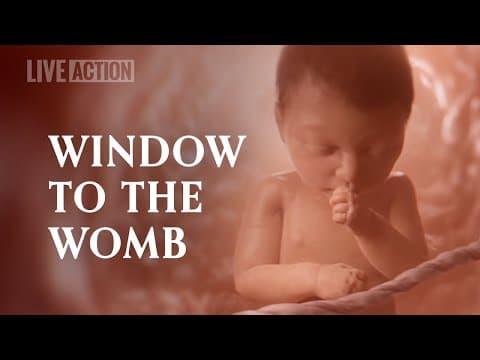
But Baby Olivia has received criticism from pro-abortion groups who have spent decades hiding the truth about prenatal development. Through sleight of hand euphemisms and falsehoods, the pro-abortion movement and its allies in the medical community have misled women to believe that abortion is a simple medical procedure that removes mere "tissue" or "cells."
The reality is much different.
Baby Olivia's gestational markers are calculated relative to fertilization (sometimes referred to as "conception") and dating is calculated based on "fetal age" versus last menstrual period (LMP) or "gestational" age, which adds approximately two weeks.
Perinatology.com, included in the TEACH abortion training manual, was created by Mark A Curran, M.D., F.A.C.O.G and "written by maternal-fetal medicine specialists and genetic counselors."
They explain it this way: "Conceptional age ≈gestational age − 2 weeks."
Yet, Baby Olivia has been accused of inaccuracy and deception for its use of fetal age. Clearly, this is not the case.
BabyOlivia.com states:
Week 3:
By week three, Olivia's heart is beating. Her brain and gastrointestinal tract have begun to form, and the cells for her nerves, blood, and kidney have appeared. Her mother may know of Olivia’s existence through a pregnancy test at this stage.
Perinatology.com appears to share the same information:
Gestational age 5 weeks (1.2 months) — embryonic age 3 weeks.
The brain, spine, and heart have begun to form. By the end of the week the heart will be pumping blood.

BabyOlivia.com states:
Week 4
At just four weeks, the buds of Olivia’s arms are and legs are visibly forming, and the right and left hemispheres of her brain are beginning to take shape.
Perinatology.com similarly notes the formation of limbs, and even more:
Gestational age 6 weeks (1.4 months) — embryonic age 4 weeks...
The embryo is about the size of a pea....
The eyes, nostrils, and arms are taking shape.
The heart is beating at about 110 beats per minute and sometimes may be seen using a transvaginal ultrasound at this time.

BabyOlivia.com states:
Weeks 5-6
At weeks five and six, Olivia moves spontaneously and reflexively, her bones begin to develop, and her brain activity can be recorded.
Perinatology.com notes the presence of movement as well:
Gestational age 7 weeks (1.6 months) — embryonic age 5 weeks...
The hands and feet are forming, as well as the mouth and face.
The heart is beating at about 120 beats per minute. Movement of the embryo can be detected by ultrasound.
By week 7 the trachea and bronchi of the lungs have formed, and the pseudoglandular stage of lung development begins.

Gestational age 8 weeks (1.8 months) — embryonic age 6 weeks
The embryo is about the size of a bean. The fingers and toes are developing.
The adrenal glands begin DHEA-S secretion and the testes begin to secrete testosterone...
BabyOlivia.com states:
Weeks 7-8
Olivia can bring her hands together, she can hiccup, she has had over one million heartbeats, and her ovaries and the cells needed for future generations of children are present.
Perinatology.com describes a beating heart and more:
Gestational age 9 weeks (2.1 months) — embryonic age 7 weeks
The heart is beating at about 170 beats per minute...
Gestational age 10 weeks (2.3 months) — fetal age 8 weeks
The embryo's tail has disappeared and it is now called a fetus. Fingerprints are being formed, and bone cells are replacing cartilage.
The adrenal glands are starting to produce catecholamines and the pituitary is starting to release ADH and oxytocin...
170 heartbeats per minute x 60 (per hour) x 24 (day) = 244,800 heartbeats per day.

BabyOlivia.com notes:
Weeks 9-10
Olivia’s stage of human development now classifies her as a fetus. She can suck her thumb, swallow, grasp an object, touch her face, sigh, and stretch out in her mother’s womb.
Perinatology.com also notes mouth movements and swallowing:
Gestational age 11 weeks (2.5 months) — fetal age 9 weeks
The fetus is starting to have breathing movements. It can open its mouth and swallow...
Gestational age 12 weeks (2.8 months) — fetal age 10 weeks
The fetus is starting to make random movements.... The heartbeat can usually be heard with an electronic monitor at this time....
Note: The image appears to show the fetus sucking his/her thumb.

BabyOlivia.com states:
Weeks 11-14
Olivia can play in the womb and her taste buds have matured to discrete tastebuds. By week 14, Olivia’s lips and nose are fully formed, she makes complex facial expressions, and her mother can finally feel her movements.
Gestational age 13 weeks (3 months) — fetal age 12 weeks...
All major organs are formed now, but they are too immature for the fetus to survive out of the womb....
Gestational age 14 weeks (3.2 months) — fetal age 12 weeks
The fetus’s toenails are appearing. The gender may sometimes be seen...
Gestational age 15 weeks (3.5 months) — fetal age 13 weeks
Fetal movement may be sensed now (called quickening)....
Gestational age 16 to 17 weeks (3.7 to 3.9 months) — fetal age 14 to 15 weeks...
Hearing is beginning to form... The canalicular period of lung development has started and will continue until about 25 weeks.

BabyOlivia.com states:
Weeks 15-16
The neuron multiplication of Olivia’s brain is mostly complete and she is sensitive to touch. At this stage of development, ultrasounds can detect speaking movements in her voice box and her teeth are beginning to grow.
Perinatology.com notes:
Gestational age 16 to 17 weeks (3.7 to 3.9 months) — fetal age 14 to 15 weeks...
Hearing is beginning to form...
The average 17-week fetus is 8 inches (20.4 cm) long...
The pseudoglandular stage of lung development ends at about 17 weeks...
Gestational age 18 weeks (4.1 months) — fetal age 16 weeks
The ears are standing out, and the fetus is beginning to respond to sound...The cerebellar vermis can be demonstrated to be fully formed on ultrasound at this age.

BabyOlivia.com states:
Weeks 19-21
By 19 weeks old, her heart has beaten over 20 million times. At 21 weeks old, Olivia could survive outside of the womb with medical assistance.
Perinatology.com points out:
Gestational age 20 weeks (4.6 months) — fetal age 18 weeks
The fetus is covered in fine hair (lanugo), has some scalp hair, and is capable of producing IgG and IgM (two types of antibodies)...
Gestational age 21 weeks (4.8 months) — fetal age 19 weeks
The fetus is now able to suck and grasp, and may have bouts of hiccups. Some women may begin feeling Braxton Hicks contractions at this time...
Gestational age 23 weeks (5.3 months) — fetal age 21 weeks
The fetus is having rapid eye movements during sleep...
The website links to a Survival and morbidity tool which indicates that babies at 22 weeks (gestation), or 20 weeks fetal age, have a range of survivable chances outside the womb.

BabyOlivia.com states:
Week 27
Olivia can recognize her parents’ voices and will react to sudden loud noises. Her eyes respond to light, and she also has a functioning sense of smell.
Perinatology.com notes:
Gestational age 26 weeks (6 months) — fetal age 24 weeks
The fetus can respond to sounds that occur in the mother's surroundings. Its eyelids can open and close...Survival out of the womb at this age would be expected to be approximately 87%.
Gestational age 27 weeks (6.2 months) — fetal age 25 weeks...Survival out of the womb at this age would be expected to be approximately 94%.
Gestational age 28 weeks (6.4 months) — fetal age 26 weeks
The fetus has eyelashes and its skin is red and covered with vernix caseous....Survival out of the womb at this age would be expected to be approximately 94%.
Gestational age 29 to 31 weeks (6.6 to 7.1 months) — fetal age 27 to 29 weeks
The average fetus...weighs 3 pounds (1379 grams).

BabyOlivia.com states:
Week 38
Olivia exhibits breathing movements, she can produce tears, her umbilical cord is typically twenty to twenty-four inches long, and she will weigh between six and eight pounds at birth.
Perinatology.com notes:
Gestational age 37 to 38 weeks (8.5 to 8.7 months) — fetal age 35 to 36 weeks
The fetus is now considered to be early term.
The average 37-week fetus...weighs 6.7 pounds (3028 grams)...
The fetus is now full term.
Gestational age 39 to 41 weeks (9 to 9.4 months) — fetal age 37 to 39 weeks...The average 41-week fetus...weighs 8.3 pounds (3787 grams).
The similarities in prenatal development markers show not just that Baby Olivia is accurate, but that human beings develop rapidly in the womb, and much more is known about their development than is often shared with the general public. States that have introduced prenatal development curricula for students are teaching them science, not propaganda.
Live Action News is pro-life news and commentary from a pro-life perspective.
Our work is possible because of our donors. Please consider giving to further our work of changing hearts and minds on issues of life and human dignity.
Contact editor@liveaction.org for questions, corrections, or if you are seeking permission to reprint any Live Action News content.
Guest Articles: To submit a guest article to Live Action News, email editor@liveaction.org with an attached Word document of 800-1000 words. Please also attach any photos relevant to your submission if applicable. If your submission is accepted for publication, you will be notified within three weeks. Guest articles are not compensated (see our Open License Agreement). Thank you for your interest in Live Action News!
Carole Novielli
·
Analysis
Angeline Tan
·
Analysis
Cassy Cooke
·
Guest Column
Michael J. New
·
Politics
Cassy Cooke
·
Analysis
Cassy Cooke
·
Abortion Pill
Carole Novielli
·
Abortion Pill
Carole Novielli
·
Abortion Pill
Carole Novielli
·
Analysis
Carole Novielli
·
Analysis
Carole Novielli
·
Prenatal development in Baby Olivia mirrors markers in abortion training source
Despite much pro-abortion handwringing over Live Action's "Meet Baby Olivia" computer-animated prenatal development video, a prenatal development website cited in a prominent abortion training manual points to similar developmental markers highlighted by the Baby Olivia video and website.
A prenatal development website cited in the TEACH abortion training manual points to similar developmental markers highlighted by the Baby Olivia video and website.
Baby Olivia has received criticism from pro-abortion groups who have spent decades hiding the truth about prenatal development.
The similarities in prenatal development markers show not just that Baby Olivia is accurate, but that human beings develop rapidly in the womb, and much more is known about their development than is often shared with the general public.
The TEACH (Training in Early Abortion for Comprehensive Healthcare) abortion training manual published by the University of California San Francisco's (UCSF) Bixby Center for Global Reproductive Health, an abortion training site, links to the prenatal development website Perinatology.com. This website specifies similar developmental markers highlighted in Live Action's Baby Olivia video and website.
"Visualization of pregnancy tissue is available at the MYA network and size and characteristics are available at Perinatology.com," the TEACH curriculum states.
While the pro-abortion MYA Network deceptively portrays the embryo/fetus as a substance resembling a cotton ball or dryer lint, the actual embryos were removed prior to being photographed, and the gestational sacs were rinsed.
In juxtaposition, Perinatology.com shows a more accurate depiction of the developing baby.
“Baby Olivia” is a computer-generated educational tool portraying human development in the womb, introduced in 2021 by Live Action and created with the support of medical experts and world-class artists.
The information and timeline (from fertilization) used in Baby Olivia is identical to that utilized by the Endowment for Human Development, a nonprofit organization dedicated to improving health science education and public health. It states that it is "committed to neutrality regarding all controversial bioethical issues."
Today, lawmakers in multiple states have included Baby Olivia tool as an option to educate students with information about human development.
But Baby Olivia has received criticism from pro-abortion groups who have spent decades hiding the truth about prenatal development. Through sleight of hand euphemisms and falsehoods, the pro-abortion movement and its allies in the medical community have misled women to believe that abortion is a simple medical procedure that removes mere "tissue" or "cells."
The reality is much different.
Baby Olivia's gestational markers are calculated relative to fertilization (sometimes referred to as "conception") and dating is calculated based on "fetal age" versus last menstrual period (LMP) or "gestational" age, which adds approximately two weeks.
Perinatology.com, included in the TEACH abortion training manual, was created by Mark A Curran, M.D., F.A.C.O.G and "written by maternal-fetal medicine specialists and genetic counselors."
They explain it this way: "Conceptional age ≈gestational age − 2 weeks."
Yet, Baby Olivia has been accused of inaccuracy and deception for its use of fetal age. Clearly, this is not the case.
BabyOlivia.com states:
Week 3:
By week three, Olivia's heart is beating. Her brain and gastrointestinal tract have begun to form, and the cells for her nerves, blood, and kidney have appeared. Her mother may know of Olivia’s existence through a pregnancy test at this stage.
Perinatology.com appears to share the same information:
Gestational age 5 weeks (1.2 months) — embryonic age 3 weeks.
The brain, spine, and heart have begun to form. By the end of the week the heart will be pumping blood.
BabyOlivia.com states:
Week 4
At just four weeks, the buds of Olivia’s arms are and legs are visibly forming, and the right and left hemispheres of her brain are beginning to take shape.
Perinatology.com similarly notes the formation of limbs, and even more:
Gestational age 6 weeks (1.4 months) — embryonic age 4 weeks...
The embryo is about the size of a pea....
The eyes, nostrils, and arms are taking shape.
The heart is beating at about 110 beats per minute and sometimes may be seen using a transvaginal ultrasound at this time.
BabyOlivia.com states:
Weeks 5-6
At weeks five and six, Olivia moves spontaneously and reflexively, her bones begin to develop, and her brain activity can be recorded.
Perinatology.com notes the presence of movement as well:
Gestational age 7 weeks (1.6 months) — embryonic age 5 weeks...
The hands and feet are forming, as well as the mouth and face.
The heart is beating at about 120 beats per minute. Movement of the embryo can be detected by ultrasound.
By week 7 the trachea and bronchi of the lungs have formed, and the pseudoglandular stage of lung development begins.
Gestational age 8 weeks (1.8 months) — embryonic age 6 weeks
The embryo is about the size of a bean. The fingers and toes are developing.
The adrenal glands begin DHEA-S secretion and the testes begin to secrete testosterone...
BabyOlivia.com states:
Weeks 7-8
Olivia can bring her hands together, she can hiccup, she has had over one million heartbeats, and her ovaries and the cells needed for future generations of children are present.
Perinatology.com describes a beating heart and more:
Gestational age 9 weeks (2.1 months) — embryonic age 7 weeks
The heart is beating at about 170 beats per minute...
Gestational age 10 weeks (2.3 months) — fetal age 8 weeks
The embryo's tail has disappeared and it is now called a fetus. Fingerprints are being formed, and bone cells are replacing cartilage.
The adrenal glands are starting to produce catecholamines and the pituitary is starting to release ADH and oxytocin...
170 heartbeats per minute x 60 (per hour) x 24 (day) = 244,800 heartbeats per day.
BabyOlivia.com notes:
Weeks 9-10
Olivia’s stage of human development now classifies her as a fetus. She can suck her thumb, swallow, grasp an object, touch her face, sigh, and stretch out in her mother’s womb.
Perinatology.com also notes mouth movements and swallowing:
Gestational age 11 weeks (2.5 months) — fetal age 9 weeks
The fetus is starting to have breathing movements. It can open its mouth and swallow...
Gestational age 12 weeks (2.8 months) — fetal age 10 weeks
The fetus is starting to make random movements.... The heartbeat can usually be heard with an electronic monitor at this time....
Note: The image appears to show the fetus sucking his/her thumb.
BabyOlivia.com states:
Weeks 11-14
Olivia can play in the womb and her taste buds have matured to discrete tastebuds. By week 14, Olivia’s lips and nose are fully formed, she makes complex facial expressions, and her mother can finally feel her movements.
Gestational age 13 weeks (3 months) — fetal age 12 weeks...
All major organs are formed now, but they are too immature for the fetus to survive out of the womb....
Gestational age 14 weeks (3.2 months) — fetal age 12 weeks
The fetus’s toenails are appearing. The gender may sometimes be seen...
Gestational age 15 weeks (3.5 months) — fetal age 13 weeks
Fetal movement may be sensed now (called quickening)....
Gestational age 16 to 17 weeks (3.7 to 3.9 months) — fetal age 14 to 15 weeks...
Hearing is beginning to form... The canalicular period of lung development has started and will continue until about 25 weeks.
BabyOlivia.com states:
Weeks 15-16
The neuron multiplication of Olivia’s brain is mostly complete and she is sensitive to touch. At this stage of development, ultrasounds can detect speaking movements in her voice box and her teeth are beginning to grow.
Perinatology.com notes:
Gestational age 16 to 17 weeks (3.7 to 3.9 months) — fetal age 14 to 15 weeks...
Hearing is beginning to form...
The average 17-week fetus is 8 inches (20.4 cm) long...
The pseudoglandular stage of lung development ends at about 17 weeks...
Gestational age 18 weeks (4.1 months) — fetal age 16 weeks
The ears are standing out, and the fetus is beginning to respond to sound...The cerebellar vermis can be demonstrated to be fully formed on ultrasound at this age.
BabyOlivia.com states:
Weeks 19-21
By 19 weeks old, her heart has beaten over 20 million times. At 21 weeks old, Olivia could survive outside of the womb with medical assistance.
Perinatology.com points out:
Gestational age 20 weeks (4.6 months) — fetal age 18 weeks
The fetus is covered in fine hair (lanugo), has some scalp hair, and is capable of producing IgG and IgM (two types of antibodies)...
Gestational age 21 weeks (4.8 months) — fetal age 19 weeks
The fetus is now able to suck and grasp, and may have bouts of hiccups. Some women may begin feeling Braxton Hicks contractions at this time...
Gestational age 23 weeks (5.3 months) — fetal age 21 weeks
The fetus is having rapid eye movements during sleep...
The website links to a Survival and morbidity tool which indicates that babies at 22 weeks (gestation), or 20 weeks fetal age, have a range of survivable chances outside the womb.
BabyOlivia.com states:
Week 27
Olivia can recognize her parents’ voices and will react to sudden loud noises. Her eyes respond to light, and she also has a functioning sense of smell.
Perinatology.com notes:
Gestational age 26 weeks (6 months) — fetal age 24 weeks
The fetus can respond to sounds that occur in the mother's surroundings. Its eyelids can open and close...Survival out of the womb at this age would be expected to be approximately 87%.
Gestational age 27 weeks (6.2 months) — fetal age 25 weeks...Survival out of the womb at this age would be expected to be approximately 94%.
Gestational age 28 weeks (6.4 months) — fetal age 26 weeks
The fetus has eyelashes and its skin is red and covered with vernix caseous....Survival out of the womb at this age would be expected to be approximately 94%.
Gestational age 29 to 31 weeks (6.6 to 7.1 months) — fetal age 27 to 29 weeks
The average fetus...weighs 3 pounds (1379 grams).
BabyOlivia.com states:
Week 38
Olivia exhibits breathing movements, she can produce tears, her umbilical cord is typically twenty to twenty-four inches long, and she will weigh between six and eight pounds at birth.
Perinatology.com notes:
Gestational age 37 to 38 weeks (8.5 to 8.7 months) — fetal age 35 to 36 weeks
The fetus is now considered to be early term.
The average 37-week fetus...weighs 6.7 pounds (3028 grams)...
The fetus is now full term.
Gestational age 39 to 41 weeks (9 to 9.4 months) — fetal age 37 to 39 weeks...The average 41-week fetus...weighs 8.3 pounds (3787 grams).
The similarities in prenatal development markers show not just that Baby Olivia is accurate, but that human beings develop rapidly in the womb, and much more is known about their development than is often shared with the general public. States that have introduced prenatal development curricula for students are teaching them science, not propaganda.
Live Action News is pro-life news and commentary from a pro-life perspective.
Our work is possible because of our donors. Please consider giving to further our work of changing hearts and minds on issues of life and human dignity.
Contact editor@liveaction.org for questions, corrections, or if you are seeking permission to reprint any Live Action News content.
Guest Articles: To submit a guest article to Live Action News, email editor@liveaction.org with an attached Word document of 800-1000 words. Please also attach any photos relevant to your submission if applicable. If your submission is accepted for publication, you will be notified within three weeks. Guest articles are not compensated (see our Open License Agreement). Thank you for your interest in Live Action News!
Carole Novielli
·Analysis
Angeline Tan
·Analysis
Cassy Cooke
·Guest Column
Michael J. New
·Politics
Cassy Cooke
·Analysis
Cassy Cooke
·Abortion Pill
Carole Novielli
·Abortion Pill
Carole Novielli
·Abortion Pill
Carole Novielli
·Analysis
Carole Novielli
·Analysis
Carole Novielli
·