Read Next
Analysis
SECURITY ALERT: US Army vet secretly pairs Chinese nationals with American surrogates
Nancy Flanders
·

 Human Interest·By Bridget Sielicki
Mom safely gives birth to rare identical quadruplets in 'very, very high risk' pregnancy
An Australian woman is making headlines after naturally conceiving identical quadruplets, which doctors have called "one of the rarest births in the world."
A woman in Australia recently gave birth to four identical quadruplets all sharing the same placenta, a situation one doctor called "unheard of."
Emily, Harriet, Alexa, and Catherine were born at 28 weeks and four days with no complications.
The girls are still recovering in the hospital, but their prognosis is good.
Jenitar Na’amoana and her husband Jortham of Brisbane, Australia, said they were taken by "immense surprise" when they learned they were expecting four babies. The couple already had four young children at home, and had reportedly not been planning to have more.
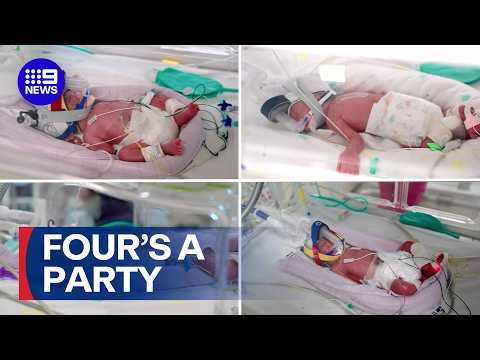
Despite the fact that the pregnancy was considered "very high risk," Jenitar was able to carry the babies — Emily, Harriet, Alexa, and Catherine — with little complication. The girls were born via c-section at 28 weeks and four days at the Royal Brisbane and Women's Hospital (RBWH).
"I was amazed that the conception happened and then we were convinced that there would be some complication in the pregnancy but the fact that they got to 28 weeks well, and well grown, is incredible," Dr. Alexis Bendall said.
"Our precious miracles have arrived safely, and while our hearts are overflowing with gratitude, the reality of caring for four newborns at once has brought challenges we never could have imagined," Jenitar wrote in a GoFundMe, noting the need to purchase a larger van to fit their whole family.
According to 9 News, the babies are still in the hospital for now, but their prognosis is good, and they are expected to join their parents and siblings at home soon.
Dr. Bendall explained that the girls were monozygotic quadruplets, which occurs when one fertilized egg splits into four embryos. While this is already rare — occurring in one in 15 million pregnancies — the babies also all shared a single placenta, a fact Bendall said "was unheard of."
Bendall called the pregnancy "very, very high risk."
"Whenever you have a pregnancy, a multiple pregnancy, which is usually twins, not quads, where the babies are sharing a placenta, there's a very high risk of complications," she said. "The fact that we've got four beautiful healthy babies born at 28 weeks and four days is incredible."
Conventional wisdom and medical advice likely would have suggested that these parents "selectively reduce" one or more of the babies in order to increase the likelihood of a healthy pregnancy. But as this story shows, miracles frequently happen, and such advice is often wrong.
Live Action News is pro-life news and commentary from a pro-life perspective.
Our work is possible because of our donors. Please consider giving to further our work of changing hearts and minds on issues of life and human dignity.
Contact editor@liveaction.org for questions, corrections, or if you are seeking permission to reprint any Live Action News content.
Guest Articles: To submit a guest article to Live Action News, email editor@liveaction.org with an attached Word document of 800-1000 words. Please also attach any photos relevant to your submission if applicable. If your submission is accepted for publication, you will be notified within three weeks. Guest articles are not compensated (see our Open License Agreement). Thank you for your interest in Live Action News!
Human Interest·By Bridget Sielicki
Mom safely gives birth to rare identical quadruplets in 'very, very high risk' pregnancy
An Australian woman is making headlines after naturally conceiving identical quadruplets, which doctors have called "one of the rarest births in the world."
A woman in Australia recently gave birth to four identical quadruplets all sharing the same placenta, a situation one doctor called "unheard of."
Emily, Harriet, Alexa, and Catherine were born at 28 weeks and four days with no complications.
The girls are still recovering in the hospital, but their prognosis is good.
Jenitar Na’amoana and her husband Jortham of Brisbane, Australia, said they were taken by "immense surprise" when they learned they were expecting four babies. The couple already had four young children at home, and had reportedly not been planning to have more.
Despite the fact that the pregnancy was considered "very high risk," Jenitar was able to carry the babies — Emily, Harriet, Alexa, and Catherine — with little complication. The girls were born via c-section at 28 weeks and four days at the Royal Brisbane and Women's Hospital (RBWH).
"I was amazed that the conception happened and then we were convinced that there would be some complication in the pregnancy but the fact that they got to 28 weeks well, and well grown, is incredible," Dr. Alexis Bendall said.
"Our precious miracles have arrived safely, and while our hearts are overflowing with gratitude, the reality of caring for four newborns at once has brought challenges we never could have imagined," Jenitar wrote in a GoFundMe, noting the need to purchase a larger van to fit their whole family.
According to 9 News, the babies are still in the hospital for now, but their prognosis is good, and they are expected to join their parents and siblings at home soon.
Dr. Bendall explained that the girls were monozygotic quadruplets, which occurs when one fertilized egg splits into four embryos. While this is already rare — occurring in one in 15 million pregnancies — the babies also all shared a single placenta, a fact Bendall said "was unheard of."
Bendall called the pregnancy "very, very high risk."
"Whenever you have a pregnancy, a multiple pregnancy, which is usually twins, not quads, where the babies are sharing a placenta, there's a very high risk of complications," she said. "The fact that we've got four beautiful healthy babies born at 28 weeks and four days is incredible."
Conventional wisdom and medical advice likely would have suggested that these parents "selectively reduce" one or more of the babies in order to increase the likelihood of a healthy pregnancy. But as this story shows, miracles frequently happen, and such advice is often wrong.
Live Action News is pro-life news and commentary from a pro-life perspective.
Our work is possible because of our donors. Please consider giving to further our work of changing hearts and minds on issues of life and human dignity.
Contact editor@liveaction.org for questions, corrections, or if you are seeking permission to reprint any Live Action News content.
Guest Articles: To submit a guest article to Live Action News, email editor@liveaction.org with an attached Word document of 800-1000 words. Please also attach any photos relevant to your submission if applicable. If your submission is accepted for publication, you will be notified within three weeks. Guest articles are not compensated (see our Open License Agreement). Thank you for your interest in Live Action News!

International
Bridget Sielicki
·
Abortion Pill
Bridget Sielicki
·
Analysis
Bridget Sielicki
·
Activism
Bridget Sielicki
·
Abortion Pill
Bridget Sielicki
·
Human Interest
Angeline Tan
·
Human Interest
Right to Life UK
·
Human Interest
Lisa Bast
·
Guest Column
Ashley Murphy
·
Human Interest
Cassy Cooke
·International
Bridget Sielicki
·Abortion Pill
Bridget Sielicki
·Analysis
Bridget Sielicki
·Activism
Bridget Sielicki
·Abortion Pill
Bridget Sielicki
·Human Interest
Angeline Tan
·Human Interest
Right to Life UK
·Human Interest
Lisa Bast
·Guest Column
Ashley Murphy
·Human Interest
Cassy Cooke
·